
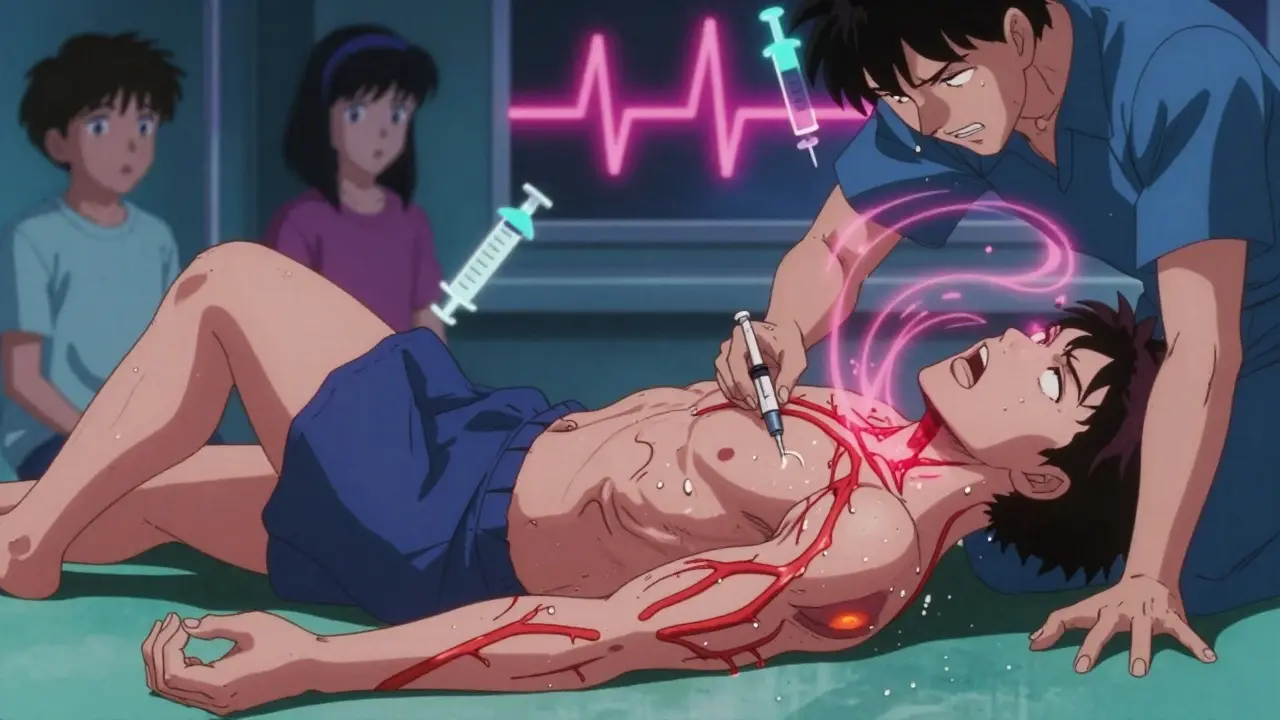
When a medication triggers anaphylaxis, you have minutes - not hours - to act. This isn’t a slow-burning problem. It’s a full-system collapse waiting to happen. One moment, someone feels fine. The next, their throat is closing, their blood pressure is crashing, and they can’t breathe. And the worst part? Epinephrine is the only thing that saves lives - but most people don’t use it fast enough, or sometimes, not at all.
What Happens During a Medication-Induced Anaphylactic Reaction
Anaphylaxis from medication doesn’t look the same every time. Some people break out in hives. Others don’t have any skin symptoms at all. That’s the trap. You might think, “No rash? Then it’s not serious.” But that’s wrong. Up to 20% of life-threatening reactions show no skin changes. The real danger signs are in the airway, breathing, and circulation - ABCs.Think about this: 89% of cases involve trouble breathing. That could mean wheezing, a hoarse voice, or a feeling like your throat is swelling shut. Seventy-six percent have tongue swelling. Nearly half collapse or feel dizzy. In kids, they may turn pale and go limp. These aren’t mild symptoms. They’re emergency signals. And they can go from bad to fatal in under 10 minutes.
Medications that cause this? Antibiotics like penicillin are the biggest culprits, making up nearly half of all fatal cases. NSAIDs like ibuprofen and aspirin are next. Then there are muscle relaxants used during surgery, chemotherapy drugs, and even contrast dye used in CT scans. It doesn’t matter if the person has taken the drug before without issue. Anaphylaxis can happen on the first exposure - or the tenth.
Step 1: Lay Them Flat - No Standing, No Sitting Up
This is the most misunderstood step. If someone is having an anaphylactic reaction, you must lay them flat on their back immediately. No exceptions. Don’t let them stand. Don’t let them sit up. Don’t help them to a chair. Even if they’re panicking and begging to sit, you must hold them down.Why? Because standing or sitting can trigger sudden cardiovascular collapse. Data shows 15-20% of deaths happen because the person was allowed to move from lying down to upright. The body can’t maintain blood pressure when gravity pulls blood away from the heart during a reaction. Lying flat keeps blood flowing to vital organs.
There are two exceptions:
- If they’re struggling to breathe, let them sit up with legs stretched out - but keep them from standing.
- If they’re unconscious or pregnant, roll them onto their left side. This prevents airway blockage and improves blood flow to the baby.
For children, hold them flat - never upright. A child’s airway is smaller and more easily blocked. Holding them in your lap while sitting up can make breathing worse.
Step 2: Administer Epinephrine - Now
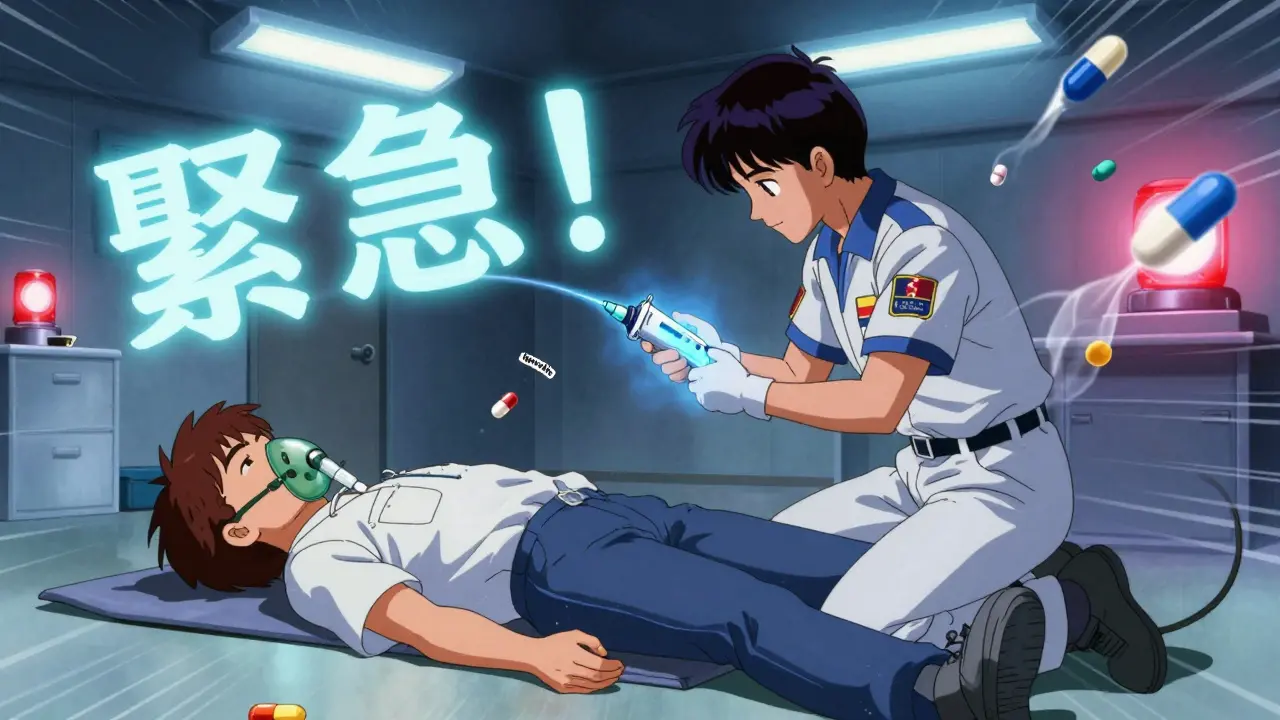
Epinephrine is not optional. It’s the only treatment that reverses airway swelling, raises blood pressure, and stops the reaction from killing the person. Antihistamines like Benadryl? They help with itching or hives - but they do nothing for breathing or circulation. Corticosteroids? They’re for preventing delayed reactions later - not saving someone right now.Use an auto-injector: EpiPen, Auvi-Q, or Adrenaclick. Inject into the outer thigh - through clothing if needed. Don’t hesitate. Don’t wait to confirm the diagnosis. If you suspect anaphylaxis, give epinephrine. The Resuscitation Council UK says: “If in doubt, give adrenaline.”
Dosing:
- Adults and children over 30 kg: 0.3 mg
- Children 15-30 kg: 0.15 mg
Hold the injector in place for 10 seconds. Don’t pull it out early. Most people don’t hold it long enough - and end up injecting into fat instead of muscle. That reduces effectiveness by up to 30%.
Epinephrine works in 1-5 minutes. But its effect fades after 10-20 minutes. That’s why you need a second dose if symptoms haven’t improved. The guidelines say: if ABC problems continue after 5 minutes, give another injection. Some protocols recommend repeating every 10 minutes until help arrives.
Step 3: Call 911 - Even If They Seem Better
Don’t assume that epinephrine means the danger is over. It buys time - not a cure. You still need emergency medical care. Call 911 immediately after giving epinephrine. Don’t wait. Don’t drive them yourself unless you have no other option.Why? Because of biphasic reactions. In 20% of cases, symptoms return hours later - sometimes up to 72 hours after the first reaction. This happens more often with medication-induced anaphylaxis than food-triggered cases. Studies show medication-related reactions carry a 25% higher risk of a second wave. That’s why hospitals require a minimum 4-hour observation period. For high-risk patients, 6-8 hours is now recommended.
Even if the person feels fine after the first shot, they’re not safe. The body is still in shock mode. They need IV fluids, oxygen monitoring, and possibly more epinephrine through an IV drip - which only trained staff can give.
What Not to Do
There are common mistakes that cost lives. Here’s what you must avoid:- Don’t give antihistamines first. They delay epinephrine. And they don’t save lives.
- Don’t wait for a doctor. In a hospital, the average time to epinephrine is 8.2 minutes - too late. In 65% of cases, it’s delayed beyond the 5-minute window.
- Don’t inject into the arm or buttocks. Only the thigh delivers fast, reliable absorption.
- Don’t use expired devices. Epinephrine loses potency over time. Check expiration dates every 6 months.
- Don’t assume it won’t happen to you. Nearly 70% of fatal cases involved no epinephrine at all. Fear of side effects - like a racing heart - stops people from acting. But the risk of not using it is death.
Surveys show that 42% of nurses delay epinephrine because they’re afraid of legal consequences. That’s a myth. Epinephrine is the standard of care. Not using it is the legal risk.
Special Considerations
Some people have hidden risks that make anaphylaxis harder to treat.If someone takes beta-blockers - common for high blood pressure or heart conditions - epinephrine may not work as well. Their body can’t respond normally. In these cases, higher doses (2-3 times the normal amount) may be needed. That’s why it’s critical to know a patient’s full medication history - especially in hospital settings.
Obese patients (BMI over 30) may need adjusted dosing. Early research shows standard weight-based doses don’t always reach effective blood levels. New studies are testing BMI-based dosing, which could improve outcomes.
And don’t forget: the FDA approved a new epinephrine auto-injector in 2023 with voice guidance. The Auvi-Q 4.0 talks you through each step: “Press here. Hold for 10 seconds.” Clinical trials showed it improved correct use from 63% to 89% among untrained people. If you or a loved one has a known allergy, consider upgrading to one with voice prompts.
Prevention and Preparedness
The best emergency response is no emergency. But if you’re on medications that carry risk - antibiotics, NSAIDs, contrast dye - you need a plan.- Carry two epinephrine auto-injectors at all times. One might not be enough.
- Teach family, coworkers, and friends how to use them. Practice with a trainer device.
- Wear a medical alert bracelet listing your drug allergies.
- Keep a written emergency action plan. Include dosing, symptoms, and emergency contacts.
- After a reaction, see an allergist. You need testing to confirm the trigger and learn how to avoid it.
Only 41% of people who carry epinephrine feel confident using it. That’s not enough. Practice every six months. Watch a video. Do a drill. Make it automatic.
Final Reality Check
Anaphylaxis from medication kills about 7-10% of all anaphylaxis-related deaths in the U.S. each year. That’s hundreds of people. Most of them didn’t die because the reaction was too strong. They died because epinephrine was delayed - or never given.You can change that. Know the signs. Know the steps. Carry the device. Use it early. Call 911. Stay calm. And never, ever wait to see if it gets worse.
Epinephrine doesn’t cure anaphylaxis. But it gives you the time to get to the hospital. And that’s all you need to survive.
Can you survive anaphylaxis without epinephrine?
Surviving anaphylaxis without epinephrine is extremely rare. Epinephrine is the only treatment that reverses airway swelling, restores blood pressure, and stops the reaction from progressing to cardiac arrest. Antihistamines and steroids don’t prevent death. In 70% of fatal cases, epinephrine was never administered. Delaying it increases the risk of death by more than 10 times.
Can anaphylaxis happen hours after taking a medication?
Yes. While most reactions start within minutes, some can begin up to 2 hours after taking the drug - especially with oral medications like antibiotics or NSAIDs. Even if you feel fine after 30 minutes, you’re not out of danger. Biphasic reactions - where symptoms return after seeming to improve - occur in up to 20% of cases, and are more common with medication triggers than food. That’s why hospital observation is mandatory.
Is it safe to use an expired epinephrine auto-injector?
Using an expired injector is better than using nothing at all - but it’s not ideal. Epinephrine loses potency over time, especially if exposed to heat or light. Studies show that expired devices may deliver only 70-80% of the labeled dose. In a life-or-death situation, use it anyway. But replace it before it expires. Check your device every 6 months. Most auto-injectors have a clear expiration date and a window that changes color when degraded.
Why can’t you just give Benadryl instead of epinephrine?
Benadryl (diphenhydramine) only treats mild allergic symptoms like itching or hives. It does nothing to open airways, raise blood pressure, or stop shock. In fact, relying on Benadryl delays the only treatment that saves lives: epinephrine. Clinical data shows no reduction in death rates when Benadryl is used alone. In anaphylaxis, seconds matter. Using antihistamines instead of epinephrine is like using a bandage on a severed artery.
What should you do if you’re alone and have an anaphylactic reaction?
If you’re alone and feel symptoms starting, immediately inject epinephrine into your thigh. Then call 911. If you can’t speak, leave the phone off the hook so emergency services can trace your location. Lie flat. If you’re too dizzy to lie down, sit with legs stretched out. Do not stand. If you lose consciousness, your body will fall - and that’s safer than standing. If you have a medical alert app or smartwatch with fall detection, activate it. Every second counts.
Can you get anaphylaxis from a medication you’ve taken before without issues?
Yes. Anaphylaxis doesn’t require prior exposure. Your immune system can suddenly recognize a drug as a threat after multiple safe uses. This is especially common with antibiotics like penicillin and NSAIDs like ibuprofen. You might have taken the same pill for years - then one day, your body reacts violently. That’s why any new reaction - even mild - should be reported to a doctor and evaluated for allergy testing.




Comments
sharad vyas
January 2, 2026When I was in Delhi, my uncle had a reaction to antibiotics. No rash, just couldn't breathe. We didn't know about epinephrine. He survived because a nurse on the train knew what to do. Lying flat saved him. I carry two pens now. Always.
Dusty Weeks
January 2, 2026bro i had a reaction once after ibuprofen 😳 i thought it was just a headache then my tongue felt like a balloon. i used my epi and called 911. they were like ‘why’d you wait so long?’ i was scared of the side effects. don’t be. just use it. 🙏
Sally Denham-Vaughan
January 3, 2026So many people think Benadryl is the answer. I’ve seen it. It’s not. I’m a nurse. I’ve watched people die because someone gave them a pill instead of the shot. Epinephrine isn’t scary-it’s the only thing standing between them and a coffin. Please just use it. 🚨
Bill Medley
January 4, 2026The data is unequivocal. Delayed epinephrine administration correlates directly with increased mortality. The physiological mechanism involves alpha-adrenergic vasoconstriction and beta-adrenergic inotropy. Failure to administer promptly constitutes a deviation from the standard of care.
Richard Thomas
January 4, 2026I’ve spent years thinking about death and how quiet it can be. Anaphylaxis is the opposite-it’s chaos in a body that was just breathing normally five minutes ago. We treat it like a medical emergency, but it’s also a philosophical one. Why do we wait? Why do we fear the thing that saves us? Epinephrine doesn’t just reverse swelling-it forces us to confront our own denial. We all know someone who didn’t use it. We all know someone who died because they thought they had time. We don’t. Not really.
Paul Ong
January 5, 2026Carry two pens. Lie flat. Use it fast. Call 911. No excuses. I used to be the guy who said ‘I’ll be fine’ now I’m the guy who carries two and teaches my coworkers how to use them. It’s not hard. It’s life
Andy Heinlein
January 5, 2026My mom had anaphylaxis from contrast dye last year. We were terrified. But we had the pens, we knew what to do, and we called 911 right away. She’s okay now. I made sure my whole family knows how to use them. Even my dog knows the sound of the injector now lol. Seriously though-this info saved her life. Please share it.
Ann Romine
January 7, 2026Does anyone know if the new voice-guided injector works for non-English speakers? My neighbor is from Guatemala and doesn’t speak much English. Would the voice prompt help? Or is there a Spanish version?
Todd Nickel
January 7, 2026There is a critical oversight in the discussion of obese patients and dosing. While BMI-based dosing is under investigation, current guidelines do not yet support weight-adjusted epinephrine dosing for auto-injectors. The 0.3 mg dose for adults over 30 kg is based on pharmacokinetic studies showing adequate plasma concentrations in individuals up to 150 kg. The notion that standard dosing is ineffective in obesity is not yet substantiated by peer-reviewed literature. Caution is warranted before altering protocol without evidence.
Austin Mac-Anabraba
January 9, 2026Let’s be honest. Most people who survive anaphylaxis did so because they were lucky, not because they were prepared. The fact that 70% of fatal cases involved no epinephrine isn’t a failure of knowledge-it’s a failure of character. People choose comfort over survival. They fear the side effects more than death. That’s not ignorance. That’s cowardice. And now you’re telling them to carry two pens like it’s a pep talk. It’s not. It’s a last resort for people who didn’t take responsibility.
Phoebe McKenzie
January 9, 2026HOW IS THIS STILL A THING?! PEOPLE ARE DYING BECAUSE THEY’RE AFRAID OF A LITTLE TINGLE IN THEIR HANDS?! I’VE SEEN IT. I’VE WATCHED A WOMAN DIE BECAUSE HER HUSBAND WAS TOO SCARED TO USE HER EPI PEN. SHE WAS 28. SHE HAD TWO KIDS. YOU DON’T GET TO BE ‘SCARED’ WHEN SOMEONE’S BREATHING IS DISAPPEARING. JUST USE THE PEN. JUST. USE. THE. PEN. I’M SO ANGRY RIGHT NOW.
Write a comment