
When you pick up a generic pill at the pharmacy, you expect it to work just like the brand-name version. But what if that pill is cracked, discolored, or contains the wrong dose? These aren’t rare mistakes-they’re common manufacturing defects that happen more often in generic drugs than most people realize. And they’re not just cosmetic. They can directly impact your health.
What Goes Wrong in Generic Drug Manufacturing?
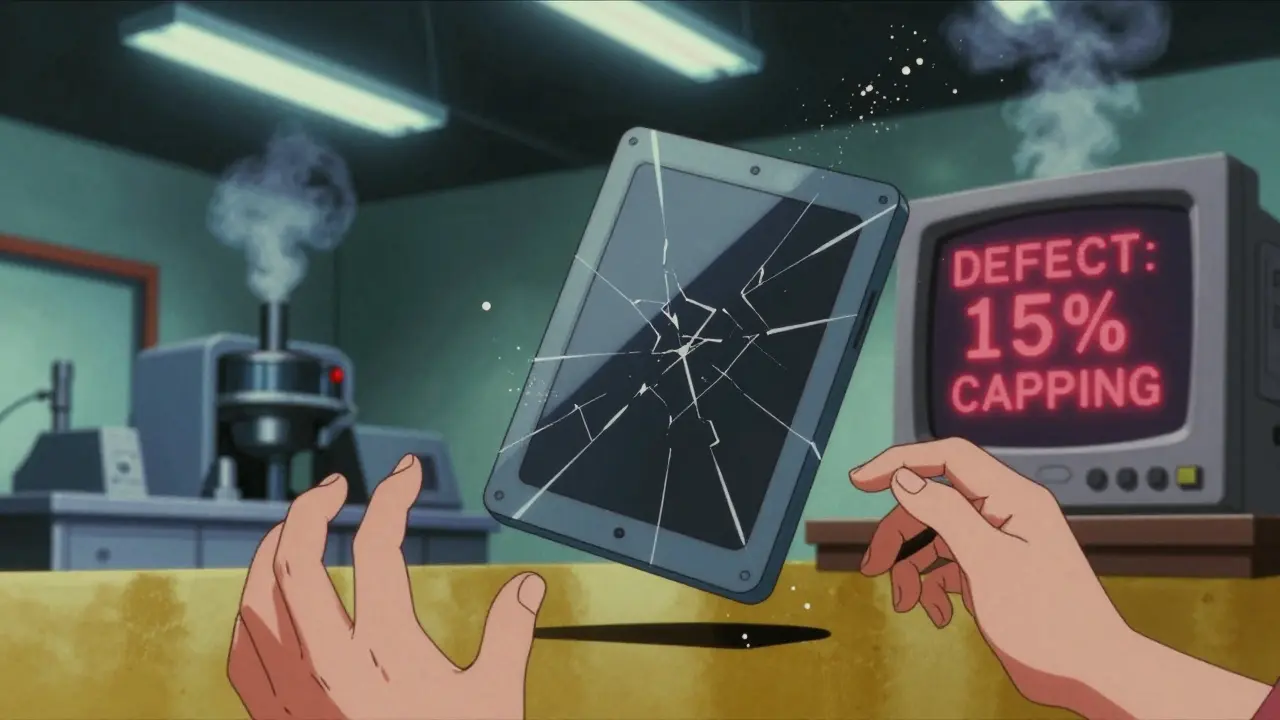
Generic drugs are copies of brand-name medications, but they’re often made in different factories, with different equipment, and under tighter cost pressures. This creates a perfect storm for quality problems. The most frequent defects show up in the physical form of the drug-tablets and capsules-and they’re not random. They follow predictable patterns tied to how the drug is made.One of the most common issues is capping, where the top or bottom of a tablet splits off during handling or swallowing. This happens when compression force during manufacturing is too high, especially if the active ingredient is hydrophobic (repels water) and the moisture content is below 2%. It’s not just a visual flaw-it can mean the tablet breaks apart in your mouth, delivering an inconsistent dose. A batch with capping issues might have 15% of tablets affected, and if undetected, patients could get too little or too much medicine.
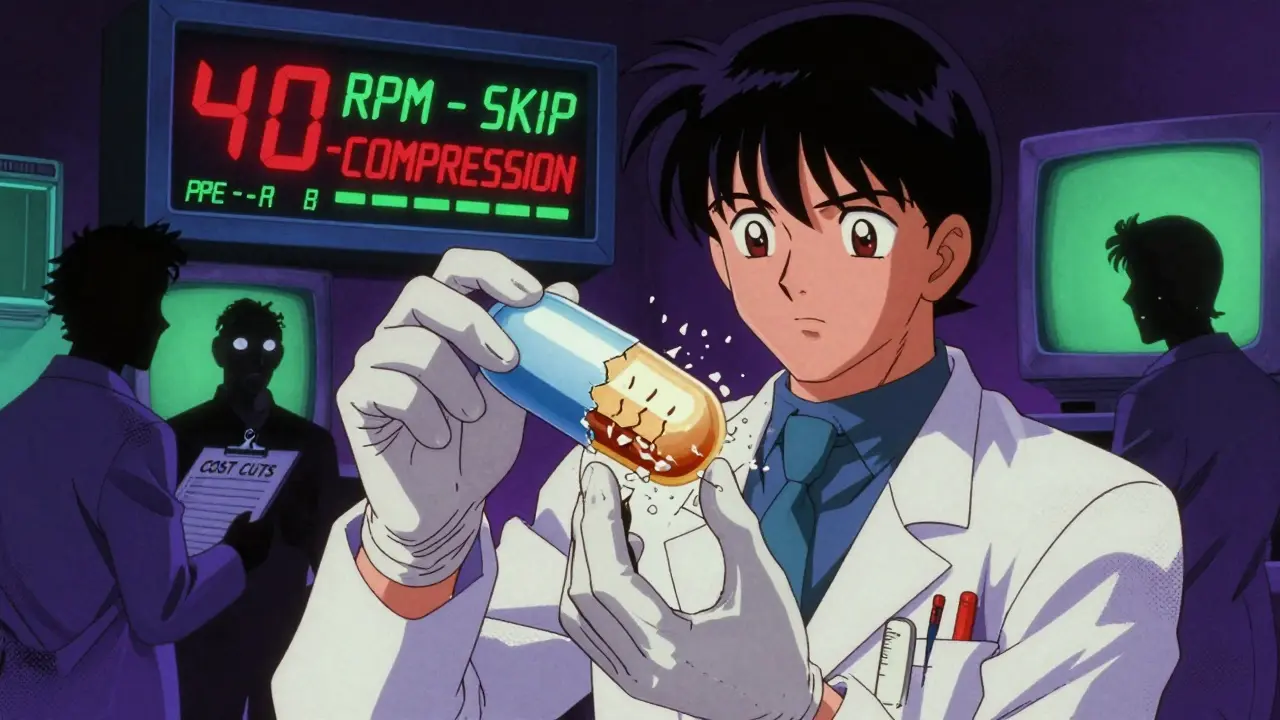
Lamination is similar but worse. Instead of the tablet splitting at the top, it separates into layers. This usually occurs when the tablet press runs too fast-over 40 rotations per minute-and the pre-compression step is skipped or underpowered. The result? A tablet that crumbles in your hand. Pharmacists have reported patients bringing back metformin ER tablets that turned to powder during dispensing, a direct result of lamination.
Sticking happens when the drug material clings to the metal punch heads that shape the tablet. This is especially common with active ingredients that melt easily (below 120°C) and when moisture levels rise above 4% during long production runs. The machine has to work harder to eject the tablet, increasing ejection forces by 300-500 Newtons. Over time, this wears out equipment and causes inconsistent tablet weights.
Mottling-uneven color on the tablet surface-is often dismissed as cosmetic. But it signals inconsistent mixing of ingredients. If the active pharmaceutical ingredient (API) isn’t evenly distributed, some tablets may contain twice the dose of others. In a 2023 FDA inspection, a batch of generic levothyroxine showed mottling and was later found to have dose variations of up to 22%, leading to a nationwide recall.
Why Are These Problems Worse in Generics?
Branded drugmakers spend 15-18% of their production budget on quality control. Generic manufacturers average only 8-10%. That gap isn’t just about money-it’s about infrastructure. Many generic drug plants in the U.S. and abroad still use equipment from the 1980s and 1990s. Modern tablet presses have real-time force sensors that adjust compression every 0.1 seconds. Older machines rely on manual checks every 30 minutes. That’s a recipe for failure.Another issue is shared facilities. One plant might produce 10 different generic drugs in the same building. Cross-contamination isn’t just a risk-it’s a documented problem. In 2022, a generic steroid inhaler was recalled after traces of a different drug were found in 3% of units. Patients with asthma were at risk of unexpected side effects.
Price pressure is the root cause. Generic drugs make up 90% of prescriptions in the U.S. but only 23% of total drug spending. To survive, manufacturers cut corners. A 2023 study found that 57% of generic manufacturing facilities failed FDA inspections, compared to 28% of branded ones. The FDA issued 42% of its warning letters for manufacturing defects to generic companies last year.
Defects That Can Kill: Sterile Injectables and Complex Formulations
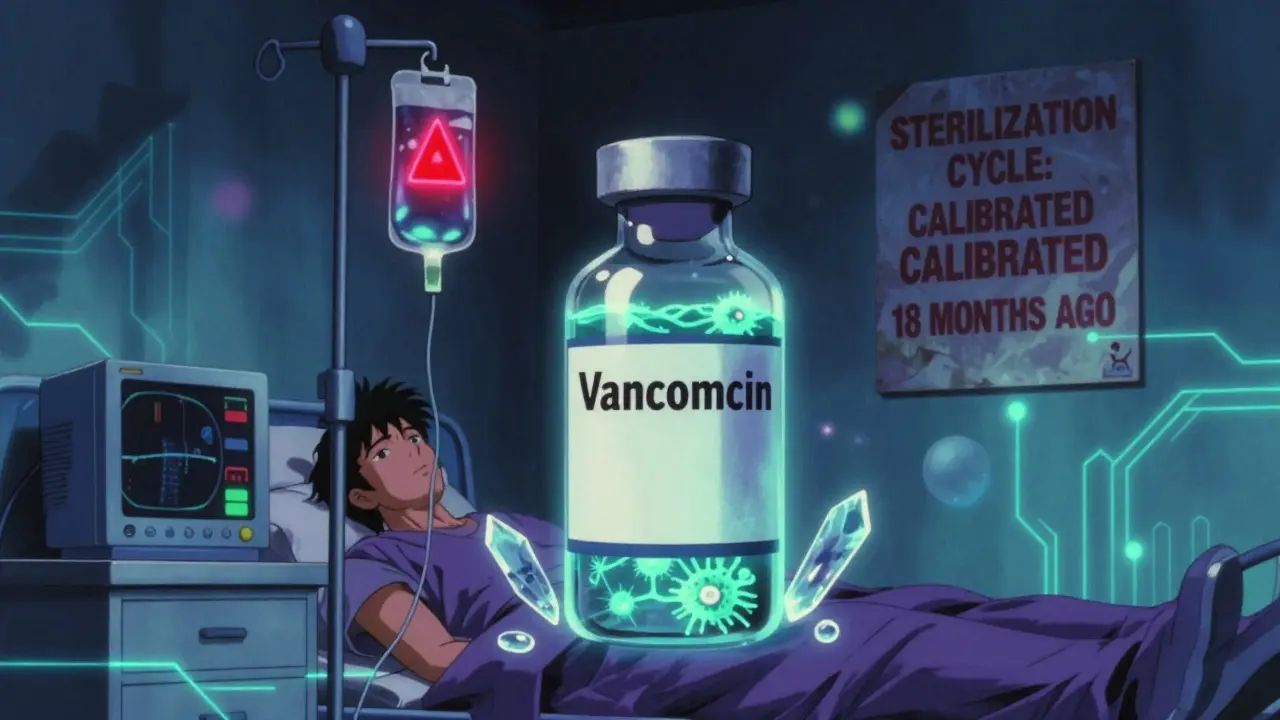
Not all defects are obvious. The most dangerous ones happen in sterile injectables-drugs given by IV or injection. Here, the biggest threat is particulate contamination. Tiny glass fragments, metal shavings, or microbial growth can enter the vial during filling. These particles don’t dissolve. They travel through the bloodstream and can cause strokes, organ damage, or severe allergic reactions.According to FDA data, 8.7% of sterile generic injectables have quality issues-more than any other dosage form. One 2023 recall involved 200,000 vials of generic vancomycin after a hospital reported 17 patients developing fever and chills after infusion. Testing found bacterial contamination in 12% of the batch. The root cause? A faulty sterilization cycle that went unnoticed because the monitoring system hadn’t been calibrated in 18 months.
Complex generics like extended-release tablets and inhalers are even more vulnerable. Modified-release tablets are designed to release medicine slowly over hours. If the coating is uneven or too thin, the drug can flood the system all at once. In 2023, a batch of generic oxycodone ER released 40% of its dose within 15 minutes instead of 12 hours. Three patients overdosed. The manufacturer had skipped a key dissolution test because it added $8,000 to the batch cost.
How Often Do These Problems Happen?
The numbers are alarming:- Generic drugs have 3.2 times more manufacturing defects than branded drugs.
- 12% of all generic drugs face recalls annually-double the rate of branded drugs.
- 63% of generic recalls are due to manufacturing flaws, compared to 41% for branded drugs.
- 78% of drug shortages between 2013 and 2017 were caused by quality problems, mostly in generic injectables.
- 17.3% of hospital formulary decisions to avoid generic substitution were based on quality concerns.
And it’s not just regulators noticing. Pharmacists are seeing it too. A 2023 survey of 1,247 pharmacists found 68% had encountered quality issues with generics in the past year. Nearly half had patients complain about tablets crumbling, discoloration, or unusual side effects after switching to a new generic batch.
What’s Being Done to Fix This?
There’s hope-but it’s slow. The FDA launched its Emerging Technology Program in 2023 to help generic manufacturers adopt continuous manufacturing. Unlike traditional batch processing, this method runs nonstop, with sensors monitoring every step. Companies using it have seen defect rates drop by 65%.AI-powered visual inspection systems are also making a difference. Older systems rely on humans checking tablets under a light-human error rates are still around 30%. New AI systems can spot defects as small as 0.1 mm at 600 tablets per minute with 92% accuracy. Sandoz and Dr. Reddy’s are already using them.
The 2024 Drug Supply Chain Security Act now requires track-and-trace systems for high-risk generics. That means if a batch is recalled, you can find out exactly which pills you received. Early results show a 22% drop in counterfeit-related issues.
But the biggest barrier remains money. Experts estimate it would take $28.7 billion to upgrade all U.S. generic manufacturing plants to modern standards. Right now, the industry invests only $1.2 billion per year. Without more funding, McKinsey & Company predicts 15-20% of generic manufacturers will exit the market in the next five years-not because they’re bad, but because they can’t afford to fix their equipment.
What You Can Do
You can’t control the factory, but you can protect yourself:- Check your pills. If they look different-new color, shape, or texture-ask your pharmacist. A change doesn’t always mean a problem, but it’s worth confirming.
- Report issues. Use the FDA’s MedWatch system if you notice cracked tablets, unusual side effects, or pills that don’t seem to work. In 2023, over 1,800 reports came in from patients about generic quality problems.
- Ask about the manufacturer. Some generic makers have far better track records than others. Teva’s batch rejection rate was 0.8% in 2023; smaller companies averaged 3.2%.
- If a generic isn’t working for you, talk to your doctor. Sometimes, sticking with the brand name is worth the cost.
Generic drugs saved the U.S. healthcare system hundreds of billions. But if quality keeps slipping, those savings come at a price: patient safety. The system isn’t broken-it’s underfunded. And until that changes, the risk of getting a bad pill will stay real.
Are generic drugs less effective than brand-name drugs?
Legally, generics must be bioequivalent to the brand name, meaning they deliver the same amount of active ingredient into the bloodstream. But manufacturing defects can cause inconsistencies-like uneven mixing or poor coating-that lead to actual differences in how the drug works. In 7.3% of generic applications between 2015 and 2020, bioequivalence failures were traced to manufacturing issues, not formulation.
Can I tell if my generic pill has a quality defect?
Yes, sometimes. Look for visible signs: tablets that crumble, split, have uneven color, or feel unusually soft or brittle. If your pill looks different from your last refill, it could be a new manufacturer or a defective batch. Don’t assume it’s safe just because it’s labeled the same. Always check with your pharmacist.
Why do some generic drugs make me feel different?
Inactive ingredients (fillers, binders, dyes) can vary between manufacturers, and some people react to them. But more concerning are actual differences in active ingredient release due to poor manufacturing-like a tablet releasing all its dose at once instead of slowly. If you notice new side effects or reduced effectiveness after switching generics, report it and ask your doctor to consider switching back to the brand or a different generic maker.
Are all generic drug manufacturers the same?
No. Quality varies widely. Top manufacturers like Teva, Sandoz, and Mylan have invested in modern equipment and have rejection rates under 1%. Smaller or overseas manufacturers often lack the resources, leading to higher defect rates. You can sometimes find out who made your drug by checking the imprint code on the pill or asking your pharmacist for the manufacturer name.
What’s being done to improve generic drug quality?
The FDA is pushing for modern manufacturing like continuous processing and AI-based quality control. The 2024 Drug Supply Chain Security Act now tracks high-risk generics from factory to pharmacy. But progress is slow because upgrading factories costs billions. Only 47 generic companies have adopted continuous manufacturing so far, despite its 65% defect reduction benefit.



Comments
Jason Yan
January 15, 2026Man, I never thought about how much goes into making a pill actually work right. I always just assumed if it’s the same name and color, it’s the same thing. But reading this made me realize it’s like buying two different brands of sneakers that look identical-one’s got a foam sole that collapses after a week, the other lasts years. The difference isn’t in the label, it’s in the factory floor. And honestly? It’s terrifying that we’re trusting our health to machines that haven’t been updated since the Clinton administration.
It’s not even about being anti-generic. I get why they exist. But if we’re going to rely on them for 90% of prescriptions, we need to treat them like life-saving tech, not cheap commodities. We don’t cut corners on airplane parts, why do it with heart meds?
I’m gonna start checking my pills now. If they look weird, I’m asking. No shame in that.
Vicky Zhang
January 16, 2026OH MY GOD. I had no idea. I’ve been taking generic metformin for years and I swear sometimes it feels like it’s not working at all. I thought I was just getting lazy or my body was changing. But now I think it’s because the tablet was crumbling in my hand and I didn’t even notice. I’m going to the pharmacy tomorrow to check my last bottle. If it’s dusty and powdery, I’m demanding the brand. My diabetes can’t afford guesswork.
Also-why is this not on the news? This should be a national scandal. People are dying because we’re too cheap to fix a machine.
Alvin Bregman
January 17, 2026so like… if the tablet splits in your mouth does that mean you get the whole dose at once or just half? and what if you dont notice? like do you just feel weird for a day and blame yourself? also why dont they just put like a little sticker on the bottle saying who made it? i mean its not that hard
also i think the real problem is we let companies make drugs like they make cheap tshirts. its all about volume not value. sad.
Sarah -Jane Vincent
January 18, 2026This is all a government scam. The FDA is in bed with Big Pharma to keep you dependent on expensive brand names. They exaggerate these ‘defects’ to scare you into paying more. You think those ‘modern’ machines are better? They’re just more expensive to maintain-so the big players can charge more. The real issue? The FDA is corrupt. They approve generics from India and China that have lead in them, then blame ‘manufacturing’ when people get sick. Wake up.
And don’t even get me started on ‘continuous manufacturing.’ That’s just a buzzword for automated poison factories. They’re not fixing the system-they’re just making it more efficient at killing people.
Henry Sy
January 19, 2026Bro. I took a generic oxycodone last month and felt like I’d been hit by a truck. Not the good kind. The ‘why is my vision blurry and my chest tight’ kind. I thought I was having a panic attack. Turns out? The tablet released all 20mg in 10 minutes. My body didn’t know what to do with it. I almost called 911.
Now I only take the brand. Yeah, it’s $150 a month. But I’d rather pay $150 than end up in the ER because some factory in Bangladesh skipped a $8,000 test. This isn’t capitalism. It’s Russian roulette with your nervous system.
Anna Hunger
January 19, 2026While the concerns raised in this post are valid and well-documented, it is imperative to contextualize them within the broader framework of pharmaceutical regulation and risk mitigation. The FDA’s adverse event reporting system, MedWatch, receives approximately 100,000 reports annually, of which less than 0.3% are directly attributable to manufacturing defects in generics. Furthermore, bioequivalence standards are rigorously enforced under 21 CFR 320, and post-market surveillance remains robust.
It is also worth noting that the majority of manufacturing facilities cited in FDA warning letters are foreign-based, and the U.S. supply chain remains largely compliant. While cost pressures exist, systemic failure is not the norm. Patient education and vigilance are commendable, but alarmism without statistical grounding risks eroding public trust in a system that, despite imperfections, saves millions annually.
shiv singh
January 20, 2026India makes the best generics in the world. You Americans are so paranoid. We make pills for Europe, Canada, Japan-everyone. But you? You want everything to be made in your country, even if it costs 10x more. You don’t care about poor people who can’t afford brand names. You just want to cry about tablets.
My cousin in Mumbai works in a factory. He makes 20,000 pills a day. He’s not trying to kill anyone. He’s trying to feed his family. Stop blaming the workers. Blame your greedy insurance companies and your lazy doctors who don’t even check what’s in the bottle.
And yes, I’ve taken Indian generics for 12 years. I’m still alive. So are my parents. So are my kids. What’s your excuse?
Robert Way
January 21, 2026so i just looked at my levothyroxine and it looks kinda speckled? like little gray dots? is that mottling? i think it is. i took it this morning and felt weird. my heart was racing. i thought it was coffee. but now im scared. i dont know who made it. the bottle just says teva. but teva makes like 50 different ones. how do i know which one? help.
also why cant we just make the pills bigger so they dont break? like why not just make em 2x the size? then theyd be harder to crack. duh.
Sarah Triphahn
January 21, 2026Let’s be real. This isn’t about quality. It’s about your personal fragility. You take a pill, feel a little off, and suddenly it’s a conspiracy. People have been taking generics for decades. Most of you can’t even tell the difference between Tylenol and acetaminophen.
And now you want to panic because a tablet looks ‘discolored’? Maybe your brain is just anxious. Maybe you’re not sleeping. Maybe you’re eating sugar. Don’t blame the pill. Blame your lack of resilience.
Also, if you’re so worried, take the brand. But don’t act like you’re saving lives when you’re just scared of a little variation in color. The FDA isn’t lying. You’re just too sensitive to handle reality.
Allison Deming
January 22, 2026It is deeply concerning that a system designed to protect public health has been allowed to devolve into a race to the bottom. The fact that 57% of generic manufacturing facilities failed FDA inspections is not a statistical anomaly-it is a moral failure. We have outsourced the production of life-sustaining medications to facilities where quality control is treated as an afterthought, all in the name of cost-efficiency.
And yet, when patients suffer, we are told to ‘ask your pharmacist’ or ‘report it.’ This is not consumer advocacy. This is victim-blaming wrapped in bureaucratic platitudes. We need mandatory real-time monitoring, public facility ratings, and federal subsidies to upgrade equipment-not vague ‘hope’ and corporate PR about AI inspections.
The $28.7 billion needed to modernize infrastructure is less than what the U.S. spends on military band uniforms in a single year. We prioritize spectacle over survival. That is the true defect.
Susie Deer
January 23, 2026China and India are poisoning our pills and the government lets them. We need tariffs. We need bans. We need to make all drugs in America. No more imports. No more excuses. If you want safe medicine you pay for it. End of story.
My grandma took generic blood pressure pills and ended up in the hospital. I know what happened. Foreign factories. No oversight. We need walls for pills too.
TooAfraid ToSay
January 25, 2026So let me get this straight-you’re saying the same pills that save millions in Africa and Asia are somehow deadly in America? That’s not a defect. That’s a narrative. You want us to believe that a pill made in Hyderabad is less safe than one made in Ohio? But Ohio’s factories have 1980s machines too. You’re not scared of bad pills. You’re scared of people who aren’t like you.
And don’t even start with ‘FDA inspections.’ They’re paid by the same companies they inspect. That’s not oversight. That’s a pay-to-play system. But you’re too busy crying about color to see the real corruption.
Dylan Livingston
January 27, 2026How quaint. You all treat pills like they’re artisanal bread. ‘Oh, this one has a speck. It’s not uniform.’ Honey, it’s a chemical compound designed to bind to a receptor in your liver. Not a hand-painted ceramic mug.
And yet here we are, treating pharmaceuticals like they’re made by monks in a monastery. The fact that you’re even worried about ‘mottling’ suggests you’ve never read a single clinical trial. The difference between a 22% dose variation and a 5% variation? In most cases? It’s statistically meaningless. Your anxiety is the real side effect.
Also, the ‘three overdoses’ from oxycodone ER? That was one batch. Out of 10 million. That’s not a crisis. That’s a quality control hiccup. You’re turning a statistical blip into a moral panic because you don’t understand probability.
Andrew Freeman
January 28, 2026generic pills are fine. i take them every day. if you think your body cant handle a little variation then maybe you shouldnt be on meds at all. also why do you care who made it? its all the same chemicals. you think your heart knows if the tablet was pressed by a robot or a human? lol
also the fda is a joke. they approved that new weight loss drug that makes people suicidal but theyre scared of a little discoloration? fix the real problems not the fake ones.
Write a comment