
Medication-Induced Smell Changes Checker
This tool helps you determine if your current medications might be causing smell or taste changes. Simply search for a medication name, and we'll tell you if it's known to cause dysosmia.
Important: Do not stop any medication without consulting your doctor. Some medications are essential for your health.
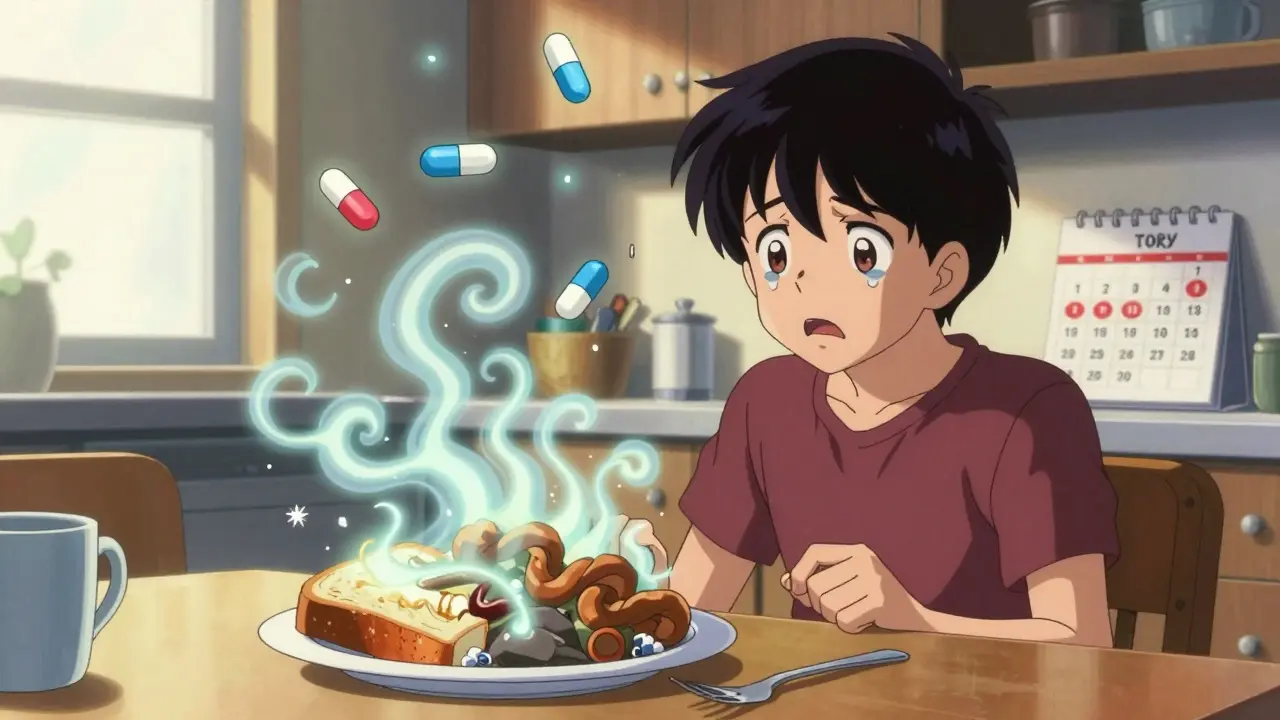
Have you ever taken a medication and suddenly noticed that your favorite food tastes like metal, or that everything smells like burning plastic? You’re not imagining it. This isn’t just a weird coincidence - it’s a real, documented side effect called dysosmia. It’s more common than most doctors realize, and it can seriously mess with your appetite, weight, and even your safety. If you’ve noticed smell or taste changes after starting a new drug, this is what’s going on - and what you can do about it.
What Exactly Is Dysosmia?
Dysosmia means your brain is misreading smells. It’s not just losing your sense of smell (that’s anosmia). It’s when normal smells turn awful - like when coffee smells like rotten eggs, or bread smells like garbage. Sometimes, you smell things that aren’t even there - cigarette smoke, burning rubber, or rotting meat - even when the room is clean. This isn’t psychological. It’s biological. And it’s often caused by the medications you’re taking.
It’s not rare. A 1995 study by Schiffman and Nagle found that over 250 medications could cause these changes. Today, that number is over 500. The American Academy of Otolaryngology estimates that 20% of all smell and taste disorders come from drugs. That’s one in five people who report these issues - and many never tell their doctor because they think it’s just "in their head."
Which Medications Cause Smell Changes?
It’s not just one class of drugs. Dysosmia can come from antibiotics, heart meds, antidepressants, seizure drugs, and even supplements. But some are far more likely to trigger it.
- Antibiotics - Fluoroquinolones like levofloxacin and moxifloxacin, and macrolides like azithromycin and clarithromycin, are top offenders. These drugs interfere with zinc and magnesium in your nose, which your smell receptors need to work properly. One study found people taking levofloxacin were 2.5 times more likely to develop a metallic taste than those on other meds.
- Heart medications - Midodrine, used for low blood pressure, can cause persistent metallic or bitter tastes. It doesn’t affect everyone, but when it does, the change sticks around long after you stop taking it.
- Neurological drugs - Carbamazepine (for seizures) and baclofen (for muscle spasms) have been linked to severe taste distortion, sometimes leading to complete loss of taste (ageusia).
- Antidepressants - SSRIs like sertraline can slip into the membranes of taste cells and mess with the signals they send to your brain. Some patients report a constant sour or bitter taste that lasts for months.
- IV drugs - Iron infusions, lidocaine, and even thyroid treatments given intravenously can cause instant metallic taste - sometimes within minutes of the drip starting.
What’s wild is that these side effects often show up 7 to 14 days after you start the drug. So if you’re wondering why your food suddenly tastes awful, check when you began your medication. The timing matters.
Why Does This Happen?
Your nose and tongue aren’t just sensors - they’re complex chemical labs. Smell receptors are proteins on nerve cells that detect odor molecules. Taste cells have channels that respond to salt, sour, bitter, sweet, and umami. Medications can disrupt this system in several ways:
- Blocking receptors - Some drugs physically block odor molecules from binding to their receptors. Think of it like jamming a lock so the key won’t fit.
- Sticking around too long - Normally, receptors turn off after detecting a smell. Some drugs prevent this shutdown, so your brain keeps getting signals even when there’s no odor. That’s why people smell smoke all day - their receptors won’t reset.
- Damaging cell membranes - Drugs like sertraline slip into the fatty layers of taste cells and change how they send signals.
- Depleting minerals - Fluoroquinolones and tetracyclines bind to zinc and magnesium. These minerals are critical for cell repair in your nose and tongue. Without them, your smell system can’t regenerate properly.
It’s not one simple mechanism. That’s why some people get metallic tastes, others smell burning hair, and a few lose all sense of smell. The drug, your genetics, and how long you’ve been on it all play a role.
How Bad Can It Get?
This isn’t just annoying - it’s dangerous.
One patient in a 2021 case study lost 8 pounds in three weeks because everything tasted like bile. Another Reddit user lost 15% of their body weight over four months because food tasted like rotten eggs. When you can’t enjoy eating, you stop eating. That leads to malnutrition, muscle loss, and fatigue.
There’s also a safety risk. If you can’t smell smoke, gas leaks, or spoiled food, you’re at risk. One survey found 78 users reported they couldn’t detect a gas leak - a potentially life-threatening situation.
And here’s the kicker: symptoms often don’t go away when you stop the drug. About 22% of people still have smell distortion three months after quitting. In rare cases, it lasts over a year. One person on Reddit described 22 months of parosmia after azithromycin - no food was safe to eat.
What Doctors Should Do - But Often Don’t
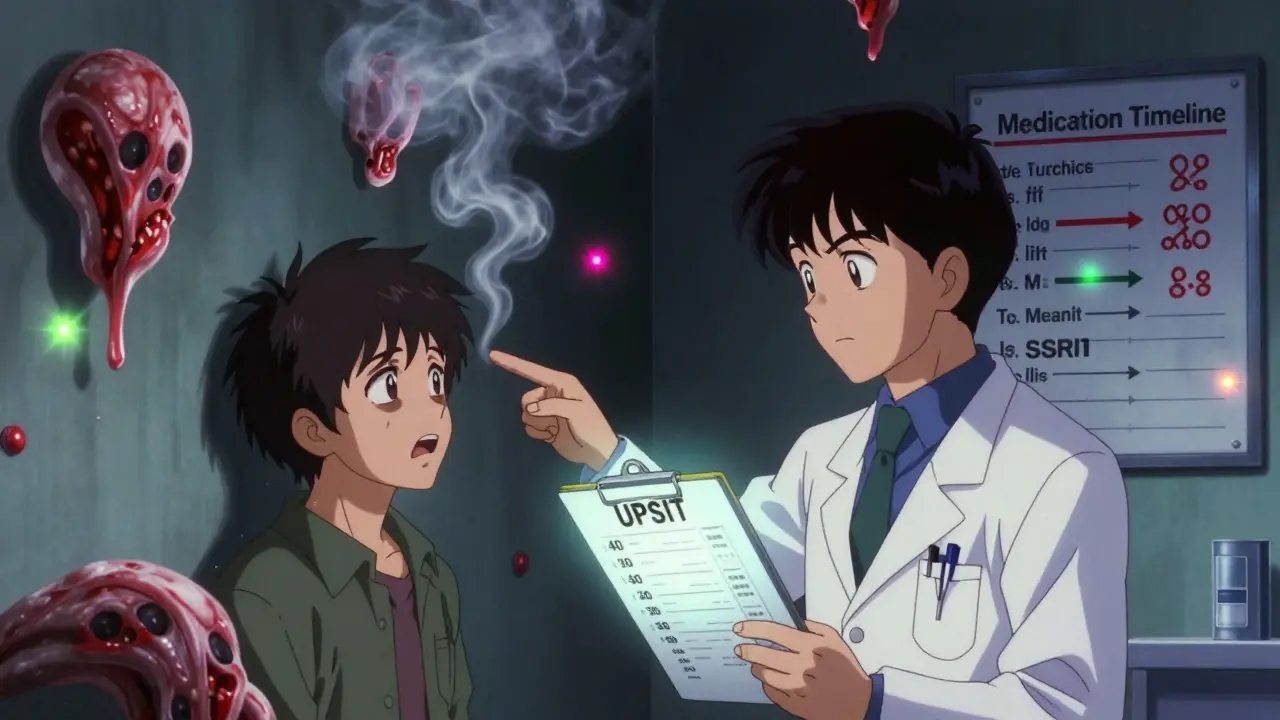
Most doctors don’t ask about smell changes. A 2022 JAMA survey found only 37% of primary care doctors routinely check for it. But if you report taste or smell issues, they should:
- Review your medication list - especially anything started in the last 6 weeks.
- Use the University of Pennsylvania Smell Identification Test (UPSIT) - a 40-item test that measures smell function. It’s quick, reliable, and used in clinics worldwide.
- Rule out other causes - sinus infections, head trauma, or neurological conditions like Parkinson’s can mimic drug-induced dysosmia.
The Cleveland Clinic recommends asking: "Have you noticed any changes in how food tastes or how things smell since starting your medication?" Just that simple question can uncover a hidden problem.
Can It Be Fixed?
Yes - but not always with what you think.
Stop the drug? If it’s safe to do so (and your doctor agrees), stopping the medication is the most effective step. Studies show 78% of people improve within 3 months of quitting.
Zinc supplements? Many online sources say zinc fixes smell loss. But that’s only true if you’re deficient. Taking extra zinc for drug-induced dysosmia? No evidence it helps. In fact, too much zinc can cause copper deficiency and worsen your immune system. Dr. Thomas Hummel of the University of Dresden warns against it.
Other treatments? Some case studies show success with:
- Mirtazapine - An antidepressant that, at low doses (15mg at night), helped resolve metallic taste in a few patients within days.
- Theophylline - A bronchodilator that helps restore receptor function. Used in some clinics for persistent cases.
- Calcium channel blockers - Used to quiet overactive smell signals.
There’s also new hope. Phase II clinical trials are testing drugs that target the TRPM5 channel - a key player in taste distortion. These could be the first real treatment for drug-induced dysosmia within the next few years.
What You Can Do Right Now
If you’re experiencing smell or taste changes:
- Write down what changed - when did it start? What smells or tastes are off?
- Check your medication list. Did you start any new drugs 1-4 weeks ago?
- Don’t stop your meds without talking to your doctor - some are essential.
- Ask your doctor about the UPSIT test. If they don’t know it, suggest they look up the American Academy of Otolaryngology’s 2017 guidelines.
- Join a support group. The Fifth Sense nonprofit runs free monthly virtual meetings for people with medication-induced smell disorders. You’re not alone.
And if you’re a caregiver - pay attention. Elderly patients often don’t mention these changes because they think it’s just "getting older." But it might be the drug.
The Bigger Picture
Right now, drug companies aren’t required to report smell or taste side effects in clinical trials. The FDA only started encouraging this in 2021. The European Medicines Agency plans to make it mandatory in 2024 for antibiotics and heart drugs. That’s a step forward.
But until then, you have to be your own advocate. Smell and taste aren’t just about enjoyment - they’re tied to survival, nutrition, and mental health. If a drug is making you lose your appetite or fear eating, it’s not a minor side effect. It’s a red flag.
More research is coming. The NIH funded $4.7 million in 2023 just to study this. The Global Chemosensory Research Consortium already has over 1,200 patients logged. We’re finally starting to take this seriously.
So if you’ve noticed something off - speak up. Your nose knows. And now, so do we.


Comments
Lakisha Sarbah
February 9, 2026So I started sertraline last month and now everything tastes like licking a battery. I thought I was going crazy. Turns out I’m not alone. This post saved my sanity.
Ashley Hutchins
February 9, 2026Why do people always blame meds when they just need to eat less junk and get off their couch? I’ve been on 12 different prescriptions and my taste is fine. You’re just being dramatic. Stop making it a thing.
Niel Amstrong Stein
February 9, 2026Bro this is wild. I took azithromycin for a sinus thing and suddenly my coffee smelled like a dumpster behind a taco truck. I thought I was haunted. Turns out my nose was just betrayed by Big Pharma. 🤯
Also, the fact that doctors don’t ask about this? That’s insane. We talk about erectile dysfunction at every checkup but not whether your toast tastes like ash? What kind of medical system are we running?
I’m gonna start asking every doc I meet: "Hey, have you ever had a patient say their pizza tastes like wet socks?" Let’s normalize this.
Joey Gianvincenzi
February 10, 2026While I appreciate the effort to raise awareness, the casual tone of this article undermines its credibility. The data presented is statistically significant, yet the presentation is marred by colloquialisms and anecdotal emphasis. This is not peer-reviewed science; it is a sensationalized blog post dressed in medical terminology. The inclusion of Reddit anecdotes as evidence is professionally indefensible.
Furthermore, the recommendation to use the UPSIT test is appropriate, but the suggestion that patients should "ask their doctor" implies a power imbalance that is ethically concerning. The burden of medical advocacy should not fall on the patient. This is a systemic failure, not a communication gap.
Amit Jain
February 11, 2026LOL this is why I stopped trusting Western medicine. In India, we know smell changes are from toxins in the body, not some stupid pill. You people take 10 pills for a headache and then cry when your nose breaks. Try turmeric. Or yoga. Or just stop eating bread.
Also, why is everyone so obsessed with food? Eat rice. Smell nothing. Be happy. 🙏
AMIT JINDAL
February 13, 2026Have you considered the possibility that dysosmia is not a pharmacological phenomenon at all, but rather a manifestation of spiritual imbalance? The olfactory system is deeply connected to the third eye chakra, and when you introduce synthetic molecules into the bloodstream, you’re essentially disrupting the etheric field that governs sensory perception. This isn’t just a medical issue - it’s a metaphysical one.
Moreover, the fact that pharmaceutical companies aren’t required to report this speaks volumes about the corruption of the medical-industrial complex. We’re being gaslit into believing that our bodies are broken machines that need more pills, when what we really need is a detox, a sound bath, and a good cry under a full moon.
Also, zinc doesn’t help? LMAO. That’s what they said about vitamin C and COVID too. 🤡
Ariel Edmisten
February 14, 2026Same. Took levo for pneumonia. Tasted like copper for 6 months. Stopped it. Got better. Talk to your doc. Don’t suffer.
Catherine Wybourne
February 15, 2026Oh honey, I’ve been there. After my chemo, everything smelled like burnt toast. Then I got on amoxicillin and suddenly my cat smelled like a wet gym sock. I laughed so hard I cried. Then I cried because I couldn’t smell my grandma’s cookies anymore.
But seriously - this is why we need more research. And more doctors who listen. I’m so glad someone wrote this. I’ve been screaming into the void for years.
Mary Carroll Allen
February 15, 2026I had this happen after starting fluoxetine. My mom’s lasagna tasted like battery acid and my cat’s breath smelled like sulfur. I stopped eating for 3 weeks. Lost 12 pounds. My partner thought I was depressed. I was just… disgusted by food. No joke. I had to eat protein shakes with a straw. I cried every night. I’m 34. I shouldn’t have to go through this. Why isn’t this on the drug insert? Why isn’t this a black box warning? This is trauma.
Eric Knobelspiesse
February 16, 2026Interesting how this post ignores the placebo effect entirely. People who report taste changes often have high anxiety levels - which means their brains are primed to detect anomalies. The fact that 78% recover after stopping meds? That’s not a pharmacological reversal - it’s regression to the mean. Also, why is no one talking about the role of gut microbiome? I’m calling shenanigans on this whole narrative.
Also, mirtazapine? That’s an antidepressant. You’re treating a drug side effect with another drug. Brilliant. 🤦♂️
Ritu Singh
February 17, 2026As an Indian medical professional working in a public hospital, I can confirm that this issue is vastly underreported in our own context. Patients rarely mention olfactory changes - not because they don’t experience them, but because they assume it is normal aging or a consequence of poor nutrition. We need culturally tailored awareness campaigns. In rural India, where polypharmacy is common and follow-up is rare, this is a silent epidemic. We must train community health workers to ask simple questions: "Do you still enjoy your food?" This is not a luxury - it is dignity.
Mark Harris
February 18, 2026My dad’s on midodrine. Tastes like pennies. He stopped eating. Now he’s weak. We switched meds. He’s eating again. This post? Lifesaver. Thank you.
Savannah Edwards
February 19, 2026I’ve been living with this for 18 months after taking clarithromycin. Everything smells like wet cardboard and burnt plastic. I can’t cook. I can’t go out to eat. I’ve lost friends because I keep canceling dinners. I cried at the grocery store yesterday because I couldn’t smell the bread. It’s not just about taste - it’s about connection. Food is memory. Food is love. And now? I don’t know what love smells like anymore.
I joined a support group. We share recipes that still work. Like plain rice. Or boiled eggs. Or… nothing. We don’t talk about meds. We talk about grief. This isn’t a side effect. It’s a mourning.
Mayank Dobhal
February 21, 2026Same. Took levo. Smelled like a dumpster fire. Stopped. Still smell it. 2 years later. I think I’m broken. I don’t even know if I’m real anymore.
Write a comment