
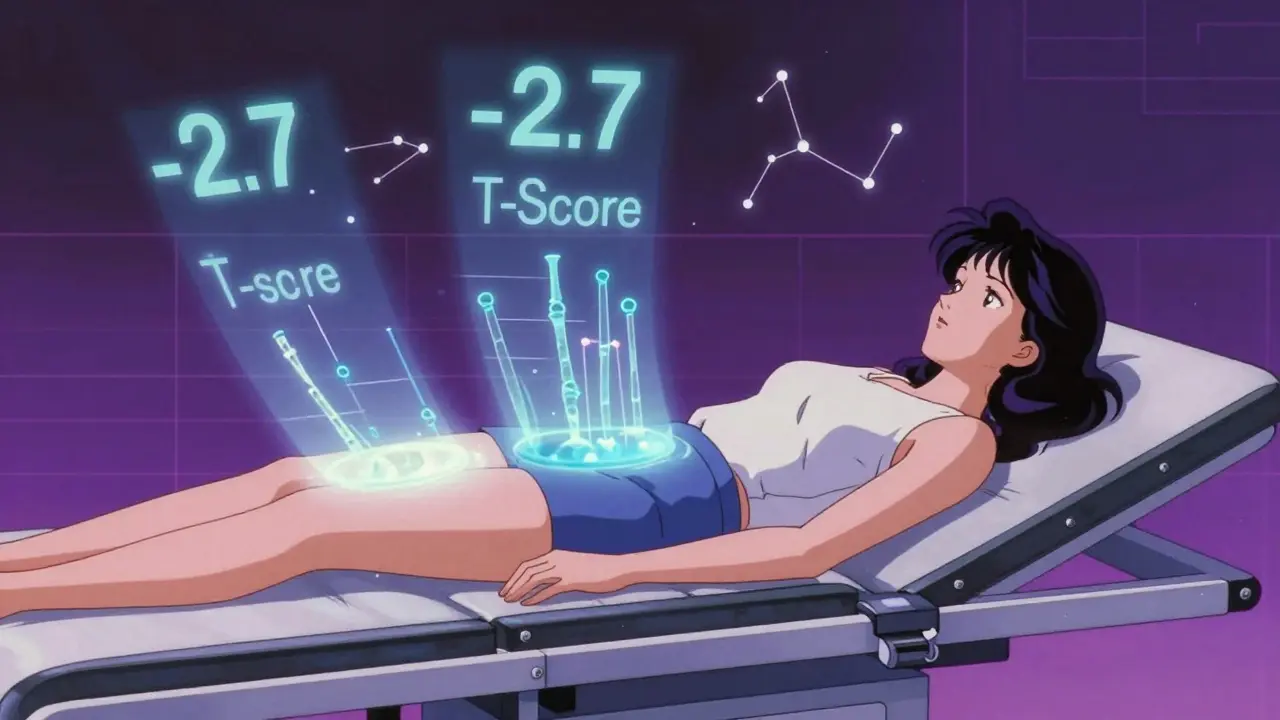
When you hear the word DEXA scan, it might sound technical, even intimidating. But here’s the truth: it’s one of the simplest, safest, and most important tests you can get for your bones-especially as you get older. Unlike a regular X-ray that just shows broken bones, a DEXA scan tells you if your bones are getting weak before they break. And that’s the whole point. Osteoporosis doesn’t come with pain or warning signs. It’s silent. By the time you fracture a hip or spine, it’s often too late to undo the damage. A DEXA scan catches it early. But knowing what the numbers mean? That’s where most people get lost.
What Exactly Is a DEXA Scan?
A DEXA scan-short for dual-energy X-ray absorptiometry-is a quick, painless test that measures how dense your bones are. It uses two very low-dose X-ray beams, one high-energy and one low-energy, to tell the difference between bone and soft tissue. The machine passes over your lower spine and hip, sometimes your forearm, and calculates how much mineral (mostly calcium) is packed into each square centimeter of bone. The result? A number in grams per square centimeter. But that number alone doesn’t tell you much. What matters is how it compares to two reference groups: healthy young adults and people your own age.
The radiation you get from a DEXA scan is tiny. Less than what you’d absorb from a day’s worth of natural sunlight. You’re exposed to more radiation on a short flight. The whole test takes about 10 minutes. You lie still on a table while the scanner moves above you. No needles. No fasting. No special prep. You just wear clothes without metal zippers or buttons. That’s it.
What Do the Numbers Mean? T-Score vs. Z-Score
After your scan, you’ll get two numbers: a T-score and a Z-score. Most people only hear about the T-score, but both matter.
The T-score compares your bone density to that of a healthy 30-year-old adult of the same sex and race. This is the number doctors use to diagnose osteoporosis. Here’s what it means:
- T-score of -1.0 or higher: Normal bone density
- T-score between -1.0 and -2.5: Osteopenia (low bone mass-your bones are weaker than normal, but not yet osteoporosis)
- T-score of -2.5 or lower: Osteoporosis
So if your T-score is -2.7, you have osteoporosis. Not borderline. Not maybe. That’s the diagnosis. And it’s not rare. About half of all women over 50 will have a T-score in the osteoporosis range at some point.
The Z-score compares your bone density to people your own age, sex, and ethnicity. This is useful if you’re under 50, pregnant, or have a medical condition that affects bone health. A Z-score below -2.0 means your bones are thinner than most people your age-and that’s something to dig into. It could point to an underlying issue like low vitamin D, thyroid problems, or even celiac disease.
Don’t confuse the two. A T-score of -1.8 might sound scary, but if you’re 45, your Z-score might be -0.5-which means your bones are actually fine for your age. That’s why both numbers matter.
Why a DEXA Scan Alone Isn’t Enough
Here’s the big mistake most people make: they think a low T-score = automatic fracture risk. Not true.
Some people with osteoporosis (T-score below -2.5) never break a bone. Others with osteopenia (T-score between -1 and -2.5) fracture easily. Why? Because bone density isn’t the whole story. Bone quality matters too. Are your bones brittle? Do they have micro-cracks? Are they losing their internal structure? DEXA can’t see that.
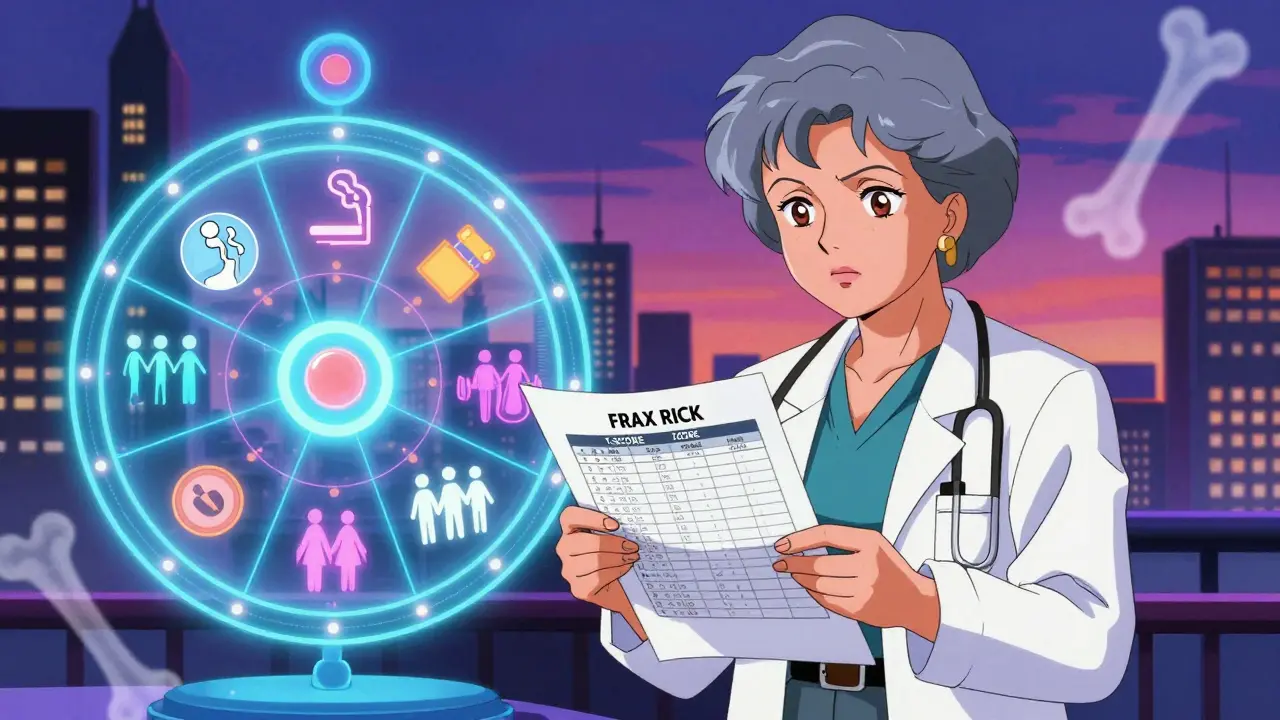
That’s where the FRAX tool comes in. Developed by the World Health Organization, FRAX takes your T-score and adds in other risk factors: age, weight, smoking, alcohol use, family history of hip fracture, steroid use, rheumatoid arthritis, and more. It doesn’t guess. It calculates your 10-year chance of breaking a hip or major bone. If your risk is over 20% for a major fracture or over 3% for a hip fracture, treatment is usually recommended-even if your T-score is only in the osteopenia range.
One real case: a 68-year-old woman had a T-score of -2.7. She was thin, smoked half a pack a day, and her mom broke her hip at 72. Her FRAX score showed a 24% chance of a major fracture in 10 years. She started a bone-building medication. Two years later, she’s still active. No fractures. That’s the power of combining data.
Who Should Get a DEXA Scan?
You don’t need one just because you’re over 50. But if you fit any of these, you should talk to your doctor about scheduling one:
- Women 65 and older
- Men 70 and older
- Postmenopausal women under 65 with risk factors (low body weight, smoking, family history)
- Adults who’ve had a fracture after age 50
- People taking long-term steroid pills (like prednisone)
- Those with conditions linked to bone loss: rheumatoid arthritis, type 1 diabetes, celiac disease, or hyperthyroidism
- People who’ve lost more than 1.5 inches in height
Medicare covers a DEXA scan every two years for people who meet these criteria. Most private insurers do too. But here’s the catch: many doctors don’t offer it unless you ask. If you’re at risk, don’t wait for them to bring it up.
What About Other Tests? Are They Better?
You might hear about QCT (quantitative CT), ultrasound, or even regular X-rays as alternatives. Here’s the reality:
- QCT gives a 3D view of bone and measures volume, not just density. But it uses 100 times more radiation than DEXA and costs twice as much. It’s not used for routine screening.
- Ultrasound (on the heel) is cheap and radiation-free. But it’s not accurate enough for diagnosis. It’s only good for initial risk screening.
- Regular X-rays only show fractures or severe bone loss. By the time you see it on an X-ray, you’ve already lost 30% of your bone mass.
DEXA is still the gold standard. It’s the only test the U.S. Preventive Services Task Force recommends for routine screening. And it’s the only one validated against actual fracture outcomes in large studies across decades.
Limitations and Pitfalls
No test is perfect. DEXA has blind spots:
- It can’t tell the difference between cortical (outer) and trabecular (inner) bone. That matters because osteoporosis often starts inside.
- Arthritis, spinal fusion, or metal implants can throw off the numbers. Your technician needs to know your history.
- It doesn’t show if you’ve already had silent spinal fractures. That’s why some scans include a VFA-vertebral fracture assessment-which looks for hidden breaks in your spine.
- For people with very high body weight, the machine may not be accurate. Some newer models handle this better.
Also, if you’ve had a scan before, make sure you go to the same facility. Different machines can give slightly different results. Comparing scans across different brands or settings can mislead your doctor.
What Happens After the Scan?
If your T-score is normal? Great. Keep doing what you’re doing: get enough calcium and vitamin D, stay active, avoid smoking, and limit alcohol.
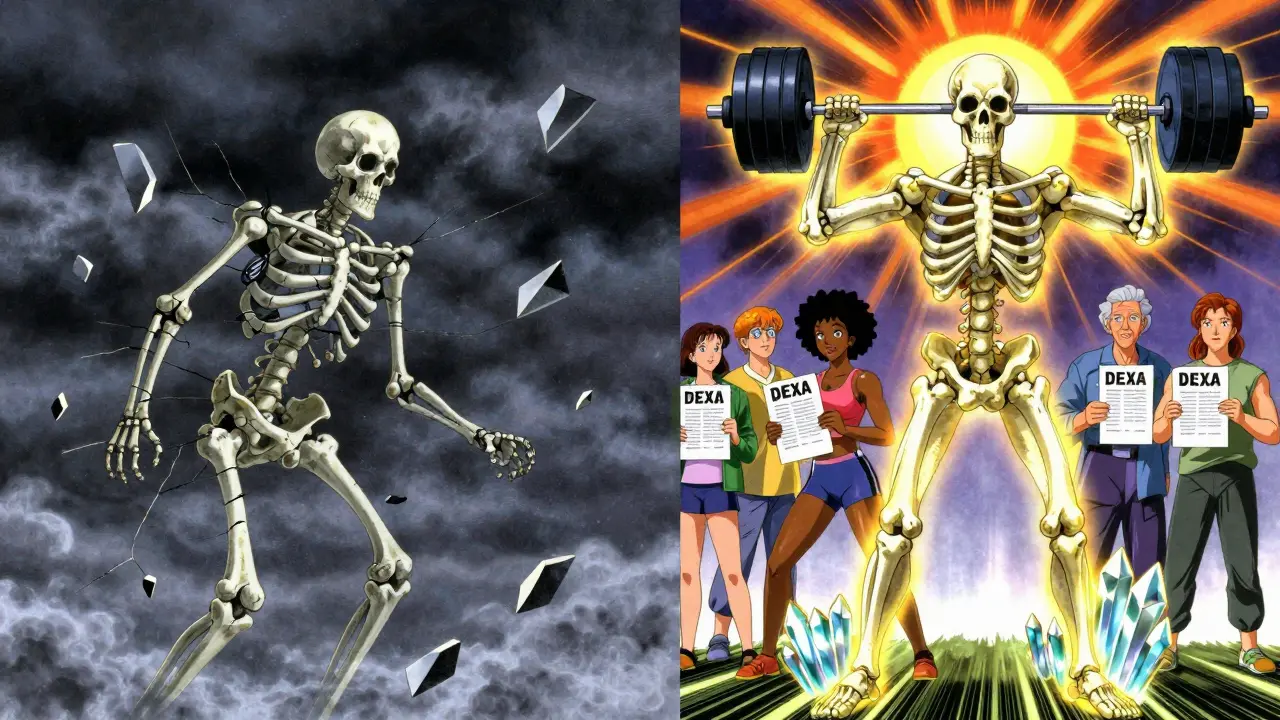
If you have osteopenia? That’s your wake-up call. Lifestyle changes can stop or even reverse bone loss. Weight-bearing exercise (walking, lifting weights, dancing) is the most powerful tool. Studies show it can improve bone density by 1-3% per year. That’s more than most medications.
If you have osteoporosis? You’ll likely need medication. Options include bisphosphonates (like alendronate), denosumab, or newer drugs like romosozumab. They don’t fix bones overnight. But they reduce fracture risk by 30-70% over three years. And they work best when paired with lifestyle changes.
And if you’ve had a fracture? Even if your T-score is only borderline, you’re at high risk for another. Treatment is almost always recommended.
Why So Many People Are Still Being Missed
Here’s the uncomfortable truth: millions of people with osteoporosis never get screened. Especially women of color. In 2022, only 22% of Black women and 18% of Hispanic women over 65 had a DEXA scan-compared to 41% of white women. That’s not a gap in knowledge. It’s a gap in access, in doctor referrals, in awareness.
And younger people? Many think osteoporosis is an “old lady disease.” It’s not. Menopause, eating disorders, intense athletic training, and certain medications can cause bone loss in your 30s and 40s. If you’ve had a stress fracture, irregular periods, or a history of anorexia, get tested-even if you’re under 50.
What’s Next for Bone Health?
Science is moving fast. New tools are being added to DEXA scans. One is the Trabecular Bone Score (TBS), which analyzes the texture of your spine on the scan to estimate bone structure quality. It doesn’t need extra radiation. Just a software upgrade. Studies show TBS improves fracture prediction by up to 18% on its own.
Artificial intelligence is now being trained to spot tiny spinal fractures in DEXA images-something even experienced radiologists sometimes miss. One 2023 study showed AI detected 95% of hidden fractures, compared to 78% by humans.
But none of this replaces the need for early screening. The best future for your bones isn’t in fancy tech. It’s in getting tested now.


Comments
Priya Patel
January 11, 2026Finally someone explains this without making it sound like a textbook. I got my DEXA scan last year at 52 and had no idea what T-score meant. Now I’m walking 30 mins daily and lifting dumbbells. Bones feel stronger already. 😊
Michael Patterson
January 12, 2026Look i get it dxa is the gold standard but honestly if you’re not a frail white woman over 65 your doctor probably won’t even mention it unless you scream about it. My aunt had three vertebral fractures before anyone ordered a scan. She’s 61. Hispanic. Never even got a z-score. This system is broken.
Matthew Miller
January 12, 2026Stop pretending osteoporosis is just a women’s issue. Men over 70 are getting ignored too. My uncle had a hip fracture at 73. His T-score was -3.1. He never smoked, never drank. He just got old. And no one told him until it was too late. This article barely mentions men. Lazy.
Adewumi Gbotemi
January 13, 2026Back home in Nigeria, people think bones only break from falls. No one talks about weak bones from inside. My cousin, 48, broke her wrist lifting a bag of rice. Doctor said her bones were like chalk. She never had a scan. We need more awareness here.
Roshan Joy
January 13, 2026Great breakdown. I work with elderly patients and see this all the time. T-score alone is misleading. One guy had -2.2 but his Z-score was -0.3 - turns out he was just small-boned. Another had -1.5 but Z-score -2.8 - turned out he had celiac. Always check both. And yes, FRAX is your real friend.
Christian Basel
January 13, 2026DEXA’s sensitivity is suboptimal for cortical bone modeling. The trabecular-to-cortical ratio variance introduces significant measurement error in postmenopausal cohorts, particularly when adipose tissue distribution is heterogeneous. You need QCT or HR-pQCT for true microarchitectural insight. DEXA is a proxy, not a diagnostic.
Jennifer Littler
January 14, 2026As a rheumatologist, I see this every day. People panic over T-scores. They don’t understand that FRAX is what actually drives treatment decisions. I had a patient with -1.9 T-score but 28% 10-year fracture risk. She started denosumab. Two years later? Zero fractures. Bone density didn’t even improve much - but her risk did. Context is everything.
Jason Shriner
January 15, 2026Oh wow. Another article telling me to ‘just walk more’ like that’s gonna fix my -2.7 T-score. Cool. So I’ll just do yoga and eat kale and suddenly my bones won’t shatter like glass? Meanwhile, my mom broke her spine lifting a suitcase. No one told her. No one told me. This is just fear porn wrapped in medical jargon.
Alfred Schmidt
January 17, 2026Why is no one talking about the fact that bisphosphonates can cause atypical femur fractures?! You take these drugs for 5 years, and suddenly your leg snaps like a dry twig. And then they say, ‘Oh, you need to stop!’ But by then, your jaw’s rotting and your bones are brittle from withdrawal. This whole system is a scam!
Vincent Clarizio
January 19, 2026Let’s be real - bone health isn’t about scans or scores. It’s about legacy. It’s about whether you’ll be able to hold your grandkid without wincing. It’s about not becoming a burden. The numbers are just tools. The real question is: do you want to live fully, or just survive? I’ve seen too many people ignore this until they’re stuck in a wheelchair. Don’t be one of them. Your future self is begging you to get tested.
Sam Davies
January 20, 2026DEXA? How quaint. In London, we’ve got AI-powered 3D bone mapping that predicts fracture risk with 92% accuracy using only a single low-dose CT. But no, let’s keep using a 1980s machine that can’t even distinguish bone from a belt buckle. Progress is for peasants, apparently.
Sean Feng
January 22, 2026My T-score was -2.1. I didn’t care. Now I’m on alendronate. My doctor said I’m fine. So I stopped. Two years later, I broke my wrist falling off a curb. Don’t be like me.
Priscilla Kraft
January 23, 2026Just got my results! T-score -1.8, Z-score -0.2. Phew. I’ve been doing yoga and eating almonds like crazy. Also started vitamin D3. So glad I didn’t wait until I broke something. You guys are right - it’s not scary if you act early. 🙌
Madhav Malhotra
January 25, 2026In India, we think milk and turmeric fix everything. But bone loss? No one talks about it. My sister, 43, stopped menstruating after intense dance training. Her DEXA showed osteopenia. She’s on supplements now. We need more doctors who understand this isn’t just for older women.
Alex Smith
January 26, 2026So let me get this straight - you’re telling me I need to lift weights to avoid breaking a hip… and that’s the same advice they gave me for avoiding a heart attack? Maybe the real problem is that we treat our bodies like disposable machines. We don’t care until they break. Then we throw money at a scan. How’s that for a philosophical take?
Write a comment