

When you're on a statin to lower cholesterol, the last thing you want is to take an antibiotic like clarithromycin and end up in the hospital with severe muscle pain, weakness, or even kidney damage. This isn’t a rare scare-it’s a well-documented, preventable danger that still happens far too often. Between 2004 and 2013, the FDA recorded 127 cases of rhabdomyolysis linked to clarithromycin and statins. That’s not just a footnote-it’s a red flag that doctors and patients still miss.
Why This Interaction Is So Dangerous
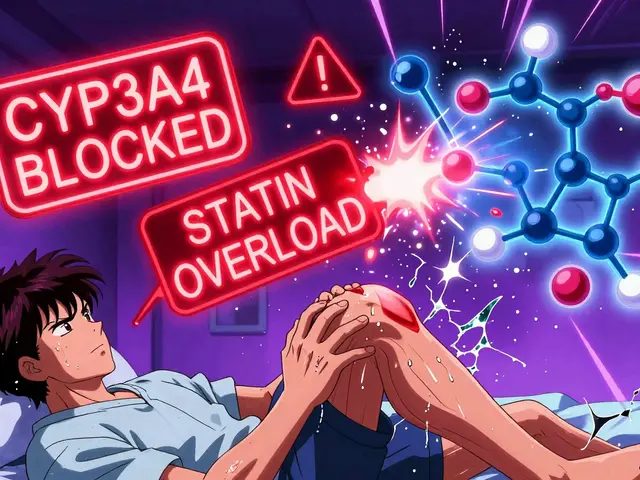
Clarithromycin doesn’t just fight bacteria. It also shuts down a key liver enzyme called CYP3A4, which your body uses to break down certain statins. When that enzyme is blocked, the statin builds up in your blood like a clogged drain. For some statins, levels can spike 10 to 20 times higher than normal. That’s enough to turn muscle cells into damaged debris, triggering a condition called rhabdomyolysis.Rhabdomyolysis isn’t just muscle soreness. It’s when muscle tissue breaks down so badly that it floods your bloodstream with proteins like creatine kinase (CK). Your kidneys can’t handle the overload. That’s when you risk kidney failure, electrolyte imbalances, and even death. One patient reported CK levels of 12,500 U/L after taking clarithromycin with 40 mg of simvastatin. Normal is under 200. That’s 60 times above the limit.
Which Statins Are Riskiest?
Not all statins are created equal when it comes to this interaction. The risk depends on how much they rely on CYP3A4 to get cleared from your body.- Simvastatin (Zocor) - Highest risk. 95% metabolized by CYP3A4. A 2004 study showed plasma levels jump 10-12 times when taken with clarithromycin. The FDA says never use more than 20 mg daily if you’re on clarithromycin. Even then, avoid it if you can.
- Lovastatin (Mevacor) - Almost as bad. Levels can spike 5-20 times. The European Medicines Agency recommends complete avoidance of this combo.
- Atorvastatin (Lipitor) - Moderate risk. Levels increase 4-8 times. The FDA limits this to 20 mg daily during clarithromycin treatment.
- Rosuvastatin (Crestor) - Lower risk. Only 10% metabolized by CYP3A4. Maximum 20 mg daily is considered safe, but still monitor closely.
- Pravastatin (Pravachol) and Fluvastatin (Lescol) - Safest options. They barely use CYP3A4 at all. No dose changes needed.
If you’re on simvastatin or lovastatin and your doctor prescribes clarithromycin, you’re in a high-risk zone. The numbers don’t lie: a 2018 study of over 312,000 patients found the risk of hospitalization for rhabdomyolysis was 4.6 times higher with clarithromycin-simvastatin than with azithromycin-simvastatin.
The Real Culprit: Time and Timing
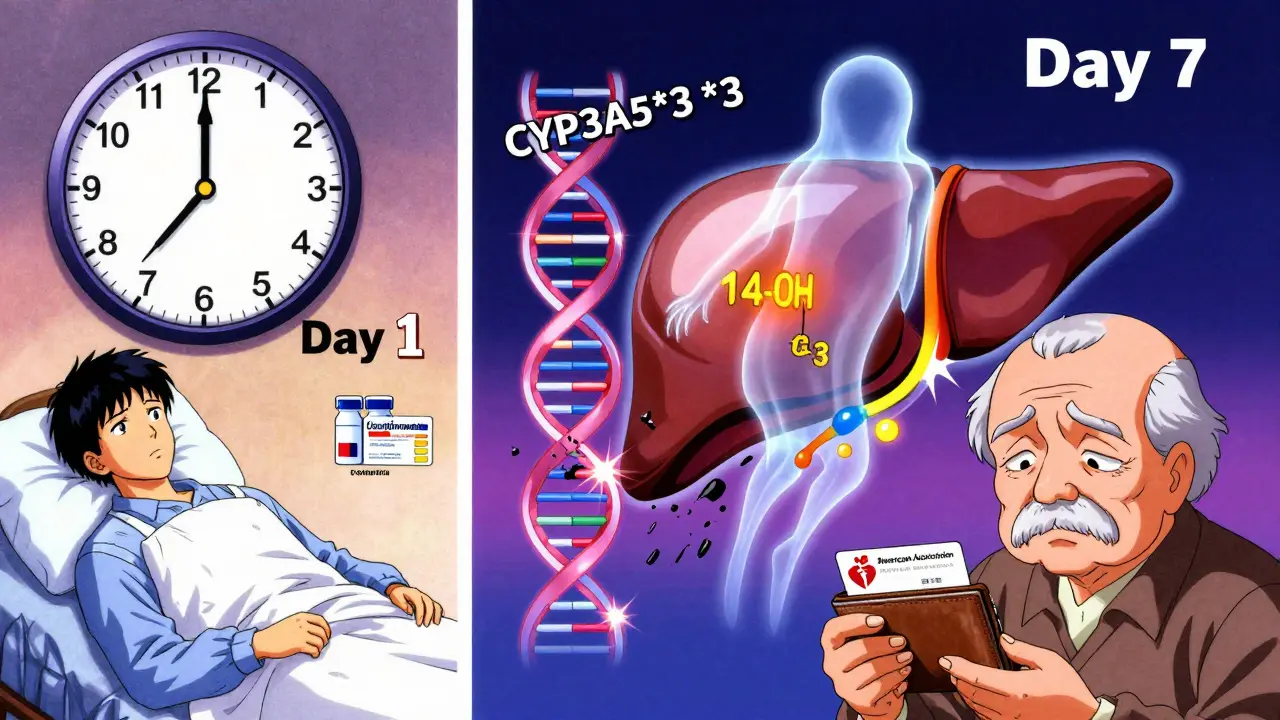
Many people think the danger ends when they finish their antibiotic. It doesn’t. Clarithromycin’s active metabolite, 14-OH clarithromycin, sticks around for 7 to 10 days after your last pill. That means even if you stop the antibiotic, your liver is still struggling to clear the statin.That’s why waiting a few days after finishing clarithromycin isn’t enough. You need to wait at least 5 days after the last dose before restarting your statin. And if you’re over 75, have kidney problems, or have hypothyroidism? Skip the statin entirely during this window. The risk isn’t worth it.
What Symptoms Should You Watch For?
Muscle pain from this interaction doesn’t feel like a sore workout. It’s deeper, more constant, and often accompanied by weakness. You might feel like you can’t climb stairs, stand up from a chair, or even lift your arms. Dark urine? That’s a red flag. It means muscle breakdown products are clogging your kidneys.On average, symptoms show up 3.2 days after starting clarithromycin. But they can hit as early as day one. If you’re on a statin and start antibiotics, pay attention to your body. Don’t wait until it’s unbearable. Call your doctor if you notice:
- Unexplained muscle pain or tenderness
- Weakness that doesn’t go away
- Fever or flu-like symptoms
- Dark, tea-colored urine
One Reddit user shared that after switching from clarithromycin to azithromycin while on atorvastatin, their muscle pain vanished within days. That’s the kind of change that matters.

The Safer Alternative: Azithromycin
There’s a simple fix: switch antibiotics. Azithromycin (Zithromax) doesn’t block CYP3A4. It’s just as effective for most bacterial infections-sinusitis, bronchitis, pneumonia-and doesn’t raise statin levels. A 2013 study in the Canadian Medical Association Journal found no increased risk of rhabdomyolysis or kidney injury with azithromycin and statins.Doctors still prescribe clarithromycin too often. A 2023 JAMA Internal Medicine study found that nearly 19% of primary care doctors still prescribe clarithromycin to patients on high-dose simvastatin. That’s over 132,000 dangerous prescriptions every year in the U.S. alone.
Ask your doctor: “Can I take azithromycin instead?” If they say no, ask why. Most of the time, it’s just habit. Azithromycin is cheaper, safer, and just as effective for most cases.
What If You Can’t Stop the Statin?
Sometimes, you can’t pause your statin-your heart condition is too unstable. In those cases, the American College of Cardiology recommends:- Reduce simvastatin to 10 mg daily
- Reduce atorvastatin to 20 mg daily
- Check your creatine kinase (CK) levels weekly
- Watch for muscle symptoms every day
And never, ever restart a high-dose statin without waiting at least five days after the last clarithromycin dose. Your liver needs time to recover.
Who’s Most at Risk?
Some people are more vulnerable. Age, kidney function, and genetics all play a role:- People over 75
- Those with chronic kidney disease
- Patients with hypothyroidism
- Those taking multiple medications that affect the liver
- People with the CYP3A5*3/*3 gene variant (new research shows they’re 3.2 times more likely to develop muscle damage)
If you fit any of these, your doctor should be extra cautious. Even if you’re young and healthy, don’t assume you’re safe. A 2022 survey found that 68% of statin users had no idea they could have dangerous interactions with antibiotics.
What Should You Do Right Now?
If you’re on a statin and your doctor just prescribed clarithromycin:- Don’t start the antibiotic until you’ve talked to your doctor or pharmacist.
- Ask: “Is there a safer antibiotic like azithromycin?”
- If you must take clarithromycin, confirm your statin dose is safe.
- Get a list of your medications and keep it in your wallet or phone. Use the American Heart Association’s statin interaction card.
- Watch for muscle pain, weakness, or dark urine. If you notice any, stop the antibiotic and call your doctor immediately.
Don’t wait for symptoms to get bad. Muscle damage from this interaction can happen fast-and it’s often irreversible.
What’s Changing in the Future?
The good news? Awareness is rising. The FDA updated clarithromycin’s label in January 2023 with stronger warnings. The American Heart Association and Infectious Diseases Society of America now recommend azithromycin as the go-to macrolide for statin users.Researchers are also looking at genetic testing to predict who’s most at risk. Early studies suggest certain gene variants make people far more sensitive to this interaction. In the next few years, we may see routine screening for CYP3A5 variants before prescribing clarithromycin.
Meanwhile, new antibiotics are in development that don’t touch CYP3A4 at all. Two candidates, AB569 and SPR720, are already in Phase II trials. These could be game-changers-no more trade-offs between treating infection and protecting your muscles.
Can I take clarithromycin with my statin if I lower the dose?
Only under strict medical supervision. For simvastatin, the FDA allows up to 20 mg daily with clarithromycin-but even that carries risk. For atorvastatin, 20 mg is the max. For lovastatin, avoid it entirely. The safest approach is to switch to azithromycin instead.
How long should I wait after clarithromycin to restart my statin?
Wait at least 5 days after your last dose of clarithromycin. Its active metabolite stays in your system for up to 10 days, continuing to block the enzyme that clears statins. Restarting too soon can cause dangerous buildup.
Is azithromycin really safer than clarithromycin with statins?
Yes. Azithromycin doesn’t inhibit CYP3A4, so it doesn’t raise statin levels. Studies show no increased risk of muscle damage or kidney injury when azithromycin is taken with any statin. It’s the preferred alternative for patients on statins.
What if I already took clarithromycin and my statin together?
Stop both medications immediately and contact your doctor. Get a blood test for creatine kinase (CK) levels. If your CK is over 1,000 U/L or you have muscle pain, weakness, or dark urine, go to the ER. Early intervention can prevent kidney failure.
Can I use natural remedies instead of antibiotics?
No. Natural remedies like garlic, honey, or echinacea won’t treat bacterial infections that require antibiotics like clarithromycin. Delaying proper treatment can lead to serious complications. The goal isn’t to avoid antibiotics-it’s to choose the right one.
Final Thought: You Have Power Here
This interaction isn’t inevitable. It’s preventable. You’re not just a patient-you’re a partner in your care. Ask questions. Push for safer options. Keep a list of your meds. Know your symptoms. The fact that you’re reading this means you’re already ahead of 68% of statin users who don’t even know this risk exists.Clarithromycin and statins don’t have to be a dangerous combo. With the right choices, you can treat your infection and protect your muscles at the same time.






Write a comment