
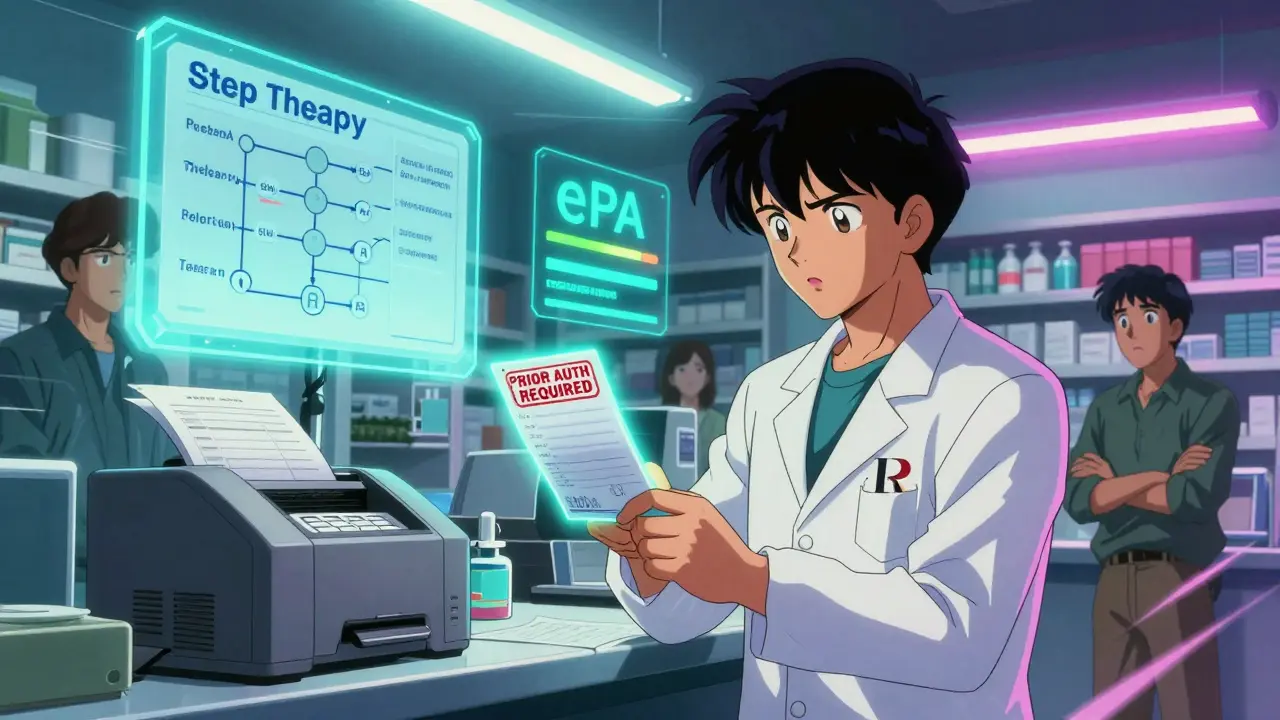
Every day, pharmacists in the U.S. face the same frustrating bottleneck: a patient walks up to the counter with a brand-name prescription, but the insurance won’t cover it unless they’ve tried cheaper generics first. This isn’t just a paperwork issue-it’s a barrier to care that delays treatment, increases costs, and burns out providers. The system behind this is called prior authorization, and for generic alternatives, it’s become the norm, not the exception.
Why Generic Alternatives Trigger Prior Authorization
Prior authorization isn’t new, but its focus on generic medications has exploded since 2010. Back then, CMS rolled out standardized rules to cut drug spending. The logic was simple: if a generic drug is FDA-approved as therapeutically equivalent (AB-rated), why pay more for the brand? So insurers started requiring doctors to prove a patient failed the cheaper option before approving the expensive one. This is called step therapy. Today, 97% of commercial insurers and 100% of Medicaid managed care plans use this model. For diabetes, hypertension, or migraine meds, you’re often forced to try two generics first. A 2024 Kaiser Family Foundation analysis found 82% of commercial plans require two failed trials before approving a brand-name drug. That means a patient might get denied a life-changing medication for weeks-just because the insurance company wants to save money.The Seven-Step Process Pharmacists Actually See
As a pharmacist, you don’t just fill the script. You become a case manager. Here’s what really happens behind the scenes:- Identify the trigger: The prescription hits your system. You check the payer’s formulary. If it’s a brand with a generic alternative, the system flags it for prior auth.
- Collect documentation: You need the prescriber’s notes: dates of prior generic use, dosage, side effects, lab results (like HbA1c for diabetes), and why it didn’t work. Vague notes like “patient didn’t respond” get denied. Specifics like “4 weeks at 500mg twice daily with <30% symptom reduction” get approved.
- Submit electronically: Fax is dead. Over 89% of submissions now go through ePA platforms like CoverMyMeds. Electronic requests have a 78% same-week approval rate. Fax? Only 34%.
- Wait for review: Payers assign clinical pharmacists to review. Cigna takes 5-10 business days. UnitedHealthcare takes 7-14 calendar days. But starting January 1, 2026, Medicaid must respond in 7 days for standard requests and 72 hours for urgent ones.
- Get the answer: Approval? Great. Denial? You get a reason-but often it’s generic: “Insufficient documentation.” That’s the most common denial reason, accounting for 63% of rejections.
- Appeal if needed: If denied, you resubmit with better data. This can add another 5-10 days. Some patients give up. A Patients Rising survey found 67% abandon treatment due to delays.
- Follow up: You track the status. Lost requests? They drop 89% with automated tracking systems.
How Insurers Differ-And Why It Matters
Not all insurers play by the same rules. Aetna might require a 14-day trial of a generic before approving a brand. UnitedHealthcare wants 30 days. Medicare Part D plans require prior auth on only 18.7% of brand prescriptions with generics available. Commercial plans? 32.4%. That’s almost double. Specialty drugs are even worse. In oncology, 94% of brand-name treatments require prior auth when biosimilars exist. For GLP-1 agonists like Wegovy, patients report spending weeks jumping through hoops after metformin fails-even though metformin isn’t even a treatment for obesity. And then there’s “gold carding.” If a provider gets 95%+ approval rates on certain drugs, they get automatic approval. Sounds fair, right? But only 29% of eligible providers even know they qualify. That’s wasted time-and wasted care.
The Hidden Costs: Time, Burnout, and Lost Care
This isn’t just a pharmacy problem. It’s a system-wide crisis. A 2024 JAMA Internal Medicine study found prior authorization wastes $13.4 billion a year in provider time. Sixty-three percent of that time is spent on generic alternatives. One physician on Sermo reported spending 14.6 hours a week just on prior auths. That’s over two full workdays. Many doctors are cutting patient loads because of it. Patients pay too. A 2023 CMS Office of Inspector General report found 17.3% of prior auth denials for brand-name drugs were medically inappropriate. That means over 1.2 million Medicare beneficiaries were denied care they needed-because paperwork didn’t match the insurer’s checklist. And the emotional toll? On Reddit, r/healthinsurance has over 1,200 comments from patients stuck in the same loop: “I’ve been denied three times for Wegovy. My doctor says it’s the only thing that works. My insurance says try metformin again.”What Actually Works: Proven Strategies for Pharmacists
You can’t change the system overnight. But you can make it work better-for your patients and your team.- Submit 14 days early. Don’t wait until the script is due. Start the process as soon as the prescription is written.
- Use payer-specific templates. Each insurer has its own form. Using the right one cuts denial rates by 37%.
- Document like a detective. Don’t say “failed treatment.” Say: “Patient took lisinopril 20mg daily for 6 weeks. BP remained 158/94. No side effects reported.” Specificity = approval.
- Use ePA, not fax. Electronic submissions are faster, trackable, and more accurate.
- Designate a prior auth lead. Practices with a dedicated staff member cut processing time by 52%.
- Check for gold carding. Ask your prescribers: “Are you enrolled in any automatic approval programs?”

The Future Is Here-And It’s Faster
Change is coming. The CMS Interoperability and Prior Authorization Proposed Rule (CMS-0057-P), set to launch in 2026, will require real-time benefit checks at the point of prescribing. That means a doctor will see, right when they write the script, whether prior auth is needed-and what’s required. AI tools are already helping. Sixty-one percent of large health systems are testing natural language processing that auto-fills prior auth forms from clinical notes. Early results show a 44% drop in submission time. And blockchain? Mayo Clinic is piloting a system where prior auth requests are stored on a secure, shared ledger. Their approval rate for generic exceptions jumped to 92%. By 2027, 100% of major payers must adopt FHIR-based APIs for prior auth. That means systems will talk to each other. No more phone calls. No more faxes. Just a click.What You Can Do Today
You’re on the front lines. You see the delays. You hear the frustration. You know when a patient needs a drug now-not in 10 days. Start small:- Ask your prescribers if they’re using templates.
- Track how many prior auths you handle per week. Are they mostly for generics?
- Find out if your pharmacy uses an ePA platform. If not, push for it.
- When a patient is denied, don’t just say “call your doctor.” Say: “Here’s what they need to include: specific dates, doses, and symptoms. I’ll email you the template.”
Why do insurers require trying generics before brand-name drugs?
Insurers require this to control costs. Generic drugs are typically 80-85% cheaper than brand-name versions and are FDA-approved as therapeutically equivalent. The goal is to use the most cost-effective option first, unless there’s a documented medical reason not to. This is called step therapy, and it’s mandated by most commercial and Medicaid plans. However, critics argue this often delays necessary care without improving outcomes.
How long does prior authorization for generics usually take?
Processing times vary by insurer. Cigna takes 5-10 business days. UnitedHealthcare takes 7-14 calendar days. Starting January 1, 2026, Medicaid plans must respond within 7 calendar days for standard requests and 72 hours for urgent cases. Electronic submissions are significantly faster-often approved within the same week-while faxed requests can take over two weeks.
What’s the most common reason prior authorization for generics gets denied?
The most common reason is inadequate documentation. Many requests fail because the prescriber uses vague language like “patient didn’t respond” instead of specific data: dates of use, dosages, symptom changes, or lab results. A 2024 study found 63% of initial denials were due to missing or unclear failure criteria.
Can pharmacists help speed up prior authorization?
Yes. Pharmacists play a critical role. They can ensure prescriptions are flagged early, use payer-specific templates, submit electronically, and help prescribers document failure criteria accurately. Pharmacies with dedicated prior auth staff reduce processing time by over 50%. They can also check if providers qualify for “gold carding,” which grants automatic approvals.
What is “gold carding” and how does it help?
Gold carding is a program where providers who consistently get high approval rates (usually 95% or more) for certain medications receive automatic prior authorization approvals. This eliminates the need to submit paperwork each time. It’s available from 76% of major insurers, but only 29% of eligible providers know they qualify. Pharmacists can help identify and inform prescribers about their status.
Are there laws changing how prior authorization works?
Yes. As of September 2024, 38 states have passed prior authorization reform laws, with 27 specifically targeting generic alternatives. Texas, for example, requires a 72-hour turnaround for urgent requests. Federal rules from CMS, effective January 1, 2026, now mandate 7-day response times for Medicaid and require clear denial reasons. Real-time benefit tools will also be required by 2026, so prescribers will see coverage rules at the point of prescribing.
What’s the impact on patients?
Delays in prior authorization lead to treatment abandonment. Patients with diabetes, mental health conditions, or chronic pain often stop taking medication because they can’t wait weeks for approval. A Patients Rising survey found 67% of respondents gave up on treatment due to prior auth delays. For some, this leads to ER visits, hospitalizations, or worsening disease.
Is electronic prior authorization better than fax?
Absolutely. Electronic prior authorization (ePA) has a 78% same-week approval rate. Fax submissions only get approved 34% of the time within a week. ePA reduces errors, tracks submissions in real time, and integrates with electronic health records. Most payers now require or strongly prefer ePA, and it’s becoming the industry standard.






Comments
Diana Dougan
January 31, 2026lol so now pharmacists are insurance cops? next they’ll be auditing our toilet paper usage too. i got my lisinopril denied because i didn’t ‘try’ the $2 generic first… even though i’ve been on brand for 12 years and my bp is perfect. yeah, let’s make people suffer for savings that never reach them.
April Allen
February 2, 2026The step therapy paradigm is a classic case of cost-shifting masquerading as cost containment. From a pharmacoeconomic standpoint, it’s logically inconsistent: the administrative overhead of prior auth requests-staff time, fax machines, electronic portal lag, appeals-often exceeds the savings from generic substitution. Moreover, therapeutic equivalence (AB rating) doesn’t account for bioavailability variance in extended-release formulations or patient-specific pharmacogenomic responses. We’re optimizing for line-item budgeting, not clinical outcomes.
And don’t get me started on the cognitive load on clinicians. A primary care provider managing 200+ patients can’t possibly document 4-week trial durations for every med with a generic alternative. The system incentivizes compliance over care, and the burden falls disproportionately on safety-net providers and marginalized populations.
Bobbi Van Riet
February 3, 2026I’ve been a pharmacist for 18 years and this breaks my heart every single day. I had a 72-year-old woman come in last week with severe migraines. She’d been on topiramate for years, but the insurance made her try three generics first-each one gave her brain fog so bad she couldn’t feed herself. Took us three weeks, two appeals, and a letter from her neurologist to get the brand approved. She cried when she finally got it. We all did.
It’s not just paperwork. It’s people. And we’re treating them like data points in a spreadsheet.
Holly Robin
February 3, 2026THIS IS THE NEW EUGENICS. Insurers are literally deciding who gets to be healthy based on their bank account. They don’t care if you’re dying-they care if your drug costs more than $3.50. Big Pharma and the insurance giants are in cahoots-generic makers pay kickbacks to get on formularies, and the rest of us? We’re collateral damage. Wake up. This isn’t healthcare. It’s profit-driven torture.
Marc Bains
February 4, 2026As someone who’s worked in pharmacy in both rural Ohio and urban Chicago, let me say this: the pain is real everywhere, but the consequences hit harder in places with no specialists, no transport, and no time. A diabetic patient in Appalachia can’t drive 90 minutes to a clinic to get a prior auth letter signed. They just stop taking meds. And then they end up in the ER. That’s not efficiency. That’s systemic neglect wrapped in a corporate policy.
Sazzy De
February 4, 2026i just wish people would stop pretending this is about savings. it’s about control. the system doesn’t want you to feel better fast. it wants you to wait. and wait. and wait. until you give up.
Kelly Weinhold
February 6, 2026Hey, I know this sounds harsh but hear me out-we can fix this. Pharmacists are the unsung heroes here. We’re the ones who actually know what’s going on with patients. What if we pushed for a ‘pharmacist-initiated prior auth’ model? Like, if you’ve got 5+ years of clinical notes and documented failures, why should the doctor have to re-do the paperwork? Let’s give pharmacists more autonomy. We’re not just dispensers-we’re frontline clinicians. And we’re tired.
Kimberly Reker
February 7, 2026My mom got her gabapentin denied last month. She’s 80. She has neuropathy. She cried because she thought she’d have to go back to the ER for pain control. We fought it for three weeks. The insurance finally approved it… but only after they made her try a different generic that gave her dizziness and nausea. So now she’s on the brand, but she’s also scared to take it because ‘what if they deny it again next month?’
This isn’t policy. It’s trauma.
KATHRYN JOHNSON
February 8, 2026It is unacceptable that pharmaceutical cost containment measures have been implemented without adequate consideration for patient autonomy, clinical judgment, or ethical obligation. The current prior authorization framework constitutes a breach of the Hippocratic principle of beneficence. I urge all licensed professionals to formally petition state medical boards to classify these practices as professional misconduct.
Eliana Botelho
February 9, 2026Wait, so you’re telling me the system is designed to make people suffer before they get better? That’s not a healthcare system-that’s a game of Russian roulette with pills. Why not just make everyone pay full price? At least then you’d know you’re getting what you paid for. This whole thing feels like a corporate experiment to see how much pain people will tolerate before they just stop trying.
Beth Beltway
February 10, 2026You’re all missing the point. This isn’t about patients. It’s about accountability. If insurers didn’t have these rules, doctors would be overprescribing brand-name drugs left and right. You think they’re doing it for the patients? No-they’re doing it because they’re lazy or because Big Pharma reps gave them free lunches. Step therapy forces them to think. It’s not cruel-it’s responsible.
April Allen
February 11, 2026That’s the most dangerous myth in this whole mess: that clinicians are just drug pushers waiting for a free lunch. Most physicians I know are burned out, overworked, and terrified of malpractice. They don’t prescribe brands because they’re paid to-they prescribe them because they’ve seen the evidence, the patient history, the lab trends. And when you force them to jump through hoops that have nothing to do with clinical outcomes, you’re not enforcing accountability-you’re enforcing incompetence.
There’s a difference between appropriate utilization and arbitrary gatekeeping. Step therapy, as currently implemented, is the latter. And it’s not just wasting time-it’s costing lives.
Write a comment