
Medical Term Translator
What is this tool?
Translate confusing medical terms from your health records into language you understand. See how your provider's clinical terms map to everyday words.
Try It Now
Why Your Doctor’s Notes Don’t Sound Like You
You walk out of the appointment with a prescription, a follow-up date, and a chart note that says "Type 2 Diabetes Mellitus, poorly controlled". You feel confused. You didn’t hear those words. All you heard was, "Your blood sugar’s too high. Take this pill. Come back in three months."
That gap isn’t a mistake. It’s a system. Healthcare providers write in one language. Patients live in another. And when those two don’t match, it doesn’t just cause confusion-it puts your health at risk.
The Two Sides of the Same Story
Healthcare providers use standardized codes to document what’s wrong with you. They use ICD-10 codes like E11.9 for Type 2 Diabetes. They write CPT codes to bill for what they did. These aren’t just paperwork-they’re how hospitals get paid, how insurance approves treatment, and how researchers track disease trends across millions of people.
But you? You don’t think in codes. You think in symptoms. "I’m always tired." "I’m peeing all night." "My feet feel numb." That’s your health story. And it’s not in the chart. Not really.
A 2019 study in the Journal of General Internal Medicine found that 68% of patients didn’t understand common medical terms. Forty-two percent didn’t know "hypertension" meant high blood pressure. Sixty-one percent didn’t recognize "colitis" as inflammation of the colon. When your doctor says "hyperlipidemia," you hear gibberish. And you’re not alone.
What’s Written vs. What’s Felt
Here’s how the same condition looks on two sides of the same chart:
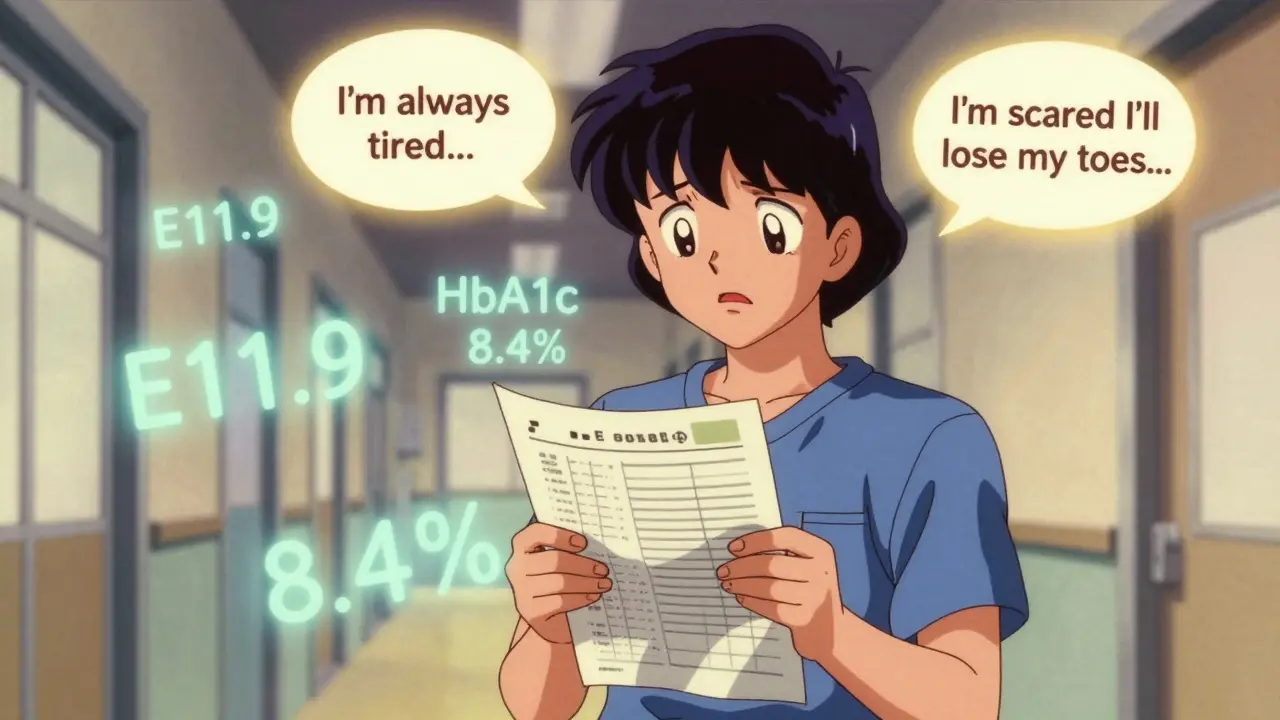
- Provider label: "HbA1c 8.4%, poor glycemic control, ICD-10 E11.9"
- Patient experience: "I’m so tired I can’t play with my kids. I drink water all day and still feel thirsty. I’m scared I’m going to lose my toes."
The provider’s note is precise. It’s useful for billing, research, and coordinating care across specialists. But it doesn’t tell you why you’re struggling. It doesn’t capture your fear, your frustration, or the fact that you skipped your medication because the pills made you sick to your stomach.
That’s not just a communication problem. It’s a safety problem. Dr. Thomas Bodenheimer from UCSF found that 30-40% of medication errors happen because patients don’t understand what they’re being told. If you think your doctor wrote "bad diabetic" in your chart, you might feel guilty-not like you need help.
How the System Was Built
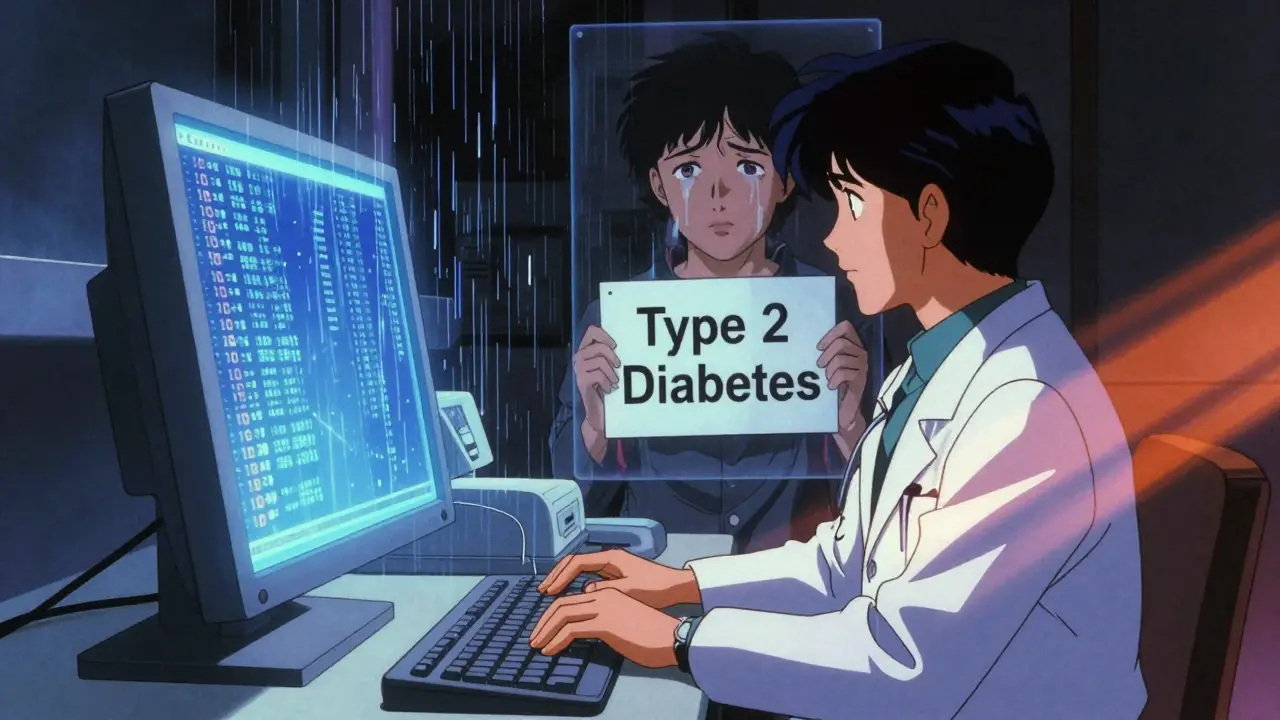
This gap didn’t happen by accident. Medical records were designed for efficiency, not empathy. When Electronic Health Records (EHRs) like Epic and Cerner became standard in the 2000s, they prioritized billing and compliance over clarity. ICD-10 codes became mandatory in 2015. HIPAA locked down privacy. CMS started tying hospital payments to how well they used these codes.
Meanwhile, patients got little say. Until 2010, most people never saw their own records. Then came OpenNotes-a movement that let patients read their doctors’ notes. By 2024, 55 million Americans had access. And what they found shocked them.
On PatientsLikeMe, one user wrote: "My doctor wrote ‘poorly controlled DM’-I thought it meant I was a bad person." That’s not a coding error. That’s a failure of language.
Who’s Trying to Fix This
Some people are working to bridge the gap.
Health Information Management (HIM) professionals-certified experts who handle medical records-are trained to translate clinical jargon into plain language. They spend over 1,200 hours learning ICD-10 codes, HIPAA rules, and how to make sure records are accurate and understandable.
Hospitals like Mayo Clinic started using "plain language" templates in their EHRs. Instead of "myocardial infarction," the patient-facing version says "heart attack." In their pilot program, patient confusion dropped by 38%.
Kaiser Permanente’s OpenNotes program saw a 27% drop in patient confusion and a 19% rise in medication adherence. Why? Because when patients read their notes in words they understand, they feel more in control. And when people feel in control, they take better care of themselves.
The government is pushing too. The 21st Century Cures Act of 2016 forced providers to share clinical notes with patients. By April 2021, it was law. And CMS now includes communication clarity in its HCAHPS survey-which affects 2% of hospital reimbursements.
What’s Changing Right Now
Technology is catching up.
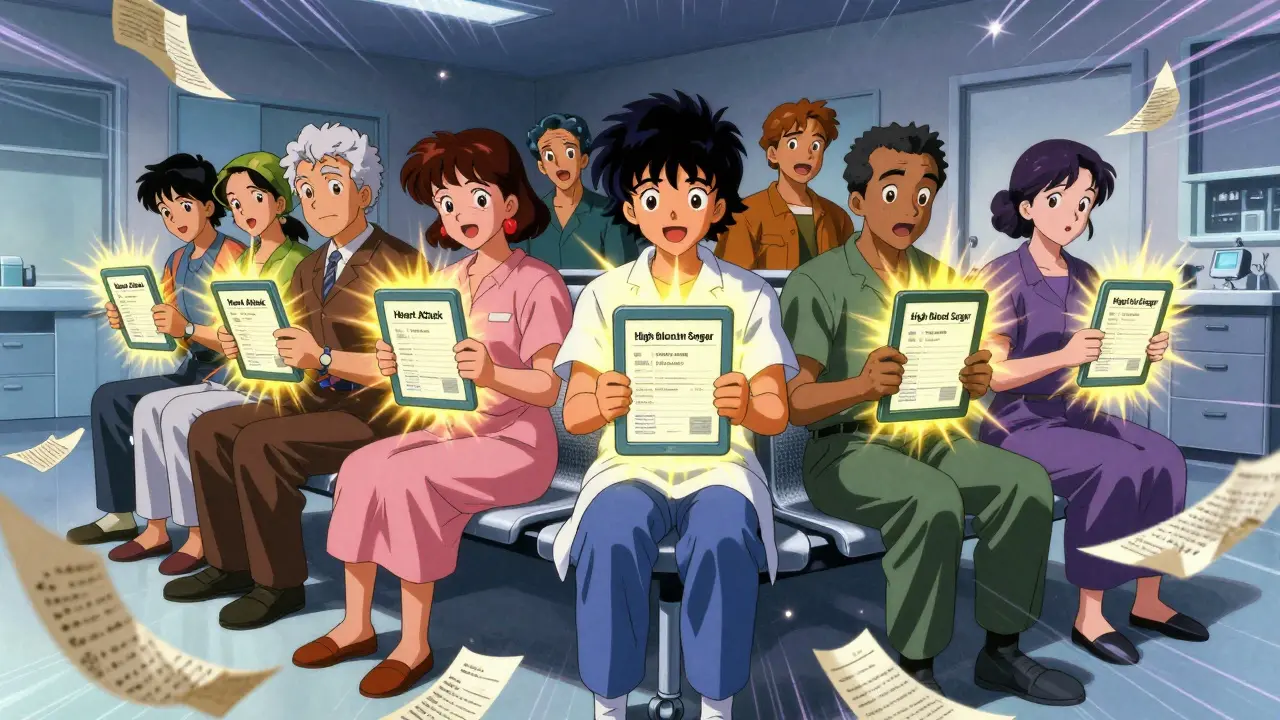
ICD-11, the global standard launched in 2022, now includes patient-friendly descriptions alongside medical codes. For the first time, the same diagnosis has two labels: one for doctors, one for you.
HL7 FHIR, the new data standard used by 78% of major U.S. health systems, lets EHRs show both versions at once. Your doctor sees "E11.9." You see "Type 2 Diabetes."
And AI is stepping in. Google’s Med-PaLM 2 can convert clinical notes into plain language with 72.3% accuracy. It’s not perfect yet-but it’s getting close. The American Medical Informatics Association predicts that by 2027, 60% of EHRs will automatically translate notes for patients in real time.
What You Can Do Today
You don’t have to wait for technology to fix this. Here’s how you can take control:
- Ask for plain language. After your doctor says something technical, say: "Can you explain that in words I’d use at home?"
- Use the teach-back method. After they explain something, repeat it back: "So if I’m feeling dizzy, it means my blood pressure is too low, and I should sit down. Is that right?" Studies show this cuts miscommunication by 45%.
- Read your notes. Log into your patient portal. If you see something confusing, write it down. Bring it to your next visit.
- Ask for a copy. You have a legal right to your medical records. If your provider says no, ask for the health information office.
- Don’t be afraid to push back. If a term makes you feel blamed or scared, say so. Your experience matters.
Healthcare isn’t just about pills and procedures. It’s about understanding. And if you don’t understand your own health, you can’t manage it.
Why This Matters More Than Ever
The gap between provider labels and patient experience isn’t just a communication issue-it’s a justice issue.
People who speak English as a second language, who have lower education levels, or who come from marginalized communities are hit hardest. They’re more likely to be misdiagnosed, miss appointments, or stop taking meds because they don’t know why.
When healthcare systems treat patients like data points instead of people, they’re not just being inefficient-they’re being unsafe.
The good news? Change is happening. Not because it’s easy, but because patients are demanding it. And when patients speak up, systems have to listen.
Your story isn’t a code. It’s your life. And you deserve to have it heard-clearly, accurately, and without translation.
Why do doctors use medical jargon instead of simple words?
Doctors use medical terms because they’re standardized-used across hospitals, insurance systems, and research databases. These terms help ensure accuracy when sharing information between providers and for billing purposes. But that doesn’t mean they’re meant to confuse patients. Many providers are now trained to explain terms in plain language, especially after the OpenNotes movement made patient understanding a priority.
Can I ask my doctor to change the wording in my medical record?
You can’t change the official clinical note used for billing and treatment, but you can ask for a clarification note to be added. For example, if your chart says "poorly controlled diabetes," you can say: "I’d like to add that I didn’t understand what that meant until I read my notes. I’m now taking my medication daily and checking my blood sugar twice a day." This becomes part of your record and helps future providers understand your perspective.
How do I know if my doctor’s notes are accurate?
Review your notes regularly through your patient portal. If something doesn’t match what you said or how you felt, write down your concerns and bring them to your next appointment. Most providers welcome feedback-especially when it helps them understand your experience better. If you notice repeated errors, ask to speak with the health information management department.
What’s the difference between ICD-10 and patient-friendly labels?
ICD-10 is a coding system used by providers and insurers to classify diseases and procedures. For example, "E11.9" means "Type 2 Diabetes Mellitus without complications." Patient-friendly labels use everyday language: "You have Type 2 Diabetes," or "Your body isn’t using insulin properly." New systems like ICD-11 and FHIR now support both versions side-by-side, so you can see what your doctor sees-and what it means for you.
Is it normal to feel scared reading my medical notes?
Yes. Many people feel shocked, anxious, or even blamed when they read their notes for the first time. Terms like "non-compliant" or "poorly controlled" can sound judgmental-even if the provider didn’t mean them that way. That’s why plain language initiatives are growing. If a note upsets you, don’t ignore it. Talk to your provider. You’re not overreacting-you’re being an active partner in your care.



Comments
Ben Harris
December 26, 2025bro why are we even talking about this like it's a revelation? doctors have been talking in alien language since forever and you think they're gonna change because some patient read a blog post? they got bills to pay and insurance codes to hit. you want plain language? go to a nurse. they actually talk to you like a human.
Jason Jasper
December 27, 2025I read my notes last year after getting my first OpenNotes access. Found out my doc wrote 'patient seems resistant to lifestyle change.' I just thought I was busy. Turns out I was labeled lazy. Didn't say anything then. Still feels weird.
Zabihullah Saleh
December 29, 2025This whole thing reminds me of how we translate poetry. The meaning gets lost in the structure. Medical jargon isn't meant to confuse-it's meant to be precise. But precision without context is just noise. The real issue is that we treat diagnosis like a label on a jar, not a living story. We need systems that hold both the code and the person.
Winni Victor
December 31, 2025I read my chart and it said 'non-compliant.' Like I'm some kind of rebel teenager refusing to take my vitamins. I skipped meds because they made me vomit and now I'm the bad guy? This system is designed to shame people into obedience. It's not healthcare-it's behavioral control with a stethoscope.
Lindsay Hensel
January 1, 2026The disconnect between clinical documentation and patient experience is a systemic failure of empathy. It is not merely a communication gap-it is an ethical deficit. Patients are not data points. They are human beings with narratives, fears, and agency. The integration of plain-language interfaces into EHRs is not optional-it is imperative.
Harbans Singh
January 2, 2026In India, we don’t have OpenNotes. My aunt’s doctor wrote 'elderly with poor adherence'-she couldn’t read the script on the bottle. No one explained it. She stopped taking pills. Now she’s in the hospital. This isn’t just an American problem. It’s a global silence.
Justin James
January 4, 2026You think this is about jargon? Nah. This is a Big Pharma and Epic EHR conspiracy. They want you confused so you keep coming back. The codes? They’re not for billing-they’re for tracking your lifetime value. The AI translations? They’re just putting lipstick on a pig. They’re still selling your data to insurers. They don’t care if you understand-just as long as you pay.
Rick Kimberly
January 5, 2026The introduction of ICD-11’s dual-labeling system represents a significant advancement in patient-centered documentation. It aligns with the principles of health literacy and demonstrates a measurable commitment to reducing disparities in care delivery. This is a necessary evolution in medical informatics.
Terry Free
January 5, 2026So let me get this straight. You want doctors to stop using words like 'hypertension' because you can't handle it? Get a dictionary. I've got a 78-year-old grandma who knows what 'diabetes' means. Stop coddling people. The system works fine. If you can't understand your chart, maybe you shouldn't be managing your own health.
sagar patel
January 6, 2026My doctor wrote 'noncompliant' after I missed one appointment because my kid got sick. I didn't know I was being judged. I just thought I'd call in. Now I'm afraid to go back. Language matters. But so does context. Neither is ever considered.
Linda B.
January 8, 2026They're watching us. Every word in your chart is stored. That 'poorly controlled' tag? It follows you forever. Insurance uses it to raise premiums. Employers see it during background checks. They don't want you healthy. They want you docile. Read your notes? That's the first step to being tracked. Don't be fooled.
Christopher King
January 9, 2026This isn’t about language. This is about control. The system doesn’t want you to understand your body. It wants you dependent. The codes? They’re not for billing-they’re for programming you. The AI translations? They’re just the new face of the machine. You think you’re getting clarity? You’re just being fed sanitized versions of your own suffering. Wake up. You’re not being helped-you’re being managed.
Bailey Adkison
January 10, 2026You're all missing the point. The problem isn't the jargon. It's that people think their feelings are facts. 'I feel tired' isn't a diagnosis. 'HbA1c 8.4%' is. Stop demanding empathy over evidence. If you want to be taken seriously, learn the language. Otherwise, stop complaining and take your pills.
Write a comment