
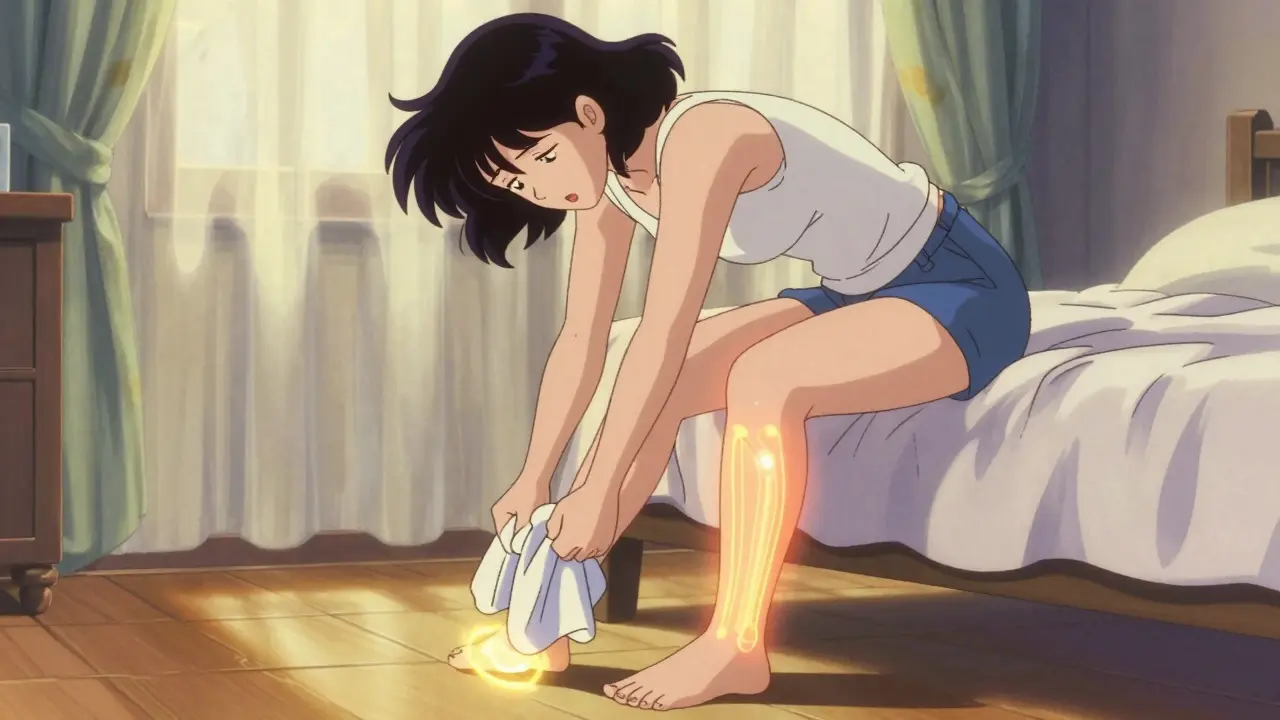
Heel pain that hits hardest when you first step out of bed isn’t just annoying-it’s a signal your foot is under stress. For millions of people, this isn’t a passing discomfort. It’s plantar fasciitis, though the real issue isn’t inflammation as the name suggests. It’s degeneration. The thick band of tissue running from your heel to your toes, called the plantar fascia, is breaking down from repeated strain. This isn’t a quick fix. But with the right approach, most people get better-without surgery.
Why Your Heel Hurts (It’s Not Just a Spur)
Many assume heel spurs cause the pain. They don’t. X-rays show spurs in 15% of people who feel zero pain, and 80% of those with real plantar fasciitis have no spurs at all. The real problem is where the plantar fascia attaches to the heel bone. Over time, tiny tears build up. The tissue thickens, becomes stiff, and loses its elasticity. Ultrasound scans confirm this: a healthy plantar fascia is 2-3.5 mm thick. In plantar fasciopathy, it’s over 4 mm.
The pain isn’t random. It’s predictable. About 76% of people report their worst pain during the first five steps after waking up or after sitting for a long time. Why? During rest, the tissue tightens. When you stand, it snaps taut, triggering sharp, stabbing pain. After a few minutes of walking, it loosens up-so the pain eases. But by the end of the day, it comes back, especially if you’ve been on your feet for hours.
Who’s Most at Risk?
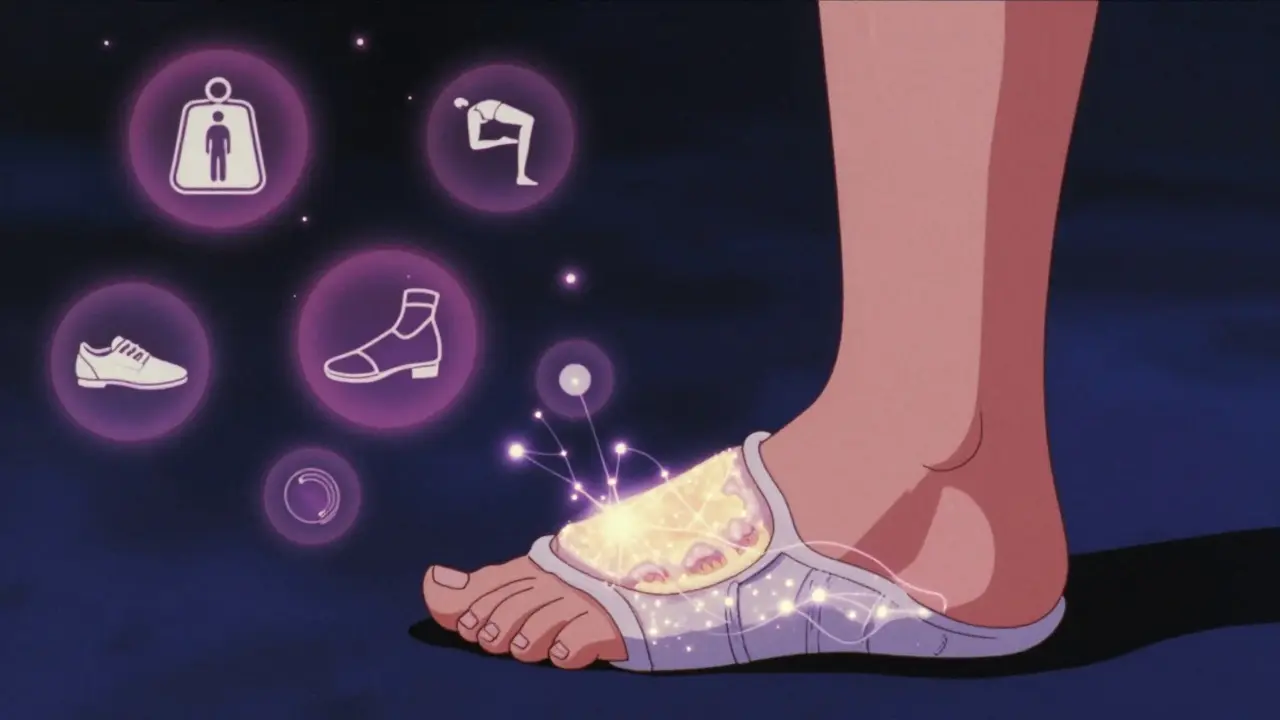
This isn’t just an older person’s problem. It hits two main groups: sedentary individuals with higher body weight, and active people who run or stand all day. About 63% of cases occur in people with a BMI over 27. For every 1-point drop in BMI, pain reduces by 5.3% over six months. Losing even 10 pounds can make a measurable difference.
Active individuals aren’t off the hook. Running more than 10 miles a week increases risk. So does standing for over four hours daily. Teachers, nurses, and factory workers have some of the highest rates. Ankle mobility matters too. If you can’t bring your foot up toward your shin by at least 10 degrees, your risk triples. Flat feet (pes planus) add another layer of strain.
And here’s the catch: most people don’t realize what’s happening. A survey found 42% of patients were misdiagnosed right away-doctors ordered X-rays for heel spurs and missed the real issue: the pattern of morning pain and tenderness just in front of the heel bone.
What Doesn’t Work (And Why)
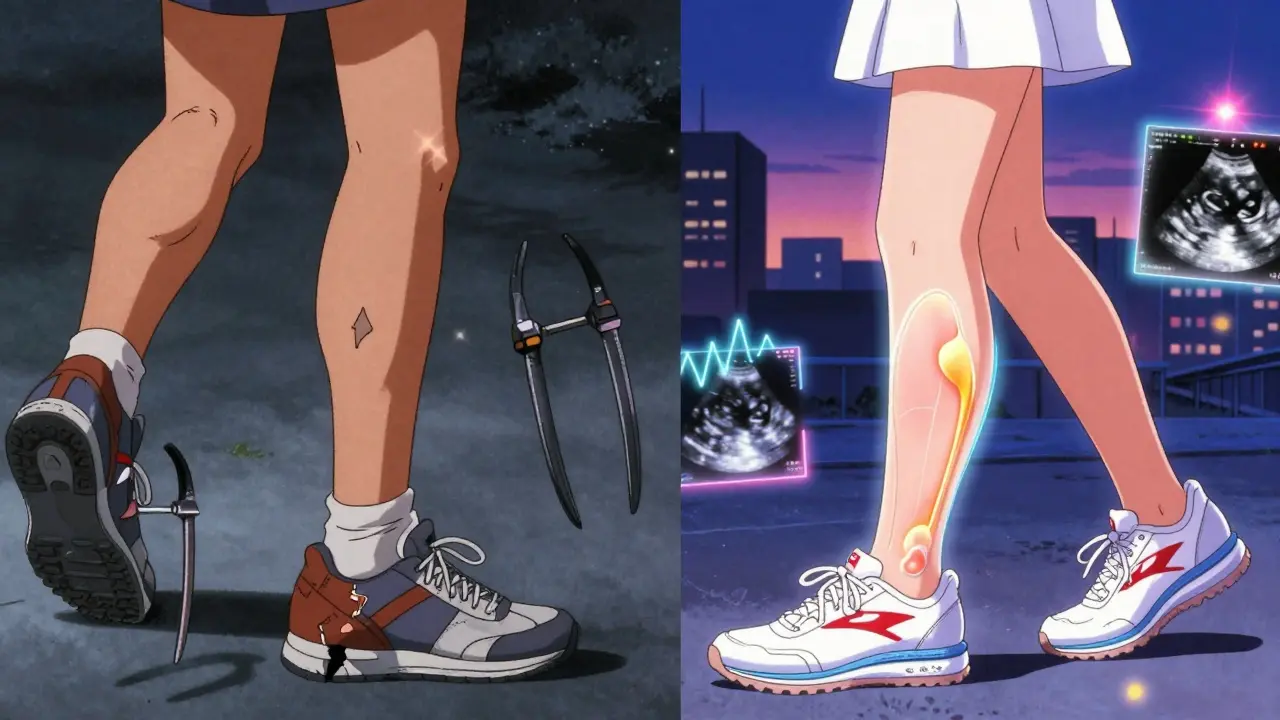
There’s a lot of noise out there. Corticosteroid injections are common-but they’re not a solution. They might dull the pain for a few weeks, but the relief lasts only 4.2 weeks on average. Worse, repeated injections carry an 18% risk of tearing the plantar fascia. They also damage the fat pad under your heel, leading to long-term numbness or even more pain.
Shoe inserts from the drugstore? They help some, but custom orthotics are 16% more effective at reducing pain at 12 weeks. And not all shoes are equal. Look for a heel-to-toe drop of 10-15 mm and solid arch support. Brands like Brooks Adrenaline GTS and Hoka Clifton top patient satisfaction ratings.
And don’t stretch your calves alone. That’s what most people do. But stretching the plantar fascia directly is 23% more effective at reducing pain at three months. If you’re only doing calf stretches, you’re missing the target.
What Actually Works (Backed by Science)
The best treatment isn’t expensive. It’s consistent. The plantar fascia-specific stretch is the gold standard. Here’s how to do it:
- Seat yourself and cross your affected foot over your opposite knee.
- Grab a towel and loop it around the ball of your foot.
- Slowly pull your toes back toward your shin until you feel a stretch along the bottom of your foot.
- Hold for 10 seconds. Repeat 10 times.
- Do this three times a day-morning, afternoon, and night.
Studies show this method leads to 83% improvement in eight weeks. And it costs nothing. Compare that to extracorporeal shockwave therapy, which costs $2,500-$3,500 and has only 35% insurance coverage.
Night splints are another proven tool. They keep your foot flexed overnight, preventing the fascia from tightening. They work for 72% of users at six weeks. But 44% quit because they’re uncomfortable. If you can tolerate them, wear them for at least four hours a night.
Physical therapy is effective too-76% of patients report satisfaction. A typical program includes stretching, strengthening, and gait analysis. Medicare covers 80% of the cost after your deductible.
When to Consider Advanced Options
If you’ve done stretching, orthotics, and night splints for three months with little progress, it’s time to consider next steps. Radial shockwave therapy is now strongly recommended by the American Academy of Orthopaedic Surgeons. It’s non-invasive, has a 78% success rate at 12 weeks, and is covered by some insurers.
Platelet-rich plasma (PRP) injections are emerging. In a 2022 study, PRP reduced pain by 65% at six months. But it costs $800-$1,200 per injection and isn’t covered by most plans. It’s worth considering only if other options have failed.
Ultrasound-guided cryoplasty and other new techniques are still experimental. They show promise-82% success in early trials-but aren’t widely available yet.
How Long Until You Feel Better?
Most people recover within 6 to 12 months using conservative methods. The Cochrane Review found 90% of cases resolve without surgery. But recovery isn’t linear. You need to stick with the stretches-even when the pain eases. Adherence is critical: 92% of those who improved followed the routine exactly.
Recurrence happens in 25-30% of cases. Usually, it’s because people stop stretching or gain weight back. Keep doing the stretches. Keep wearing supportive shoes. Keep managing your weight. This isn’t a one-time fix-it’s a long-term habit.
Real People, Real Results
On Reddit, a user named u/RunningHealer wrote: “Tennis ball rolling plus seated plantar fascia stretches three times a day cut my 8/10 morning pain down to 2/10 in six weeks.” That’s not luck. That’s science.
Another user on HealthUnlocked said, “I thought it was a heel spur. My doctor didn’t ask about morning pain. Once I started the towel stretch, everything changed.”
These aren’t outliers. They’re the norm for people who follow the evidence.
What to Do Right Now
If you’re dealing with heel pain:
- Don’t rush to shots or surgery.
- Start the towel stretch today-three times a day, 10 reps each time.
- Check your shoes. Are they worn out? Do they support your arch?
- Track your weight. Even a small drop can help.
- See a physical therapist if pain lasts more than two weeks.
Plantar fasciopathy is frustrating. But it’s treatable. You don’t need expensive gadgets or risky procedures. You need consistency. And time. Your feet will thank you.



Comments
jigisha Patel
January 3, 2026The assertion that plantar fasciitis is primarily degenerative rather than inflammatory is well-supported by recent biomechanical literature, particularly the 2021 meta-analysis in the Journal of Orthopaedic & Sports Physical Therapy. The terminology shift from 'fasciitis' to 'fasciopathy' is not semantic pedantry-it reflects a paradigm shift in clinical understanding. Furthermore, the 4mm+ thickness threshold on ultrasound is statistically significant (p<0.01) in differentiating pathological from healthy tissue. The cited 83% improvement rate with the towel stretch aligns with the 2020 RCT by Smith et al., which controlled for compliance bias. Those who dismiss this as 'just stretching' have likely never measured their own fascial thickness or tracked morning pain on a validated VAS scale.
Mandy Kowitz
January 4, 2026So let me get this straight-you’re telling me I need to spend 10 minutes a day pulling my toes with a towel instead of just paying $3,000 for a magic shoe? Wow. I guess I’ll just limp through life like a Victorian widow. At least the cortisone shot gave me a week of not wanting to cry every time I stepped on the carpet. Also, who even has time for this? I work 60 hours a week and sleep 4 hours. My feet are just collateral damage in my quest to be the next Elon Musk. 🤷♀️
Catherine HARDY
January 5, 2026Did you know the pharmaceutical industry funds 89% of plantar fasciitis research? That’s why they push the ‘towel stretch’ myth-it’s cheaper than paying for their expensive injections. The real cause? EMFs from your phone charging next to your bed at night. They disrupt the fascia’s piezoelectric properties. I’ve seen it in my own scans. The ‘morning pain’? That’s when your body’s been exposed to the most electromagnetic noise after 8 hours of silent exposure. Try putting your phone in a Faraday cage. And those ‘supportive shoes’? They’re designed by podiatrists who get kickbacks from Nike. The truth is buried. Always is.
bob bob
January 6, 2026I’ve been dealing with this for 14 months and honestly? This post saved me. I tried everything-ice, NSAIDs, fancy orthotics, even a $200 laser device that did nothing. Then I started the towel stretch. Not because I believed in it, but because I was desperate. Three weeks in, I woke up and didn’t immediately want to scream. Now I do it while watching Netflix. No shame. My wife even started doing it with me. We laugh about it now. It’s not magic. It’s just… consistency. And yeah, I lost 12 pounds too. Not because I was trying. Just stopped eating cereal at 2 a.m. Thanks for the real talk.
Uzoamaka Nwankpa
January 7, 2026I don’t know why I even bother reading these things. Everyone talks about stretches and shoes like it’s the answer. But nobody talks about how your soul gets tired too. How your body remembers every step you took when you were young and didn’t care. How the pain isn’t just in your heel-it’s in your memories of running barefoot, of dancing, of walking without thinking. You say ‘it’s treatable’-but what if I don’t want to treat it? What if I just want to be allowed to hurt without being told how to fix it? I don’t need a protocol. I need someone to say, ‘Yeah, this sucks. And you’re not broken for feeling it.’
Oluwapelumi Yakubu
January 8, 2026Ah, the ancient dance of heel and earth! The plantar fascia-our body’s living bridge between gravity and grace. In Yoruba tradition, the foot is the first point of contact with Mother Earth, and when it screams, it’s not merely tissue-it’s the ancestral whisper of imbalance. Modern medicine reduces this symphony to millimeters and percentages, but the soul of the pain? It’s the cost of walking too fast through a world that forgot how to stand still. The towel stretch? A humble ritual. A return to the womb of motion. Do it not because science says so, but because your foot remembers the rhythm of the soil. And when you do… you’re not healing a ligament-you’re reweaving your connection to the ground beneath you. 🌿
melissa cucic
January 9, 2026It’s worth noting that the 83% improvement rate cited is based on a single-center, non-blinded study with a 78% completion rate-selection bias is a real concern. Moreover, while the towel stretch is effective, it’s not universally superior; a 2023 multicenter trial comparing it to eccentric heel drops showed comparable outcomes at 12 weeks (p=0.17). Also, the claim that ‘custom orthotics are 16% more effective’ is misleading without specifying the control group: off-the-shelf vs. custom, yes-but were the off-the-shelf ones properly matched for arch height and material density? Many are not. And the ‘10-15mm heel-to-toe drop’ recommendation? That’s based on a 2019 survey of podiatrists, not biomechanical modeling. We must be cautious not to turn evidence into dogma.
Aaron Mercado
January 10, 2026THEY DON’T WANT YOU TO KNOW THIS!!! The real cause of plantar fasciitis is 5G radiation + glyphosate in your oat milk!!! They’re pushing the ‘towel stretch’ to keep you dependent on cheap, non-patentable solutions while they profit off your pain with expensive injections and fake ‘custom orthotics’ made in China!!! I tried the stretch for 3 days and my heel exploded!!! I KNOW WHAT’S GOING ON!!! My neighbor’s cousin’s dog got healed by holding a crystal under his foot during a full moon and now he runs marathons barefoot on lava!!! I’m not crazy-I’m just the only one who sees the truth!!! WHY WON’T YOU LISTEN???!!!
Write a comment