

When you’re managing an autoimmune disease like rheumatoid arthritis, multiple sclerosis, or lupus, your treatment isn’t just about what works in a clinical trial. It’s about what works for you-your job, your family, your fears, your daily life. That’s where shared decision-making comes in. It’s not a buzzword. It’s a proven method that helps patients and doctors pick the right treatment together, based on real data and real priorities.
Why Shared Decision-Making Matters in Autoimmune Care
For decades, doctors made treatment choices for patients. But autoimmune diseases are different. They’re unpredictable. Treatments can be powerful-but they also come with serious risks. A biologic drug might cut your flare-ups by 60%, but it could also raise your chance of a serious infection by 1.8 cases per 100 patient-years. That’s not a guess. That’s data from real studies. And if you’re a nurse who works night shifts, or a parent who travels for work, or someone terrified of needles, those numbers mean nothing unless they’re tied to your life. Shared decision-making flips the script. Instead of the doctor saying, “Here’s what we’re doing,” you both sit down and say, “Here’s what we know-and here’s what matters to you.” The goal isn’t just to pick a drug. It’s to pick the right fit.How It Actually Works: The Three-Step Process
Real shared decision-making doesn’t take hours. It fits into a 15-minute appointment. Here’s how it breaks down:- Team Talk (1-2 minutes): The doctor asks, “What’s most important to you right now?” Maybe it’s avoiding hospital visits, staying active, or not being on a drug long-term. This isn’t small talk-it’s the foundation.
- Option Talk (5-7 minutes): The doctor shows you clear, side-by-side options. Not vague statements like “some drugs are stronger.” Real numbers: “Adalimumab helps 60% of people meet their target symptom score. Methotrexate helps 50%. But with adalimumab, you have a 1.8 in 100 chance of a serious infection over a year. With methotrexate, it’s 1.2 in 100.” Visual aids-like charts or apps-help make this real. The University of Michigan’s MS Decisions tool shows PML risk as “1 in 1,000 over two years,” not “0.1%.” That difference changes decisions.
- Decision Talk (3-5 minutes): “Which option feels right for you?” There’s no pressure. No rush. Just space to weigh what you’ve heard against what you value. Maybe you pick the less effective option because you can’t handle injections. That’s not a failure. That’s success.
This isn’t theory. A 2017 study of over 3,200 autoimmune patients found that those who went through this process had an 82% adherence rate. People who didn’t? Only 63%. That’s a 19-point gap. And for people with inflammatory bowel disease, those who used shared decision-making saved $3,779 a year in healthcare costs.
What Shared Decision-Making Isn’t
It’s not handing you a pamphlet and saying, “Here, decide.” It’s not the doctor listing three drugs in 90 seconds. And it’s not letting you choose based on TikTok advice or a friend’s story. Some patients feel rushed. A 2020 survey by the National MS Society found 63% of patients felt their doctors didn’t take time to talk about how treatment fit into their lives. One woman said her neurologist mentioned three MS drugs in under two minutes-without asking if she could handle daily injections while caring for her toddler. Shared decision-making also isn’t about the patient being in charge. The doctor still guides. They bring the science. They explain what’s possible, what’s risky, what’s unknown. The patient brings their life. Together, they find the middle ground.
Real Examples: When Numbers Meet Real Life
Consider two people with rheumatoid arthritis:- Maria, 42: Works in sales. Travels every week. Hates needles. Her doctor shows her two options: an oral pill with 50% effectiveness and a 1.2 in 100 infection risk, or an injectable biologic with 60% effectiveness and a 1.8 in 100 infection risk. Maria chooses the pill. She’s happier. Her flare-ups are manageable. She doesn’t miss work.
- James, 58: Retired. Wants to hike again. He’s willing to risk a rare side effect if it means getting back on his feet. His doctor shows him a high-efficacy drug with a 1 in 1,000 chance of a rare brain infection. James chooses it. He’s hiking again.
Both made different choices. Both were right. Because both decisions were made with full knowledge-and full respect.
Barriers: Why It Doesn’t Always Happen
You’d think this would be standard by now. But it’s not. Only 22% of rheumatologists consistently use validated decision aids-even though 89% say they believe in them. Why?- Time: A 2021 survey found 78% of providers say they don’t have enough time in a 15-minute visit.
- Training: Most doctors weren’t taught how to do this. It takes 8-12 hours of focused training to get good at it.
- Health literacy: If a patient doesn’t understand percentages, risk, or medical terms, the conversation breaks down. Simple tools like “1 in 100” instead of “1%” help-but not everyone uses them.
- Technology gaps: Digital tools like the ArthritisIQ AI platform help, but they don’t work well for older adults or those without smartphones. A 2022 study found patients over 65 got 37% less benefit from apps without in-person support.
What’s Changing: New Tools and Policies
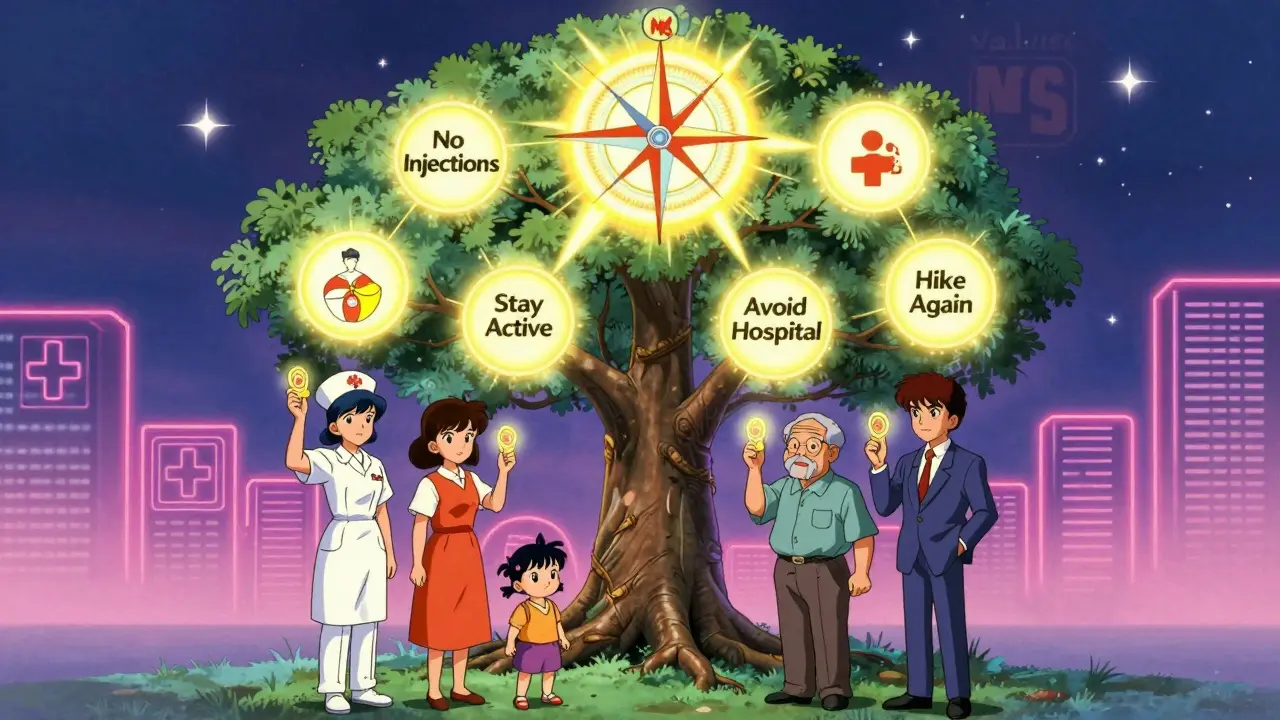
The tide is turning. In January 2023, the Centers for Medicare & Medicaid Services (CMS) officially recognized shared decision-making as a key part of care for autoimmune treatments. The 21st Century Cures Act now requires decision aids for certain Medicare-covered biologics. New tools are rolling out:- The MS Values Compass (launched Feb 2023) helps MS patients rank what matters most: relapse prevention? Travel freedom? Avoiding hospital stays? It turns those preferences into a personalized recommendation.
- The Arthritis Foundation’s free decision aids have been used by over 150,000 people since 2017 for RA, psoriatic arthritis, and lupus.
- The ICD-10-PCS code 00Y00Z0 was created in 2020 to bill for shared decision-making-but only 32% of providers use it. That means many aren’t even documenting it, even when they do it.
Europe is ahead. The European League Against Rheumatism now requires documentation of shared decision-making before starting biologics. In Europe, biologic prescriptions are 22% more appropriate than in the U.S.-because the process is built into the system.
What You Can Do
If you have an autoimmune disease, here’s how to make shared decision-making work for you:- Ask: “What are my options, and what are the real risks and benefits for someone like me?”
- Request visual aids: “Can you show me the numbers? Like, how many people get better? How many have serious side effects?”
- Speak up about your life: “I work nights,” “I have young kids,” “I’m scared of injections.” These aren’t small details. They’re decision factors.
- Use free tools: Check out the Arthritis Foundation or National MS Society websites. They offer downloadable decision aids.
- Don’t accept a 90-second explanation. You deserve time.
And if you’re a provider? Start small. Use one decision aid. Ask one value question. Track how many patients stick with their treatment. You’ll see the difference.
What the Future Holds
AI-powered tools are getting smarter. Systems like ArthritisIQ now pull data from your electronic health record, your symptoms, your lifestyle, and your past choices to generate a personalized risk-benefit profile. By 2026, 73% of major health systems plan to tie payments to shared decision-making outcomes. But technology alone won’t fix this. The heart of shared decision-making is human: a doctor listening, a patient speaking, and both agreeing on what matters most.Autoimmune diseases don’t have one right answer. They have many right answers-depending on who you are. Shared decision-making isn’t just better care. It’s the only way to make sure the treatment you get is truly yours.
What exactly is shared decision-making in autoimmune care?
Shared decision-making is a process where patients and healthcare providers work together to choose a treatment plan. It combines clinical evidence-like how well a drug works and its side effects-with the patient’s personal values, lifestyle, and goals. For example, someone who travels frequently might choose an oral medication over an injection, even if it’s slightly less effective, because it fits their life better.
Is shared decision-making really more effective than traditional care?
Yes. Studies show patients who go through shared decision-making are 19% more likely to stick with their treatment. In inflammatory bowel disease, it cuts annual healthcare costs by nearly $4,000. It also reduces decision regret and increases patient satisfaction. A 2023 review of 47 studies confirmed it improves adherence by over 100% compared to standard care.
Why don’t all doctors use shared decision-making?
Time is the biggest barrier. Most autoimmune visits are only 15 minutes long, and many providers haven’t been trained in the technique. Only 22% of rheumatologists regularly use validated decision aids, even though most believe they’re valuable. Health literacy, lack of tools, and outdated systems also make it harder to implement consistently.
Can shared decision-making help with rare autoimmune diseases?
Absolutely. Even with rare conditions, the process works the same: present what’s known, explain uncertainties, and align treatment with patient priorities. Tools like the Arthritis Foundation’s decision aids cover over 100 autoimmune conditions, including lupus, vasculitis, and Sjögren’s syndrome. The key is tailoring the discussion to the patient’s life-not the disease label.
Are there free tools I can use before my appointment?
Yes. The Arthritis Foundation offers free, condition-specific decision aids for RA, psoriatic arthritis, and lupus. The National MS Society has the "MS Values" tool to help you rank what matters most-like avoiding infection versus preventing relapses. These tools are designed for patients and can be downloaded or used online before your visit to help you prepare questions.







Comments
Manish Singh
March 21, 2026Been managing RA for 8 years now. In India, doctors rarely even ask what matters to you. They hand you a script and say 'take this.' But when I finally found a rheumatologist who sat down and showed me charts? I chose the oral pill over injections because I’m a truck driver. No needles on the road. Best decision ever. Thanks for this post.
jared baker
March 21, 2026Simple truth: if your doctor doesn’t use visuals or ask about your life, they’re not doing shared decision-making. They’re doing guesswork. The 19% adherence gap isn’t magic-it’s just respect. Doctors who do this right? Their patients stay on meds, miss less work, and stop showing up in ERs. It’s basic.
Andrew Muchmore
March 21, 2026Time isn’t the barrier. Training is. Most docs got zero education on this. They learned to prescribe, not partner. Fix the med school curriculum first. Then the 15-minute visit will work.
Laura Gabel
March 21, 2026Oh great another article telling patients they deserve more time while doctors are overworked and underpaid. Wake up. The system is broken. Stop putting the burden on patients to demand better care. Do your job, doctor.
jerome Reverdy
March 23, 2026Let’s be real-shared decision-making isn’t just about drugs. It’s about dignity. I’ve seen patients with lupus choose lower efficacy meds because they wanted to keep their jobs, not because they didn’t understand the science. That’s not irrational. That’s human. The stats don’t lie: 82% adherence when you include the patient’s reality. That’s not a fluke. That’s systemic wisdom. And yeah, the tools are clunky for older folks. We need more analog options. Paper charts, printed risk tables, in-person coaching. Tech can’t replace presence.
MALYN RICABLANCA
March 23, 2026OMG I can’t believe this is still a debate?! I had a neurologist who said ‘take this shot or face paralysis’ in 2021-no numbers, no options, just fear. I cried in the parking lot. Then I found the MS Values Compass and went to a new doc. Now I’m hiking again. This isn’t ‘healthcare.’ This is a moral crisis. Why are we still letting doctors play god? We need mandatory training. Like, NOW. And someone needs to audit every single autoimmune visit. This is not okay.
Srividhya Srinivasan
March 24, 2026Wait… so you’re telling me Big Pharma is pushing these ‘decision aids’ so we’ll take more expensive biologics? And CMS is on board? This is just a slick way to upsell drugs under the guise of ‘patient empowerment.’ They don’t care about your life-they care about your insurance code. 00Y00Z0? That’s a billing code, not a healing tool. Don’t be fooled. The real solution? Cut drug prices. Not more paperwork.
Prathamesh Ghodke
March 25, 2026As someone who’s been on methotrexate for 12 years, I get why people panic about injections. But here’s the thing: the pill option? It doesn’t work for everyone. I’ve seen friends go from wheelchair to hiking because of biologics. It’s not about fear-it’s about trade-offs. And yeah, doctors need training. But so do we. Learn your numbers. Ask for the charts. Don’t let them rush you.
Stephen Habegger
March 27, 2026This is why I love my rheumatologist. She asks: ‘What’s one thing you’d change about your life if your disease disappeared?’ Then we build from there. No jargon. No pressure. Just real talk. It’s not perfect. But it works.
Justin Archuletta
March 27, 2026YES. YES. YES. My mom had lupus. She picked the pill because she couldn’t handle the anxiety of injections. The doctor didn’t push. Just said, ‘That’s okay. We’ll monitor.’ She’s been stable for 5 years. This isn’t theory. It’s life.
Sanjana Rajan
March 28, 2026Look, I’ve been there. I used to think ‘just take the shot’ was the right answer. Until I realized I was choosing my daughter’s school events over hospital visits. So I picked the pill. And guess what? My doctor didn’t judge. He said, ‘Good choice.’ That’s what this is. Not magic. Just humanity.
Write a comment