
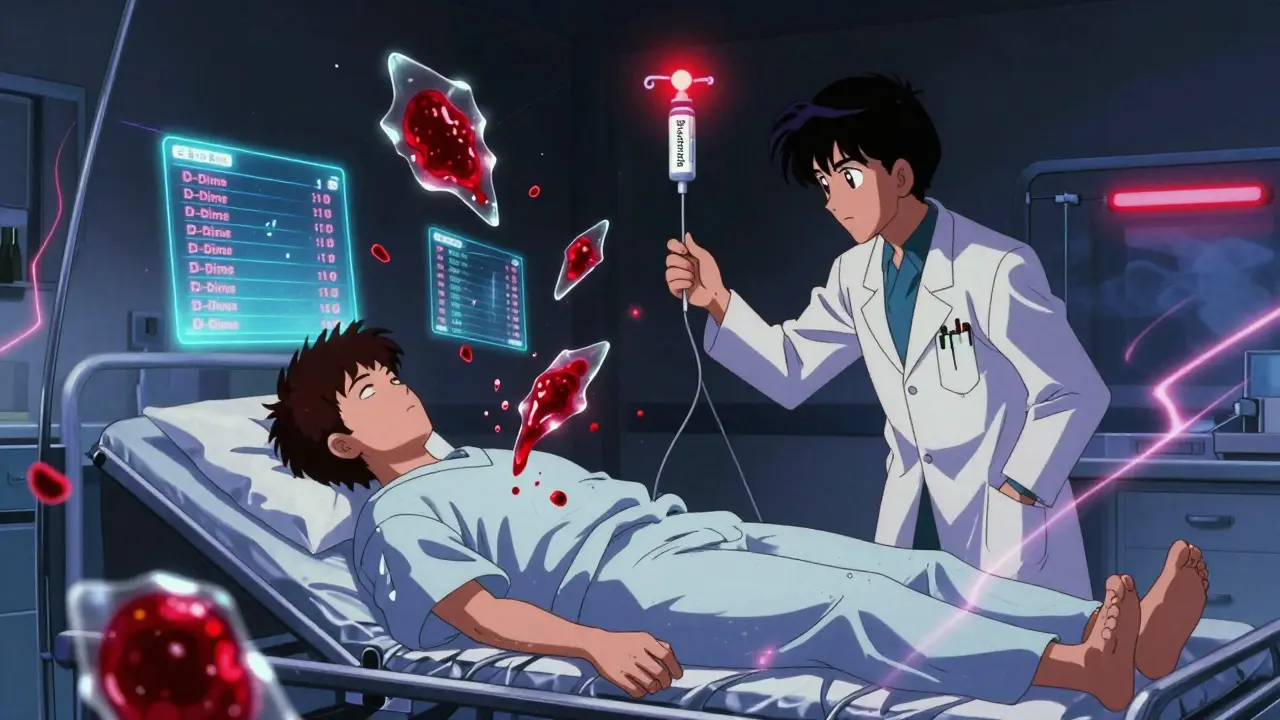
DIC Diagnostic Calculator
DIC Scoring System Calculator
Calculate the ISTH score for disseminated intravascular coagulation based on laboratory values. A score of 5 or higher indicates overt DIC.
What Is Drug-Induced Disseminated Intravascular Coagulation?
Disseminated Intravascular Coagulation, or DIC, isn’t a disease you catch-it’s a dangerous chain reaction inside your blood. When certain drugs trigger it, your body starts clotting everywhere at once. Tiny clots clog small blood vessels, starving organs of oxygen. Then, your clotting resources get used up. Suddenly, you can’t stop bleeding. It’s like your blood switches from being a firefighter to a arsonist-first burning everything, then running out of water.
Drug-induced DIC is rare but deadly. About 1.2% of all serious adverse drug reactions reported worldwide involve DIC. It shows up most often with cancer drugs, blood thinners, and antibiotics. You won’t find warnings about it on most drug labels, even though doctors see it often enough to know it’s real. In one global database, over 4,600 cases were linked to medications between 1968 and 2015. That’s not a fluke. It’s a pattern.
Which Drugs Are Most Likely to Cause DIC?
Not all drugs carry the same risk. Some are far more dangerous than others. The top offenders include:
- Oxaliplatin - a chemotherapy drug used for colorectal cancer. It’s linked to 75 reported cases of DIC, with a strong association score (ROR 1.77).
- Bevacizumab - a monoclonal antibody for cancers like colon and lung. It has the highest risk signal among common drugs (ROR 2.02).
- Gemtuzumab ozogamicin - a targeted therapy with a shockingly high ROR of 28.7. This drug can cause DIC so fast, it’s often fatal within days.
- Dabigatran - a blood thinner marketed as safer than warfarin. But in rare cases, it triggers DIC, requiring emergency reversal with idarucizumab.
- Vancomycin - an antibiotic sometimes used for MRSA. It’s not the first drug you’d suspect, but it’s been tied to DIC in multiple case reports.
These aren’t old drugs. Most are modern treatments, used daily in hospitals. The problem? Many prescribing doctors don’t know DIC is even possible. A 2020 study found that nearly half of the drugs linked to DIC don’t list it as a risk in their official prescribing information. That’s a dangerous gap.
How Do You Know If It’s DIC?
DIC doesn’t have one obvious symptom. It looks like a mix of things: bruising, bleeding from IV sites, low blood pressure, confusion, or sudden organ failure. But behind the scenes, your blood is falling apart. The key is catching it early-before it’s too late.
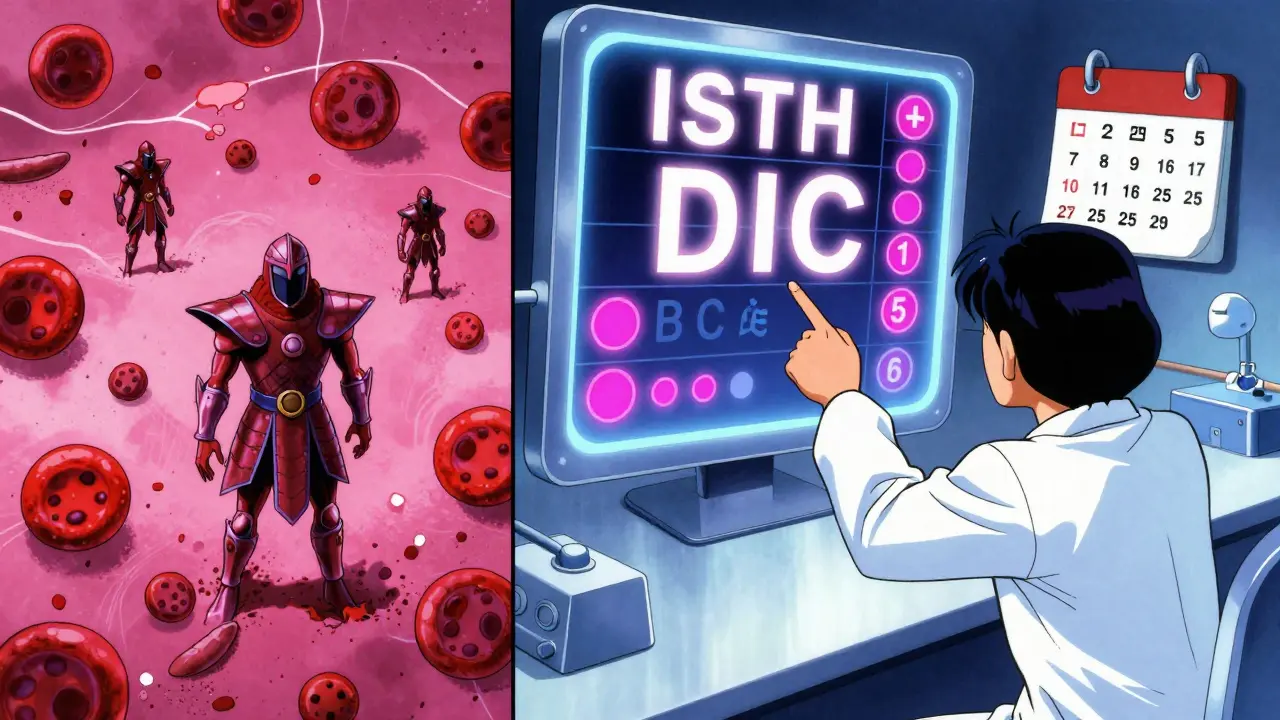
The International Society on Thrombosis and Haemostasis (ISTH) created a simple scoring system doctors use. You get points for:
- Platelet count: Below 50,000? That’s 2 points.
- Prothrombin time (PT): Longer than 6 seconds above normal? Another 2 points.
- D-dimer: More than 10 times the upper limit? That’s 3 points.
- Fibrinogen: Below 1.0 g/L? Add 1 point.
If your score is 5 or higher, you have overt DIC. That’s not a guess. That’s a diagnosis.
Lab results tell the story:
- Platelets: Often under 100,000/μL-sometimes under 20,000.
- Fibrinogen: Drops below 1.5 g/L. Below 80 mg/dL? You can’t even give blood thinners anymore.
- D-dimer: Skyrockets. Sometimes over 10,000 ng/mL.
- PT and aPTT: Both prolonged. Your blood takes forever to clot.
One ICU doctor in San Francisco told me he saw a patient with a D-dimer of 28,000. That’s not just abnormal-it’s catastrophic. The patient had just started bevacizumab. By the time they checked the labs, she was bleeding from her gums, her nose, and her catheter sites. She didn’t survive.
Why Is Immediate Drug Stopping So Critical?
Unlike DIC caused by sepsis or trauma, drug-induced DIC can be stopped dead in its tracks-if you act fast. The first step isn’t a transfusion. It’s not a drug. It’s not even a test. It’s stopping the medication.
Continuing the drug while treating the DIC is like putting out a fire while pouring gasoline on it. A case report in the Journal of Thrombosis and Haemostasis described a patient who got oxaliplatin, developed DIC, and was given platelets and plasma. But the chemo kept going. He died 10 days later. When the team realized the drug was the cause, they stopped it. The next patient with the same reaction? They pulled the drug immediately. He survived.
For cancer patients, this is hard. No one wants to stop treatment. But if you keep giving gemtuzumab ozogamicin after DIC starts, death is almost guaranteed. One hematologist reported 12 cases of drug-induced DIC in his career. Eight of them were from cancer drugs. Five of those patients died because the drug wasn’t stopped in time.
How Is It Treated?
Treatment isn’t about fixing the clotting. It’s about supporting the body while the trigger is removed. There’s no magic pill. Here’s what actually works:
- Stop the drug - non-negotiable. This is step one, every time.
- Replace what’s been used up - if you’re bleeding, give platelets. If fibrinogen is below 1.5 g/L, give cryoprecipitate or fibrinogen concentrate. The goal isn’t to normalize labs-it’s to keep you from bleeding out.
- Don’t give heparin unless you’re sure - Heparin can help in some cases, but not if the DIC is caused by heparin itself (HIT). And if you’re not sure? Don’t risk it. One wrong dose can make bleeding worse.
- Avoid warfarin - It makes DIC worse at first. Warfarin lowers protein C and S, which are natural anticoagulants. That can cause skin necrosis or even more clots.
- Transfuse platelets wisely - If you’re actively bleeding or having surgery, keep platelets above 50,000/μL. If you’re stable and not bleeding, 20,000/μL is enough. Over-transfusing can cause more clots.
Some doctors try anticoagulants like antithrombin or thrombomodulin. But the data is messy. One study showed they only helped patients who weren’t already on heparin. That means if you’re already giving heparin, those drugs won’t help-and might even hurt.
What Happens If You Miss It?
Mortality is high. Studies show 40% to 60% of patients with severe DIC die, even with the best care. That’s not because treatment is weak. It’s because DIC is fast. It can go from normal to multiorgan failure in hours.
Patients who survive often have long recoveries. One man who got DIC from oxaliplatin spent 14 days in the ICU. He needed 6 units of platelets and 4 units of plasma every day. He lost 20 pounds. His kidneys were damaged. He still has nerve pain two years later.
The biggest killer isn’t the clotting. It’s the delay. If you don’t suspect DIC, you won’t order the right tests. If you don’t order the tests, you won’t see the pattern. And if you don’t see the pattern, you won’t stop the drug. That’s how people die.
How Can Doctors Prevent It?
Prevention starts with awareness. New guidelines from the International Council for Standardization in Haematology (ICSH) now recommend:
- Weekly blood tests for patients on high-risk drugs like bevacizumab or gemtuzumab.
- Immediate DIC screening if a patient on these drugs develops unexplained bleeding or low platelets.
- Updating drug labels when safety signals appear. The FDA and EMA are starting to act-seven cancer drugs got new warnings in early 2023.
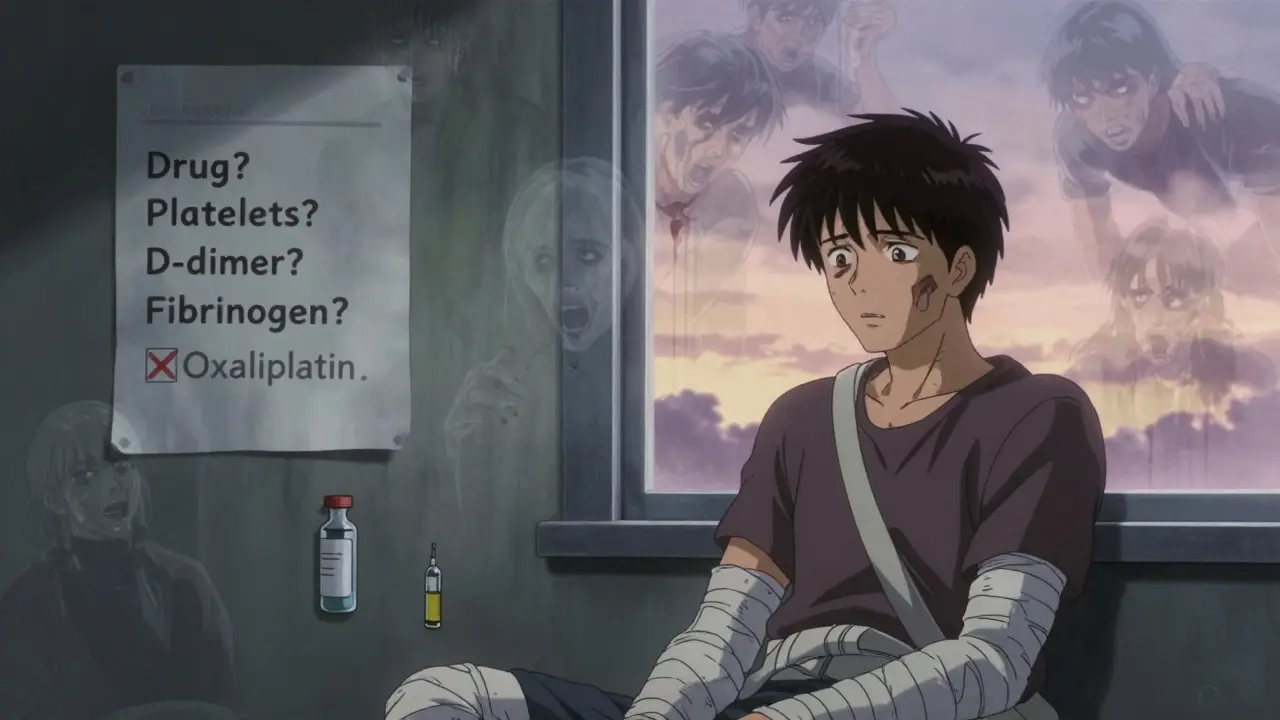
But the real change needs to happen in training. Hematologists spend years learning DIC. Generalists? They get a one-page handout. That’s not enough. Every ICU and oncology unit needs a DIC checklist: Is the patient on a high-risk drug? Are platelets dropping? Is D-dimer up? Is fibrinogen down? If yes to three of those, treat it like DIC until proven otherwise.
What Should Patients Know?
If you’re on chemotherapy, a monoclonal antibody, or a blood thinner like dabigatran, know this: unexplained bruising, nosebleeds, blood in urine, or bleeding from IV sites isn’t normal. It’s not just "side effects." It could be DIC.
Don’t wait for your doctor to notice. Ask: "Could this be DIC?" Show them your lab results. Bring up the drug you’re taking. Your life might depend on it.
Can DIC from drugs be reversed?
Yes-if caught early. Stopping the drug is the most important step. Once the trigger is removed, the body can often recover its clotting balance. Supportive care like platelet and fibrinogen transfusions helps the body heal. But if DIC has caused organ damage or multiorgan failure, recovery may be incomplete or impossible.
Is DIC always fatal?
No, but it’s very dangerous. Mortality ranges from 40% to 60% in severe cases. Survival depends on how quickly the cause is found and stopped, and how fast supportive care begins. Patients who receive timely transfusions and have no organ failure have much better outcomes.
Can I get DIC from over-the-counter drugs?
It’s extremely rare. Almost all documented cases involve prescription drugs-especially cancer treatments, anticoagulants, and antibiotics. Over-the-counter painkillers like aspirin or ibuprofen don’t cause DIC. But if you’re on multiple medications, always tell your doctor everything you’re taking.
Why isn’t DIC listed on drug labels?
Because reporting systems lag behind real-world use. Many drugs linked to DIC were approved before enough cases were documented. Regulatory agencies now require updates when signals emerge, but the process takes years. That’s why doctors need to stay alert-even if the label doesn’t warn you.
How long does it take for DIC to develop after taking a drug?
It varies. With some drugs like oxaliplatin, DIC can start within hours to days after infusion. With others, like dabigatran, it might take several doses. There’s no fixed timeline. Any sudden bleeding or drop in platelets after starting a new drug should raise suspicion.
What Comes Next?
The future of DIC management is in prediction and prevention. Researchers are studying genetic markers that might show who’s at higher risk before they even take the drug. A current clinical trial is looking at mutations in clotting proteins to see if they predict drug-induced DIC. If it works, we could one day screen patients before giving them high-risk drugs.
For now, the best tool is vigilance. Know the drugs. Know the signs. Act fast. DIC doesn’t wait. Neither should you.





Comments
Bryan Wolfe
January 12, 2026This is exactly why I always ask my oncologist for the lab trends before each infusion now. I used to just trust the process, but after reading this, I’m checking my platelets like a hawk. You’re right-no one talks about this enough. Thanks for laying it out like this. 🙏
Sumit Sharma
January 12, 2026The ROR values for gemtuzumab ozogamicin are not merely concerning-they are catastrophic. The fact that this drug carries a risk signal of 28.7 and still lacks mandatory labeling in many jurisdictions is a systemic failure of pharmacovigilance. Regulatory agencies are operating on 1990s paradigms while clinicians are managing 2020s pharmacodynamics. This is malpractice by algorithm.
Jay Powers
January 12, 2026I’ve seen DIC from oxaliplatin in my unit and honestly it’s terrifying how fast it can hit. The key is not just stopping the drug but also knowing when to give cryo vs platelets. Too many docs just throw PRBCs at everything. This post nails it-no magic bullet, just smart support. Thanks for sharing.
Lawrence Jung
January 14, 2026DIC is nature’s way of saying your body has had enough of your pharmaceutical arrogance. We treat cancer like a puzzle to be solved with more chemicals when really we’re just rearranging deck chairs on the Titanic. The real question isn’t how to treat DIC-it’s why we keep poisoning people in the name of hope. This isn’t medicine. It’s alchemy with body bags.
Alice Elanora Shepherd
January 16, 2026I’m a hematologist in London, and I’ve had three DIC cases from bevacizumab in the last 18 months. The ISTH score is gold-but I’ve had residents miss it because they didn’t check fibrinogen. We now have a printed checklist taped to every chemo bay. If you’re on a high-risk drug and your platelets drop 20% in 48 hours? Assume DIC until proven otherwise. This needs to be standard.
Christina Widodo
January 17, 2026Wait so if I’m on dabigatran and I get a nosebleed that won’t stop, should I just stop the drug myself or wait for the doctor? I’m scared to ask because I don’t want to sound like a hypochondriac.
Prachi Chauhan
January 18, 2026I think this is like when your phone gets too many apps and crashes. Your blood is just overwhelmed. Stop the bad app (the drug), let it reboot (supportive care), and don’t reinstall the same app too soon. Simple. Why do we make it so complicated?
beth cordell
January 19, 2026This post made me cry 😭 I’m a cancer survivor and I didn’t know any of this. My mom almost died from something like this and no one told us. I’m sharing this with everyone I know. Thank you for writing this. 🤍
Lauren Warner
January 20, 2026Let’s be real-this is just another case of pharma hiding risks until lawsuits pile up. The FDA approves drugs on mouse data and then acts shocked when humans die. DIC isn’t rare. It’s just underreported because doctors don’t connect the dots. And they won’t until someone sues them.
Bryan Wolfe
January 22, 2026I get where you’re coming from, but I’ve also seen docs who were too scared to give chemo because of fear of DIC. That’s not better. The answer isn’t stopping treatment-it’s knowing when to pull the plug fast. We need better training, not less chemo. I’ve seen people live because someone caught it early. That’s hope.
Write a comment