
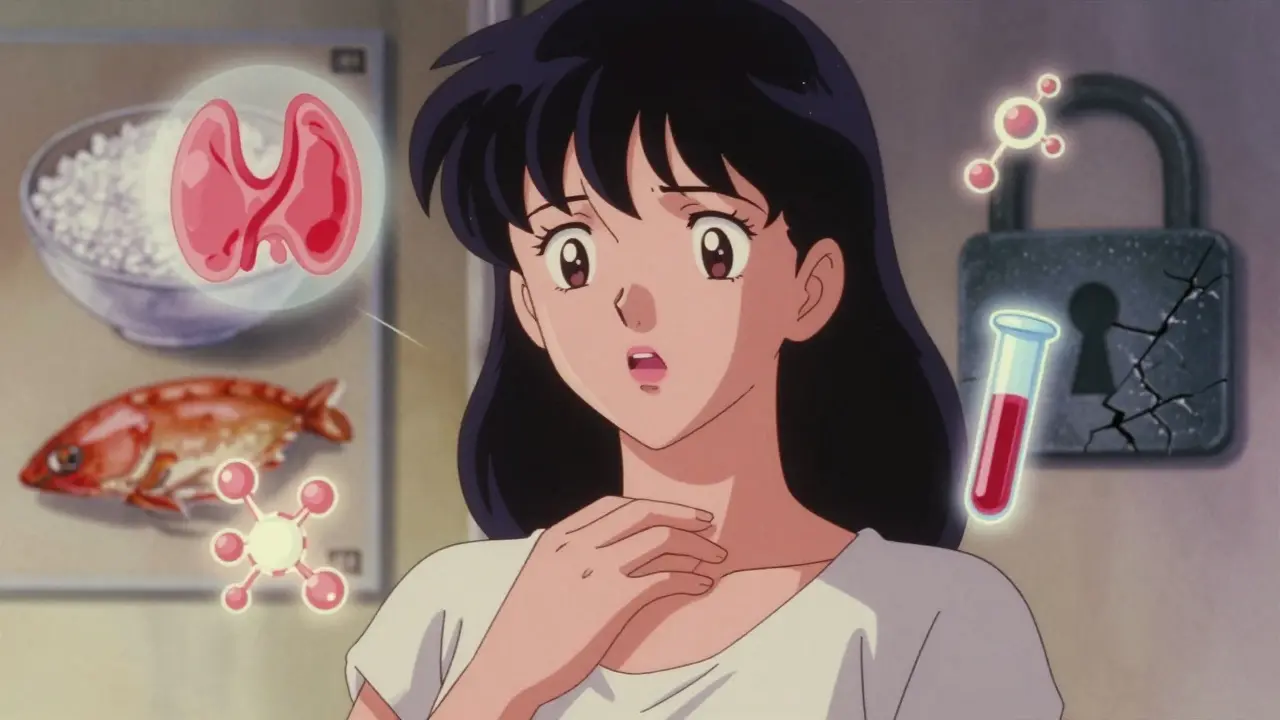
When you notice a lump in your neck that wasn’t there before, it’s natural to panic. But that swelling might not be cancer-it could be a goiter. A goiter is simply an enlarged thyroid gland, and while it can look alarming, it’s often treatable. The thyroid, a small butterfly-shaped gland at the base of your neck, controls your metabolism, energy, and even your mood. When it grows larger than normal-usually over 25 mL in volume-it’s called a goiter. In the U.S., about 5% of people have one, and women are three times more likely to develop it than men, especially after age 40.
What Causes a Goiter?
For decades, people thought goiters were just a problem in mountain villages without access to seafood. And yes, iodine deficiency used to be the #1 cause worldwide. In fact, 90% of goiters in countries without iodized salt are due to not getting enough iodine. But in the U.S., where iodized salt has been common since the 1920s, that’s not the main issue anymore.
Today, the most common cause of goiter here is Hashimoto’s thyroiditis, an autoimmune condition where your immune system attacks your thyroid. Over time, this inflammation makes the gland swell. Another major cause is Graves’ disease, which overstimulates the thyroid, leading to a toxic goiter that produces too much hormone. Less common causes include thyroid nodules, thyroid cancer, and even certain medications.
Here’s the thing: a goiter doesn’t always mean your thyroid isn’t working right. Some people have a large gland but normal hormone levels. Others have a small goiter but severe hypothyroidism. That’s why just seeing a lump isn’t enough-you need blood tests and an ultrasound to know what’s really going on.
How Much Iodine Do You Actually Need?
Let’s clear up a big myth: taking extra iodine won’t fix every goiter. In fact, it can make some worse.
The Recommended Dietary Allowance (RDA) for iodine in adults is 150 micrograms (mcg) per day. Pregnant women need 220 mcg, and breastfeeding mothers need 290 mcg. That’s about the amount in one teaspoon of iodized salt-roughly 45 mcg per gram. Most people in the U.S. get enough from salt, dairy, eggs, and seafood like cod or shrimp.
But if you’re eating a lot of processed food, which often uses non-iodized salt, or you follow a strict vegan diet without fortified foods, you might fall short. In those cases, a daily 150 mcg iodine supplement can help-especially if your goiter is due to deficiency.
Here’s what the data shows: if your goiter is from low iodine, taking 150 mcg daily for 6 to 12 months typically shrinks the gland by 30-40%. That’s a real, measurable improvement. But if your goiter is from Hashimoto’s or Graves’, extra iodine can actually trigger more inflammation. That’s why doctors never recommend iodine supplements without testing first.
When Iodine Supplementation Works-and When It Doesn’t
Think of iodine like a key. If your thyroid is enlarged because the key (iodine) is missing, adding the key helps. But if the lock (thyroid) is broken from an autoimmune attack, adding more keys won’t fix the mechanism.
Studies from the NIH and American Thyroid Association confirm that iodine supplementation is only effective for goiters caused by true deficiency. In the U.S., that’s a small group-maybe 5-10% of goiter cases. The rest are autoimmune or nodular.
Here’s what happens in different scenarios:
- Iodine-deficient goiter: 70-85% of cases shrink significantly with daily 150 mcg iodine. Complete resolution in 1-2 years is common.
- Hashimoto’s goiter: Iodine does nothing-or makes it worse. The treatment is levothyroxine, a synthetic thyroid hormone. Even then, the goiter only shrinks 10-20% because the tissue becomes scarred over time.
- Graves’ disease: Iodine is dangerous here. Treatment uses antithyroid drugs like methimazole, which reduce hormone overproduction and shrink the gland by 40-60% over a year.
There’s also a lot of buzz around selenium supplements for thyroid health. Some European studies suggest it might help with autoimmune thyroid inflammation. But a major 2021 Cochrane Review found no significant benefit for goiter size reduction. The evidence isn’t strong enough to recommend it routinely.
When Surgery or Radioactive Iodine Becomes Necessary
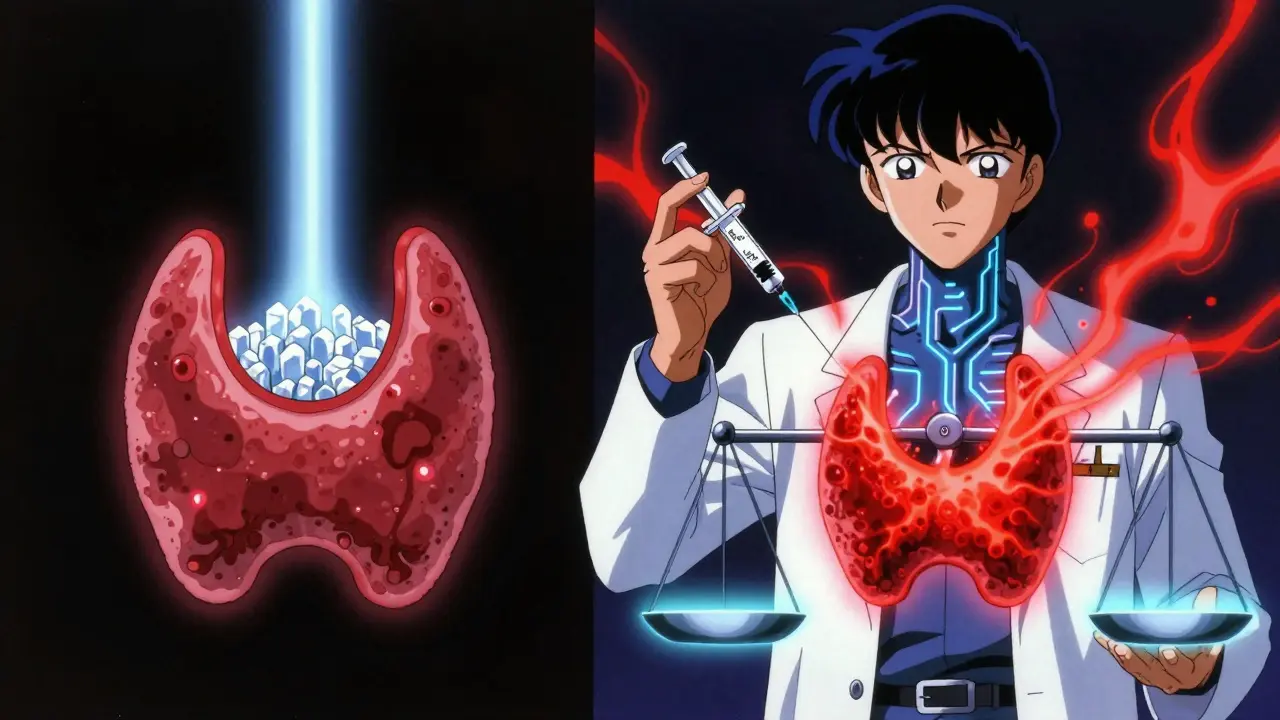
Not all goiters can be fixed with pills. If your thyroid grows too big-over 80-100 mL-or starts pressing on your windpipe or esophagus, you might need more aggressive treatment.
That’s when doctors consider either surgery or radioactive iodine.
Surgery (thyroidectomy) removes part or all of the gland. On average, surgeons remove 30-40 grams of thyroid tissue. It’s effective for large goiters and when cancer is suspected. But it comes with risks: about 15% of patients experience voice changes due to nerve damage, and 8% develop low calcium levels from accidentally removing nearby parathyroid glands. Patient satisfaction with surgical outcomes is only around 42%, mostly because of these side effects.
Radioactive iodine is often used for toxic goiters from Graves’ disease. You swallow a capsule, and the radiation destroys overactive thyroid tissue. Within 6-12 months, the gland shrinks by 50-60%. But here’s the catch: 75-80% of people end up with permanent hypothyroidism and need lifelong thyroid hormone replacement. It’s not a cure-it’s a trade-off.
That’s why doctors usually try medication first. Surgery and radioactive iodine are reserved for when the goiter is causing physical problems or when drugs don’t work.
What You Can Do Right Now
If you’ve noticed neck swelling, don’t guess. Get checked. Here’s what to ask your doctor:
- Can you test my thyroid hormone levels (TSH, free T4)?
- Can you check for thyroid antibodies (TPOAb, TgAb) to rule out Hashimoto’s or Graves’?
- Can I have a thyroid ultrasound to measure the size and look for nodules?
- Should I get a urine iodine test to check for deficiency?
Don’t start taking iodine pills on your own. Too much iodine can cause hyperthyroidism, especially if you have an underlying autoimmune condition. The FDA requires iodine content to be labeled on salt products since 2022, so check your labels. If you’re using sea salt, Himalayan salt, or kosher salt, those usually don’t contain iodine.
For most people, eating a balanced diet with dairy, eggs, fish, and iodized salt is enough. If you’re pregnant or breastfeeding, a prenatal vitamin with 150 mcg iodine is recommended. No extra supplements needed.
What’s New in Goiter Research
Science is moving fast. The NIH-funded TRIPOD study, launched in 2023, is tracking 5,000 people across 10 countries to find genetic links to thyroid size. Early results suggest 37 genes may influence how big your thyroid gets-even if iodine levels are normal.
Also, the global market for thyroid treatments is growing fast. It’s expected to hit $6.3 billion by 2027. Levothyroxine, the main drug for hypothyroidism, is prescribed over 120 million times a year in the U.S. alone. That’s how common thyroid issues have become.
But the biggest takeaway? Goiter isn’t one disease. It’s a symptom with many causes. Treating it like it’s always iodine deficiency is outdated-and potentially harmful. The right treatment depends on the root cause. That’s why testing matters more than ever.
Prognosis: What to Expect Long-Term
If your goiter is from iodine deficiency and you fix it early, you have an excellent chance of full recovery. Most people see the lump shrink or disappear within a year or two.
If it’s from Hashimoto’s, you’re looking at lifelong management. About 60% of people with Hashimoto’s eventually develop an atrophied (shrunken) thyroid over 10-15 years. That’s not bad-it just means your body adapts, but you’ll need to keep taking thyroid hormone.
With Graves’ disease, treatment can control the overactivity, but relapse is common. About half of patients need long-term medication or definitive treatment like radioactive iodine.
The bottom line: goiter is manageable. It’s not a death sentence. But it’s not something to ignore. Early detection and proper diagnosis make all the difference.




Comments
Skye Kooyman
January 25, 2026Been dealing with a thyroid nodule for two years. Got tested, turns out I’m iodine sufficient. My endo said goiter’s from Hashimoto’s. Took me 6 months to stop googling ‘iodine cure’ and trust the science.
TONY ADAMS
January 25, 2026so i heard if you eat seaweed every day it fixes everything? i tried it for a week and now my heart is racing. whoops.
rasna saha
January 26, 2026Thank you for writing this. As someone from India where iodized salt isn’t always available, I used to think my neck swelling was normal. Your post made me finally get tested. Turned out I was deficient. Took 150 mcg for 8 months and the lump is gone. You’re right-testing first changes everything.
Uche Okoro
January 28, 2026The pathophysiological distinction between iodine-deficient goiter and autoimmune-mediated thyroid hypertrophy is clinically paramount. Epidemiological data from NHANES demonstrate that non-iodized salt consumption correlates with subclinical hypothyroidism in 18% of vegan cohorts, whereas TPOAb positivity predicts resistance to iodine repletion. Supplementation without serological stratification constitutes iatrogenic risk.
shivam utkresth
January 28, 2026In India, we used to call goiter ‘jholi’-big neck. Grandmas swore by ashwagandha and sea salt. Turns out, the sea salt was useless. I got my TSH checked last year after my cousin’s goiter turned into a tumor. Now I take levothyroxine. No drama, no miracle supplements. Just science. And yes, I still eat my mom’s dal.
Kipper Pickens
January 30, 2026Interesting how the narrative shifted from ‘iodine fixes everything’ to ‘iodine might kill you.’ The thyroid is basically a high-maintenance roommate-needs just the right amount of input, and if you give it too much or too little, it throws a tantrum and swells up. No wonder people are confused. Testing isn’t just smart-it’s survival.
Aurelie L.
January 31, 2026I took iodine for 3 months. My goiter got bigger. My anxiety spiked. My doctor said I had Graves’. I cried for a week. Then I got meds. Now I’m fine. Don’t be like me.
SWAPNIL SIDAM
February 2, 2026My uncle had a goiter so big he couldn’t wear collared shirts. He took iodine pills like candy. Then he had a heart attack. Doctors said it was the iodine. He’s fine now. But man, don’t mess with your thyroid. It’s not a vitamin.
Mohammed Rizvi
February 3, 2026People still think iodine is magic because their great-aunt ate kelp and lived to 98. Meanwhile, the rest of us are getting autoimmune flares from seaweed snacks. The thyroid doesn’t care about your holistic Instagram bio. It cares about TSH and antibodies. Get tested. Or don’t. But don’t blame me when your heart skips a beat.
Curtis Younker
February 5, 2026Hey everyone-just wanted to say this post changed my life. I was about to start buying iodine gummies from Amazon because ‘everyone says it helps.’ Then I read this. I went to my doctor, got tested, found out I had Hashimoto’s. Now I’m on levothyroxine, and I actually have energy again. No miracle supplements. Just real medicine. And yeah, I’m still alive. You can be too. Don’t guess. Test. You’ve got this.
Robin Van Emous
February 5, 2026It’s so important to remember that iodine isn’t evil-it’s just not the answer for most of us. I used to think my thyroid was broken because I didn’t eat seafood. Turns out, I just needed to stop eating salt from a fancy rock. Iodized salt is the unsung hero of public health. And if you’re vegan? Get a prenatal vitamin. It’s that simple.
Angie Thompson
February 7, 2026THANK YOU. 🙏 I took iodine because I saw a TikTok saying it ‘detoxes the thyroid.’ My TSH went from 4.2 to 12.8. I was exhausted, crying, gaining weight. My endo said ‘stop the supplements immediately.’ Now I’m on meds and feel human again. Don’t be me. Get tested. Love you all.
James Nicoll
February 8, 2026So the real mystery isn’t why people get goiters. It’s why we still believe in quick fixes for complex biology. We’ll take a pill for a broken immune system but won’t take 10 minutes to read a blood test. The thyroid doesn’t care about your detox tea. It cares about your TPO antibodies. And yet-we still Google ‘iodine cure’ at 2 a.m. We’re amazing.
Ashley Porter
February 9, 2026NIH’s TRIPOD study just dropped Phase 1 data-37 genes linked to thyroid volume independent of iodine. That’s huge. We’re moving from ‘one-size-fits-all’ to ‘genetic thyroid profiling.’ In 5 years, your goiter treatment might be tailored by your SNPs. The future is here. And it’s not kelp.
bella nash
February 9, 2026The historical trajectory of iodine supplementation as a public health intervention remains one of the most successful examples of population-level preventive medicine. However, the conflation of deficiency-based pathology with autoimmune etiologies in contemporary discourse represents a significant epistemological regression. The medical literature consistently demonstrates that non-targeted iodine administration in autoimmune thyroid disease exacerbates inflammatory cascades via increased antigen expression and oxidative stress. Clinical guidelines, including those of the American Thyroid Association, explicitly contraindicate empirical iodine supplementation in the absence of confirmed deficiency. The persistence of this myth underscores the enduring tension between scientific consensus and popular health narratives. The thyroid is not a garden. It is not a machine. It is a biological system governed by intricate regulatory feedback loops. Misunderstanding its complexity is not ignorance-it is negligence.
Write a comment