
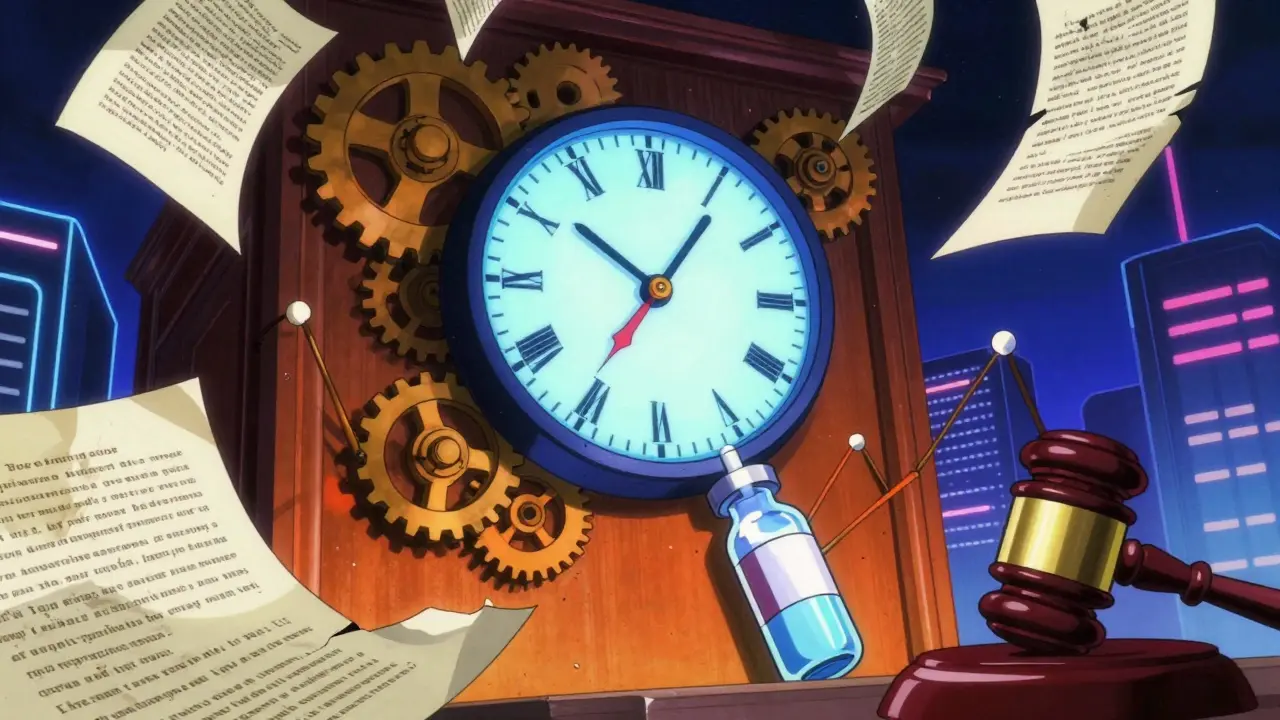
You might think that as soon as a brand-name drug's patent expires, generic drugs hit the shelves. But reality is different. On average, it takes 18 months after patent expiration for generics to actually become available. Why? It's not just about the patent expiring-it's a complex web of legal, regulatory, and manufacturing hurdles.
Understanding the Hatch-Waxman Act Framework
The Hatch-Waxman ActThe Drug Price Competition and Patent Term Restoration Act of 1984, which established the framework for generic drug approval through the Abbreviated New Drug Application (ANDA) pathway. is the foundation of how generic drugs enter the market. Before this law, brand-name companies could block generics indefinitely. Now, generic manufacturers can file an Abbreviated New Drug Application (ANDA) to prove their drug is bioequivalent to the brand, skipping costly clinical trials. But the law also gives brand-name companies protections like patent extensions and regulatory exclusivity periods. For example, new chemical entities get 5 years of exclusivity, while new clinical investigations get 3 years. Orphan drugs receive 7 years of protection. These layers of protection mean that even after a patent expires, other barriers can keep generics off the market.
The ANDA Process: What It Takes to Get Approval
The ANDA process sounds simple-prove your drug works like the brand-but it's far from easy. Generic manufacturers must show bioequivalence through rigorous testing. The FDAU.S. Food and Drug Administration, responsible for approving generic drugs and ensuring their safety and efficacy. takes an average of 25 months and 15 days to review an ANDA application. But this timeline doesn't include the time spent developing the product. Companies often spend 18-24 months just preparing the application, especially for complex drugs. For instance, a 2022 FDA report found that 68% of first generic applicants successfully launch within the 180-day exclusivity window, but 22% delay due to manufacturing issues. This shows how tricky it is to get everything right on time.
Patent Challenges and Legal Hurdles
Patent challenges are where things get messy. When a generic company files a Paragraph IV CertificationA legal notice filed by generic manufacturers challenging the validity or infringement of a brand-name drug's patent., the brand-name company can sue. This triggers a 30-Month StayA legal delay that pauses FDA approval of a generic drug while patent litigation is ongoing., halting FDA approval until the lawsuit is resolved. A 2021 study in the PMC journal found that patent litigation takes an average of 37 months and 20 days to reach a court of appeals decision. Even worse, "reverse payment" settlements-where brand companies pay generics to delay entry-have been a major issue. The FTC estimates these cost consumers $3.5 billion annually. While the Supreme Court's 2021 Amarin Pharma v. Helsinn decision cracked down on secret settlements, they still happen.
Why Some Generics Take Longer Than Others
Not all drugs face the same delays. Small molecule drugs usually see generics within 1.5 years of patent expiration. But complex biologics? That's a different story. The BPCIABiologics Price Competition and Innovation Act, which governs the approval pathway for biosimilar drugs. pathway for biosimilars takes an average of 4.7 years. Patent ThicketsMultiple overlapping patents filed by brand-name companies to delay generic competition. also play a role. A drug with 10+ patents listed in the Orange BookFDA's official list of approved drug products with patent and exclusivity information. delays generic entry by 28 months on average. Cardiovascular drugs, for example, have an average delay of 3.4 years post-patent expiration, while dermatological products take just 1.2 years. Why? It's often about the number of patents and how aggressively brand companies protect them.
Recent Changes Improving Generic Availability
Efforts are underway to speed things up. The FDA's 2023 guidance on "Improving Efficiency in Generic Drug Development" introduced new pathways for complex generics. The CREATES ActA law that helps generic manufacturers access brand-name drug samples for testing, reducing development delays. of 2019 helps generic manufacturers get samples of brand-name drugs for testing, which used to be a major bottleneck. Also, the Orange Book Transparency Act of 2020 requires more precise patent listings, reducing disputes by 32% in its first year. The FDA is also using AI in bioequivalence testing, which could cut development timelines by 25%. But challenges remain. A 2024 Brookings study found that 68% of brand-name drugs get new patents within 18 months of expiration-a tactic called "patent evergreening" that keeps generics at bay.
What This Means for Patients and Healthcare Costs
The delays have real-world impacts. Generic drugs save the U.S. healthcare system $373 billion annually, but every month of delay costs money. The Congressional Budget Office estimates that a one-year delay for a top-selling drug adds $1.2 billion to Medicare costs. For patients, this means paying higher prices longer. A 2023 IQVIA report showed generics make up 92% of prescriptions but only 16% of drug spending. When generics launch quickly, prices drop by 80-90%. But when they're delayed, brand-name drugs stay expensive. As FDA Commissioner Robert Califf stated in 2024, "Even with all our improvements, the median time from patent expiration to generic availability remains 18 months, representing a significant barrier to affordable medicines for millions of Americans."
Why don't generic drugs launch immediately after patent expiration?
Even after a patent expires, generic drugs can't hit the market right away. The Hatch-Waxman Act requires generic manufacturers to file an ANDA and address any remaining patent protections. If a brand-name company sues over a patent challenge, a 30-month stay can delay FDA approval. Additionally, manufacturing processes and FDA reviews take time-often 18 months or more from patent expiration to actual availability.
What is the 180-day exclusivity period?
The first generic manufacturer to successfully challenge a patent gets 180 days of exclusive marketing rights. During this time, no other generics can enter the market. This creates a race among generic companies to be first, but it also means delays for other manufacturers. About 68% of first filers launch within this window, while others forfeit exclusivity due to manufacturing issues or legal setbacks.
How do patent thickets affect generic availability?
Patent thickets occur when brand-name companies file multiple patents covering different aspects of a drug-like its chemical structure, formulation, or use. Each patent creates a new hurdle for generics. Drugs with more than 10 Orange Book-listed patents see delays averaging 28 months longer than those with single patents. Cardiovascular drugs, which often have thickets, take 3.4 years on average to see generic competition after patent expiration.
What role does the FDA play in generic drug approval?
The FDA reviews ANDA applications to ensure generics are bioequivalent to brand-name drugs. They check manufacturing quality, safety, and effectiveness. While the average review takes 25 months, the agency has new initiatives to speed this up for complex drugs. The FDA also tracks patent disputes and exclusivity periods to determine when generics can legally enter the market.
Are there any recent improvements in speeding up generic drug availability?
Yes. The CREATES Act helps generic manufacturers access brand-name drug samples for testing, reducing delays. The Orange Book Transparency Act requires more precise patent listings, cutting disputes by 32%. The FDA is also using AI in bioequivalence testing, which could shorten development timelines by 25%. However, "patent evergreening"-where brands file new patents just before expiration-still blocks many generics.


Comments
jan civil
February 6, 2026The Hatch-Waxman Act is complex but vital for balancing innovation and access. Understanding its nuances is key to improving generic drug availability.
lance black
February 7, 2026Agreed! Fast-tracking complex generics could save billions. Let's push for more efficient FDA reviews.
Matthew Morales
February 8, 2026Wow this post is eye-opening 🤯 I had no idea about the 18-month delay Patent thickets are wild brands file so many patents to block generics 🤷♂️ typo maybe But seriously this needs attention
one hamzah
February 10, 2026So many factors affect generic drug availability! 🌍 The Hatch-Waxman Act is foundational but has loopholes.
Patent thickets are a huge issue-brands file multiple patents to delay generics.
For example cardiovascular drugs take 3.4 years on average. 😔
But the CREATES Act helps get samples for testing.
FDA's AI use could cut development time by 25%! 🤖
The Orange Book Transparency Act reduced disputes by 32%.
Still patent evergreening is a problem.
68% of drugs get new patents within 18 months of expiration. 🤯
The 30-month stay during patent litigation causes delays.
Reverse payment settlements cost $3.5B yearly. 💸
Generic drugs save $373B annually but delays cost patients and Medicare.
The FDA's new guidance on complex generics is a step forward.
Let's push for policies that speed up access. 🌟
Also the BPCIA pathway for biosimilars takes 4.7 years on average.
It's a complex system but improvements are happening!
Diana Phe
February 11, 2026This is all a conspiracy. The FDA and big pharma are in cahoots to keep generics off the market. They're hiding the truth to keep prices high. Trust me I've done my research. 🤔
Andre Shaw
February 13, 2026Wow conspiracy theories again. The data shows it's about regulatory hurdles not conspiracies. The Hatch-Waxman Act was designed to balance innovation and competition. Stop believing in nonsense.
Sam Salameh
February 15, 2026Yeah generics should be available faster. It's a national security issue-relying on foreign manufacturing. We need to bring production back to the US. 💪
Arjun Paul
February 16, 2026Production in the US is expensive. Many generics are made overseas because it's cheaper. This isn't a national security issue but a cost issue. Stop oversimplifying
divya shetty
February 18, 2026While cost is a factor it's also about regulatory compliance. The FDA ensures quality regardless of location. Your assertion that it's solely a cost issue ignores the complexities of international pharmaceutical manufacturing standards
Jennifer Aronson
February 19, 2026It's fascinating how international collaboration impacts drug availability. The FDA's role is critical in ensuring safety while promoting competition. A balanced approach is necessary
Lana Younis
February 20, 2026Agreed! The FDA's new guidance on complex generics is a step forward. But jargon-heavy terms like 'bioequivalence' can confuse patients. We need simpler explanations to empower people. Also patent evergreening is a big problem-brands keep extending patents to block generics. 😔
Jenna Elliott
February 21, 2026Generics take too long
Samantha Beye
February 22, 2026It's a complex issue but there are improvements happening. The CREATES Act and FDA initiatives are helping. Progress takes time but we're moving in the right direction
Kate Gile
February 22, 2026Patent challenges and regulatory hurdles are tough but the industry is adapting. Collaboration between brands and generics can lead to faster access. Let's keep pushing for solutions!
anjar maike
February 22, 2026Yes! The Orange Book Transparency Act is helping reduce disputes. More transparency is key. 🌈 But what about biosimilars? They take even longer. Need to address that too
Write a comment