

Every year, millions of people take prescription drugs, over-the-counter medicines, and dietary supplements without a problem. But for some, a medication can cause a serious reaction - one that wasn’t listed on the label, wasn’t caught in clinical trials, and might not show up until thousands of others have taken it. That’s where MedWatch comes in. It’s not a hotline for emergencies. It’s not a customer service line. It’s the U.S. Food and Drug Administration’s official system for collecting reports about dangerous side effects, product failures, and用药错误. And if you’ve ever wondered whether your experience with a drug matters - it does. Your report could help prevent someone else from being hospitalized, or worse.
What Exactly Is MedWatch?
MedWatch is the FDA’s safety reporting program. Launched in 1993, it’s the main way the agency finds out about problems with medicines, medical devices, vaccines, dietary supplements, and even cosmetics after they’re already on the market. Think of it as the nation’s early warning system for drug safety. While clinical trials test drugs on thousands of people, real-world use involves millions. That’s where rare side effects - like a sudden heart rhythm issue or a liver reaction that only happens in one in 50,000 users - show up. MedWatch collects those reports.
The FDA doesn’t just rely on drug companies. It also depends on doctors, nurses, pharmacists, patients, and caregivers. Manufacturers are legally required to report serious problems. But voluntary reports from everyday people? Those are what make MedWatch powerful. A 2022 study found that nearly half of all drug safety alerts started with a report from a patient or healthcare provider - not a company.
Who Can Report to MedWatch?
Anyone can report. You don’t need to be a doctor. You don’t need to prove anything. If you or someone you care for had a bad reaction to a medication, device, or supplement, you can file a report. Here’s who typically uses it:
- Patients and caregivers - If you took a new pill and ended up in the ER, or your parent had a dangerous skin rash after using a cream, you can report it.
- Healthcare professionals - Doctors, nurses, pharmacists, and hospital staff report hundreds of thousands of cases each year. They’re trained to recognize what’s reportable.
- Manufacturers - Companies must report any serious adverse events they learn about, usually within 15 days.
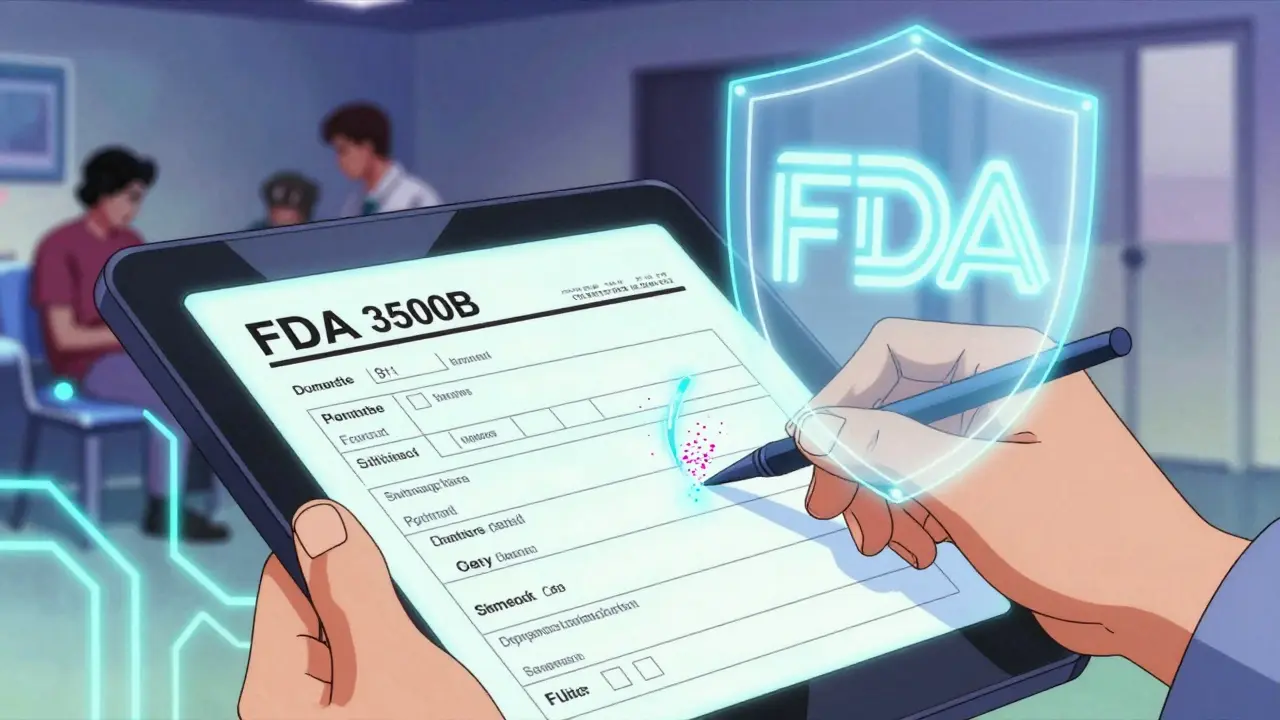
The FDA makes it easy. There are two main forms: Form FDA 3500 for professionals and Form FDA 3500B for patients and the public. The patient form is shorter, written in plain language, and available in Spanish since 2022. You can fill it out online, print and mail it, or fax it. No cost. No registration. No follow-up required - though many wish there was one.
What Should You Report?
You don’t have to be sure it was the drug. You don’t have to be a medical expert. The FDA just needs to know what happened. Here’s what counts as reportable:
- Death - Even if you’re not certain the drug caused it, report it if it happened after taking the medication.
- Hospitalization - If you or someone else had to go to the hospital because of a side effect, that’s a big one.
- Disability or permanent damage - Nerve damage from a shot, hearing loss after antibiotics, liver failure from a supplement.
- Birth defects - If a woman took a medication during pregnancy and the baby had a problem, report it.
- Therapeutic failure - A blood pressure pill that suddenly stopped working, or an insulin that didn’t lower glucose like it should.
- Product defects - A pill bottle with the wrong label, a faulty glucose monitor, a contaminated batch of vitamins.
Even if the side effect seems “mild” - like extreme fatigue, anxiety, or nausea - if it was unexpected and affected your life, report it. The FDA doesn’t know what’s common unless people tell them.
How to File a Report
Filing a report takes 15 to 20 minutes. Here’s how:
- Go to fda.gov/MedWatch - This is the official portal. Don’t use third-party sites.
- Choose your form - Click “Voluntary Reporting” and pick Form 3500 (for professionals) or 3500B (for patients).
- Fill in what you know - You’ll need: the product name (brand and generic if you know it), the date you started taking it, when the problem started, what happened, and what you did (e.g., stopped the drug, went to the doctor).
- Include your contact info - It’s optional, but if you want a confirmation email, leave your name and email.
- Submit - You can do it online, print and mail to FDA MedWatch, or fax to 1-800-FDA-0178.
There’s also a phone option: call 1-800-FDA-1088. An operator will walk you through the report over the phone. Average wait time is under 3 minutes. You can also download printable PDFs of the forms from the site.
What Happens After You Submit?
Once you hit submit, your report goes into a database with over 1.4 million reports a year. The FDA doesn’t respond to every single one. They don’t call you back. They don’t send a thank-you note. That’s frustrating - and it’s a known problem. A 2022 survey found that 42% of patients who reported felt ignored.
But here’s what actually happens behind the scenes:
- Reports are reviewed by FDA scientists and pharmacovigilance experts.
- Similar reports are grouped together - if 10 people report the same rare rash after taking Drug X, that’s a red flag.
- If enough reports point to a pattern, the FDA may issue a safety alert, update the drug label, or even pull the product.
Since 2021, MedWatch data helped lead to 18 label changes, 7 public safety warnings, and 3 drug withdrawals. One well-known example: Rosiglitazone (Avandia) was linked to heart attacks after hundreds of reports poured in. The FDA added a black box warning and restricted its use.
But don’t expect immediate results. This isn’t a customer service ticket. It’s data collection for long-term public health. Your report might not change anything tomorrow - but it could save a life next year.
Why Do So Few People Report?
Here’s the hard truth: only 1% to 10% of serious side effects are ever reported. The Institute of Medicine estimated that as many as 95% of dangerous reactions go unreported. Why?
- People don’t know MedWatch exists - A 2022 National Consumers League survey found 78% of Americans had never heard of it.
- They think it’s not their job - “That’s the doctor’s responsibility,” many say. But doctors are overwhelmed. Patients are often the first to notice.
- No feedback - If you report and hear nothing, you assume it didn’t matter. But silence doesn’t mean inaction.
- Confusion about what’s reportable - Many think only life-threatening events count. But disability, hospitalization, and unexpected reactions matter too.
And here’s the kicker: the FDA admits that about 30% of reports are incomplete or contain errors. That’s why clear, detailed reports are so important.
What Makes a Good Report?
If you’re going to take the time, make it count. Here’s what helps:
- Be specific - Don’t say “I felt sick.” Say “After taking Metformin for 10 days, I had severe diarrhea 4 times a day for 5 days, lost 8 pounds, and went to urgent care.”
- Include dates - When did you start the drug? When did the problem start? When did you stop?
- List all medications - Even vitamins, herbal supplements, and OTC painkillers. Interactions matter.
- Attach lab results - If you had blood work done, mention the abnormal values (e.g., “ALT 180 U/L - normal is 7-56”).
- Don’t guess - If you’re not sure, say “I’m not certain” instead of making up an answer.
Even if you don’t have all the details, submit what you have. The FDA can follow up if needed.

MedWatch vs. Other Systems
The U.S. isn’t alone. Europe has EudraVigilance, Canada has Canada Vigilance, and Japan has its own system. But MedWatch stands out in two ways:
- It lets patients report directly - In Japan and some European countries, only healthcare providers can submit reports. In the U.S., anyone can.
- It’s huge - MedWatch gets over 1.4 million reports a year, more than any other national system.
But it’s not perfect. Experts like Dr. Joseph Ross from Yale point out that MedWatch is passive - it waits for reports instead of actively checking health records. That’s why the FDA is now using its Sentinel Initiative, which scans data from 300 million electronic health records to spot patterns automatically. MedWatch and Sentinel are becoming a two-part system: one driven by people, the other by data.
What’s Next for MedWatch?
The FDA isn’t sitting still. In 2023, they launched a new online portal with real-time error checking and mobile-friendly design. They’re testing AI tools to sort reports faster - cutting review time by 35% in pilot tests. By 2025, they plan to let certified health apps and EHR systems send reports directly to MedWatch. Imagine your doctor’s software auto-filing a report when it detects a dangerous drug interaction.
They’re also pushing to use standardized medical terms (SNOMED CT) across all reports by 2026. That means your “chest pain” will be coded the same way as someone else’s - making it easier for computers to spot trends.
But none of this matters if people don’t report.
Why Your Report Matters
You might think: “One report won’t make a difference.” But that’s how big changes start. A single report about a rare liver injury led to a warning on a popular cholesterol drug. A patient’s note about blurred vision after a new diabetes pill helped uncover a widespread issue. A mother’s report about her baby’s rash after a supplement led to a recall of a popular brand.
MedWatch doesn’t just protect the public. It protects you - next time you’re prescribed a new drug. The warnings on the label? They’re there because someone like you reported a problem.
So if you’ve had a bad reaction - even if it was months ago, even if you didn’t think it was serious - take five minutes. Go to fda.gov/MedWatch. Fill out the form. Hit submit. You’re not just sharing your story. You’re helping make medicines safer for everyone.
Can I report a side effect if I’m not sure it was caused by the medication?
Yes. You don’t need to prove causation. The FDA’s job is to look for patterns. If multiple people report the same issue after taking the same drug, even if it’s not certain, that’s enough to trigger an investigation. Uncertainty is why the system exists.
Do I need to be a U.S. resident to report to MedWatch?
No. Anyone, anywhere in the world, can report a problem with a product sold or used in the United States. If you took a U.S.-approved drug and had a reaction, your report counts - even if you live in Canada, Mexico, or Germany.
Is MedWatch only for prescription drugs?
No. MedWatch accepts reports for prescription drugs, over-the-counter medicines, vaccines, dietary supplements, medical devices (like insulin pumps or pacemakers), cosmetics, and even infant formula. If it’s regulated by the FDA, you can report issues with it.
Will my report be kept private?
Yes. The FDA protects personal information. Your name and contact details are not made public. Reports are anonymized in public databases. Only authorized FDA staff can access identifying information, and only for safety investigations.
What if I don’t remember the exact name of the medication?
You can still report. Write down what you remember: color, shape, markings on the pill, how it was packaged, or the condition it was for. The FDA has databases to match descriptions. Better to report with partial info than not at all.






Comments
Scottie Baker
January 14, 2026This system is a joke. I reported my wife’s liver failure from that damn statin two years ago. Got zero feedback. Zero. Meanwhile, the company kept selling it like nothing happened. If the FDA cared, they’d have pulled it before the third person died. Why do I even bother?
Anny Kaettano
January 15, 2026Y’all need to stop underestimating this. I’m a nurse, and I file reports every single time something weird pops up - even if it’s just a patient saying ‘I feel weird after this new pill.’ It’s not about the individual case. It’s about the pattern. One report? Maybe noise. Ten? That’s a signal. And that signal saves lives. Don’t be the person who says ‘someone else will do it.’ Be the person who makes the difference. 💪
Angel Molano
January 16, 2026If you don’t report, you’re complicit.
Randall Little
January 17, 2026So let me get this straight - the FDA relies on the public to report side effects, yet doesn’t even acknowledge receipt? That’s like asking strangers to report arson, then ignoring every 911 call. And yet we wonder why drug safety is a mess. The system’s designed to fail. The only thing worse than a bad drug? A broken system that pretends it’s fixing things.
Adam Rivera
January 19, 2026Hey, I just used MedWatch last week after my cousin had a wild reaction to a new supplement. Took me 12 minutes. Didn’t even need to log in. Seriously, if you’ve ever had something weird happen after taking something - just do it. No guilt, no pressure. Just hit submit. You’re not just helping yourself - you’re helping the next person who might take that same pill.
Trevor Davis
January 19, 2026Look, I used to think this stuff was pointless. But then my mom got hospitalized after a flu shot she’d taken for 10 years. No one warned her. No one knew. I filed the report. Three months later, the FDA added a new warning. That’s the power of this thing. It’s not flashy. It’s not fast. But it works. So yeah - report. Even if you think it’s small. It’s not.
John Tran
January 19, 2026Okay so like imagine this: you take a pill, right? And then you start seeing ghosts. Not metaphorical ghosts. Actual ghosts. Like, you see your dead grandma in the hallway. And you’re like, ‘Is this the medication or am I losing my mind?’ But you don’t report it because you think people will think you’re crazy. But what if 12 other people also saw their dead relatives after taking the same pill? And what if that pill was FDA-approved? And what if the FDA had no idea? And what if they could’ve prevented it? And what if your silence meant someone else’s grandma was now haunting them too? 🌫️👻
So yeah. Report. Even if you think you’re insane. Maybe you’re the only one who’s sane.
Milla Masliy
January 21, 2026My daughter had a rash after a new antibiotic - didn’t think much of it until it spread. I filed the report on the 3500B form. Took less than 15 mins. I didn’t expect anything back, but I felt better knowing I did my part. And honestly? I’m glad the FDA lets patients report directly. Too many countries make you go through a doctor first. That’s just a delay. If you’re the one living it, you should be able to speak up.
Angel Tiestos lopez
January 22, 2026MedWatch is the quiet hero of public health. 🌱 No fanfare, no viral tweets, no celebrity endorsements. Just real people typing out their pain so others don’t have to feel it. I used to think science was about labs and microscopes. Now I know it’s also about a mom in Ohio typing ‘my son’s tongue swelled after this vitamin’ into a form. That’s not just data. That’s love in action. ❤️🩺
So yeah. Do it. Even if it’s late. Even if you’re tired. Even if you’re not sure. Your voice? It’s the only thing keeping this system alive.
Write a comment