
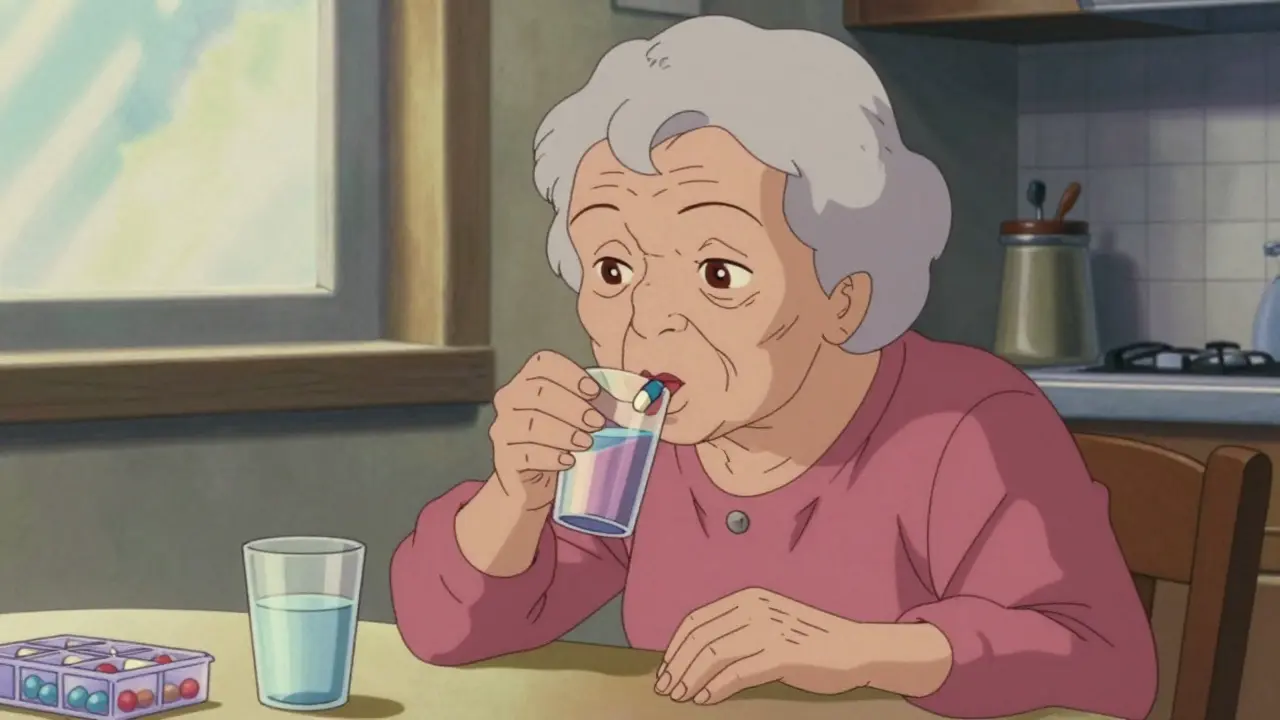
For millions of people, taking medicine is more than just a routine-it’s a lifeline. But what if you can’t swallow your pills? Swallowing difficulties, or dysphagia, affect up to 15% of older adults living at home and nearly 7 out of 10 nursing home residents. When pills get stuck, people stop taking them. And that’s when health problems start to spiral. Missing a dose of blood pressure medicine, antibiotics, or diabetes drugs isn’t just inconvenient-it can land you in the hospital. The good news? There are real, practical ways to get your medicine down without risking your safety.
Why Swallowing Pills Gets Harder with Age
It’s not just about being older. Swallowing involves over 30 muscles and several nerves working together. As we age, those muscles weaken. Conditions like Parkinson’s, stroke, Alzheimer’s, or even throat cancer can disrupt the process. Some people have trouble moving food from the mouth to the throat. Others can’t get it past the esophagus. A pill that used to slide right down might now feel like a rock. And because pills are often dry and hard, they don’t always mix well with saliva. That’s why many people gag, choke, or just give up.
Here’s the scary part: research shows nearly half of all pill modifications-like crushing tablets or opening capsules-are done incorrectly. Crushing a slow-release pill can cause a dangerous overdose. Opening a capsule with a protective coating might make the medicine useless. In one study, 14 out of 110 altered medications had a real risk of toxicity. That’s not a minor mistake. That’s a life-threatening one.
Don’t Crush or Open Pills Unless You Have to
It’s tempting. You see someone mix crushed pills into applesauce or yogurt. You’ve heard it works. But here’s the truth: most pills aren’t designed to be crushed. Extended-release tablets, enteric-coated pills, and capsules with time-delayed release can become dangerous when tampered with. A blood pressure pill meant to release over 12 hours might dump its full dose all at once. An antibiotic with a stomach coating might break down too early and lose its power.
UK guidelines and U.S. pharmacy experts agree: altering pills should be the last resort. Always ask your pharmacist or doctor first. There’s almost always a better way.
Try These Swallowing Techniques First
Before you reach for the blender, try these proven methods. They’re simple, safe, and work for most people-even those with mild to moderate dysphagia.
- The Lean Forward Method: Place the capsule on your tongue. Take a medium sip of water-not too much, not too little. Then, lean your head slightly forward (like you’re looking at your chest) and swallow. This technique helps the pill slide down more easily by changing the angle of your throat. Studies show it improves success rates by up to 75%.
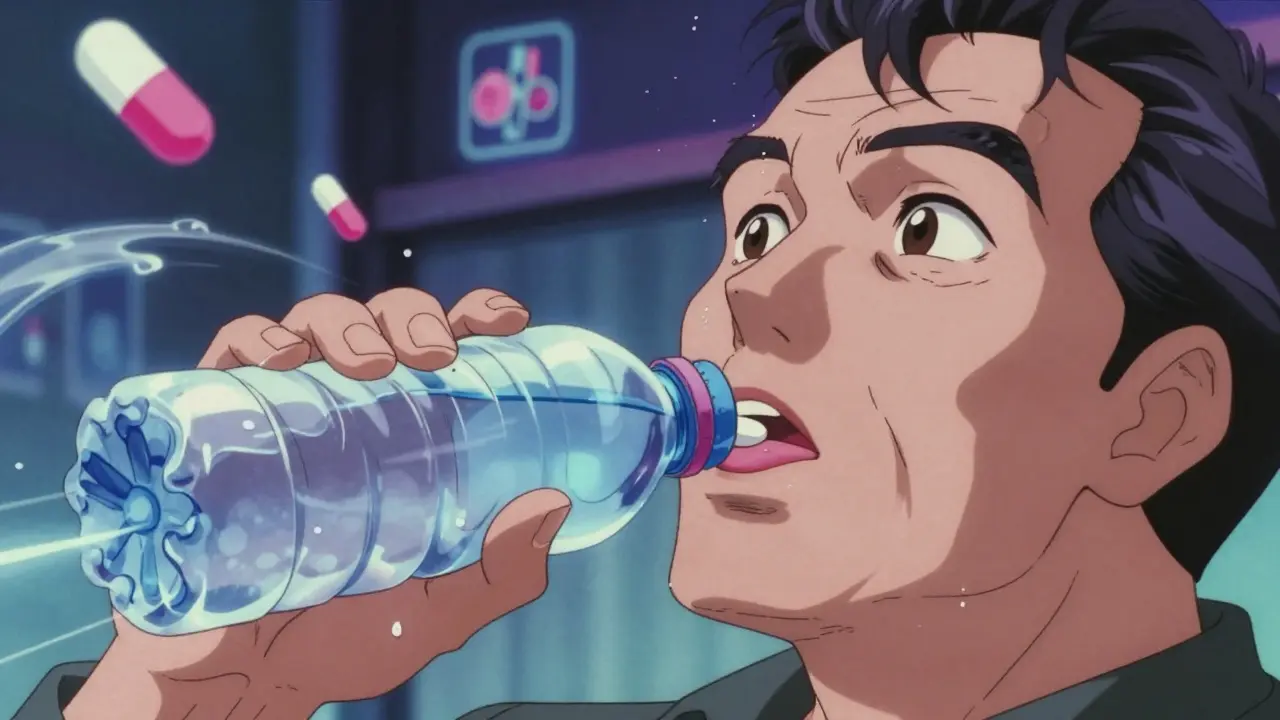
- The Water Bottle Trick: Fill a plastic water bottle halfway. Place the pill on your tongue. Seal your lips tightly around the bottle’s opening. Take a drink using suction. The sucking motion creates a strong swallowing reflex that helps carry the pill down.
- The Ice Chip Trick: Before swallowing your pill, suck on an ice chip. The cold numbs your throat slightly and increases saliva production. This makes the pill slide more smoothly. It’s especially helpful for people who feel like their throat is dry or tight.
- Use Thicker Liquids: If you’re at risk of choking, thin liquids like water can slip into your airway. Try thickened drinks-like those used for dysphagia patients. They move slower and are easier to control. If you’re at risk of aspiration (breathing in food or liquid), thicker liquids are safer.
Switch to Easier-to-Swallow Formulations
Not all pills are created equal. Some shapes and coatings are much easier to swallow than others.
- Smaller pills: A 5mm pill is easier than a 12mm one. Ask if a lower-dose version is available.
- Torpedo-shaped capsules: These are narrower at the ends and glide down better than round tablets.
- Coated tablets: The slippery coating helps them slide. Avoid uncoated ones if you have trouble.
- Liquids: Many medications come in liquid form. Check if your prescription has a liquid alternative. Even if it’s more expensive, it might be worth it to avoid complications.
- Orodispersible tablets: These dissolve on your tongue without water. They’re made for people with swallowing issues.
- Effervescent tablets: Dissolve in water to create a fizzy drink. Often easier to take than pills.
- Dissolvable films: New technology like VersaFilm sticks to the inside of your cheek and releases medicine without swallowing. One study showed 85% adherence in patients with moderate dysphagia.
The FDA estimates that only 37% of essential medications have alternative formulations suited for swallowing difficulties. But that’s changing. More companies are developing these options. Ask your pharmacist: "Is there a version of this medicine that doesn’t require swallowing?"
Use Feeding Tubes the Right Way
If you’re on a feeding tube, you still need to take your pills. But giving meds through a tube isn’t as simple as pouring them in.
- Always flush the tube with at least 10ml of water before and after each medication.
- Give one drug at a time. Don’t mix them together.
- Use liquid forms when possible. If you must crush a pill, make sure it’s safe to do so, then mix it with water-not with formula or food.
- Check for interactions. Some medications bind to enteral feed and become ineffective.
Many nursing homes and home care providers still don’t follow these rules. That’s why communication between your care team matters.
Work With Your Care Team
This isn’t something you should handle alone. You need a team: your doctor, pharmacist, nurse, speech therapist, and caregiver. Each plays a role.
- Your doctor should review whether every pill is still necessary. Sometimes, you can stop one.
- Your pharmacist can suggest alternative formulations, check for crushability, and advise on safe mixing.
- Your speech therapist can teach you swallowing techniques and assess your risk level.
- Your caregiver needs clear instructions-not guesses. Write down the exact steps.
The American Society of Health-System Pharmacists now recommends that all patients with dysphagia get a formal assessment. If your doctor hasn’t asked about swallowing, bring it up. Say: "I’m having trouble taking my pills. Can we talk about safer ways?"
What to Do If Nothing Works
Some people still struggle-even with techniques and alternatives. That’s when other routes come in.
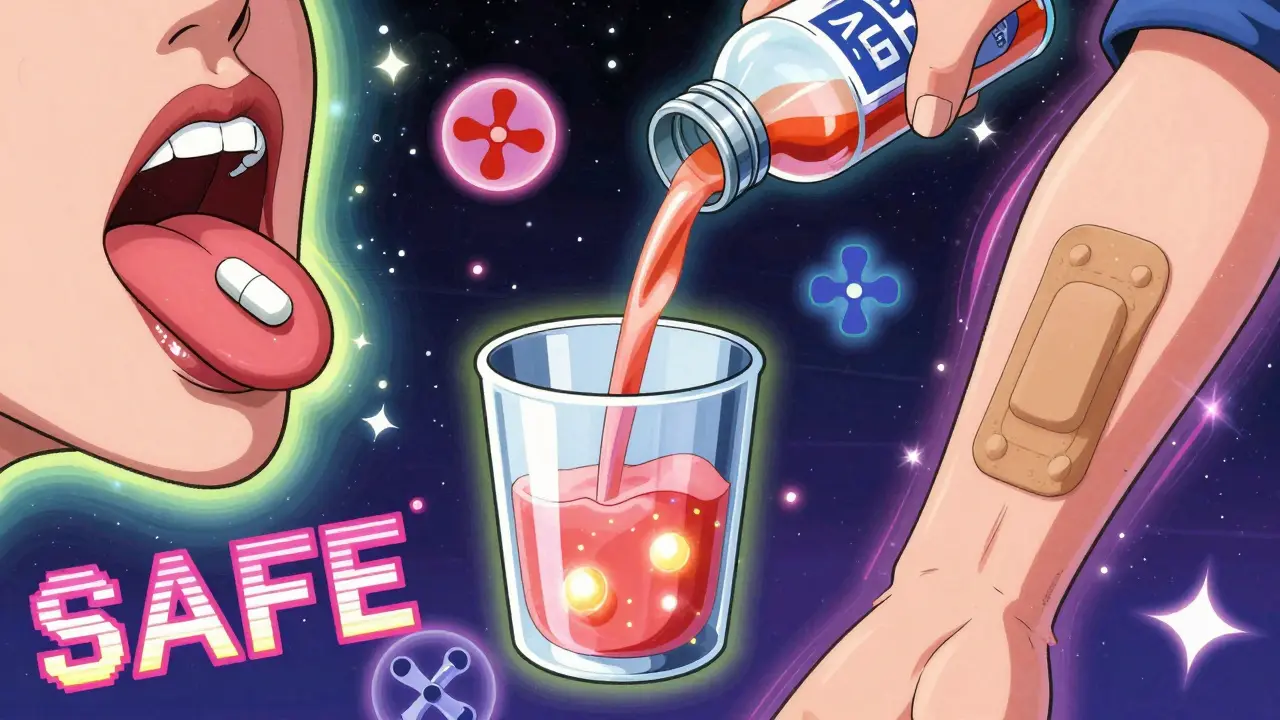
- Injection or patch: Some medicines, like pain relievers or hormone treatments, are available as shots or skin patches.
- Rectal suppositories: For fever reducers, anti-nausea drugs, or some seizure meds, this can be a good option.
- Sublingual tablets: These go under the tongue and absorb directly into the bloodstream. Useful for some heart and anxiety meds.
Not every medicine has a non-oral version. But many do. Ask: "Is there a way to take this without swallowing?" Don’t assume the answer is no.
Real-Life Tips from People Who’ve Been There
- "I used to gag on every pill. Then I started using the water bottle trick. Now I take all 6 of mine without a problem." - Maria, 72
- "My mom couldn’t swallow her blood thinner. We switched to the liquid form. It cost more, but she hasn’t been hospitalized since." - James, 49
- "I asked my pharmacist if my antidepressant came in a dissolvable tablet. Turns out it did. Game-changer." - Linda, 68
- "I keep a small cup of ice chips next to my pill box. I suck one before I take each pill. It makes everything easier." - Robert, 81
The message is clear: you don’t have to stop taking your medicine just because swallowing is hard. There are options. You just need to ask, test, and try.
What to Avoid
- Don’t crush pills without checking first.
- Don’t mix meds with thick foods like peanut butter or pudding unless approved-some drugs bind to fat and won’t absorb.
- Don’t assume a pill is safe to crush just because it looks small or soft.
- Don’t give up. Keep talking to your care team until you find a solution.
The global market for dysphagia solutions is growing fast-projected to hit $2.9 billion by 2029. That’s because more people are living longer with chronic conditions. And the medical community is starting to catch up. But change starts with you.



Comments
Mike Hammer
February 15, 2026I used to hate swallowing pills until I tried the water bottle trick. Game changer. Now I take all my meds like a pro. No more gagging. Just suck, swallow, done.
Life's too short to choke on a capsule.
Daniel Dover
February 15, 2026The lean forward method works. Simple. No tools needed. Just tilt and go.
Charlotte Dacre
February 16, 2026Oh wow. So we’re now treating swallowing like a TikTok hack? 'Here’s how I got my 800mg oxycodone down with a plastic bottle and a prayer.'
Next up: How to meditate while crushing your beta-blocker into your oatmeal.
Mandeep Singh
February 18, 2026This whole article is just a marketing brochure for pharmaceutical companies trying to sell you fancy dissolvable films and effervescent tablets. The real solution? Stop taking so many unnecessary pills. Most elderly are on 12+ medications. Half of them are useless. You don’t need a blood thinner if you’re not at risk. You don’t need statins if your cholesterol is fine. The system is built to keep you dependent. Stop being a patient. Start being a person.
And before you say 'but my doctor prescribed it' - your doctor is paid by pill companies. Ask yourself: why does this country have more pharmacists than grocery stores?
Josiah Demara
February 20, 2026Let’s be real. The water bottle trick? That’s just a fancy way of saying 'use your diaphragm.' The ice chip method? That’s just cold therapy. The 'torpedo-shaped capsules'? That’s just better engineering. None of this is revolutionary. What’s revolutionary is that it took 15 pages to explain something that should’ve been taught in high school biology.
Also, 85% adherence with dissolvable films? That’s because people don’t want to swallow pills. Not because the films are magic. They’re just less traumatic. Which says more about how awful pills are than about the solution.
And yes, I’ve read the FDA reports. And yes, I’ve seen the toxicity data. You’re still better off asking your pharmacist than Googling 'how to crush pills.'
Kaye Alcaraz
February 20, 2026I love how practical this is. Every single tip is doable. No fluff. No jargon. Just clear steps that actually work. If you’re struggling, try one thing today. Just one. The water bottle trick. The ice chip. A liquid form. Small wins build confidence. And confidence saves lives.
You’re not broken. You just haven’t found your method yet. Keep going.
Esha Pathak
February 21, 2026The human body is a symphony of muscles, nerves, and ancient survival instincts - and we treat it like a vending machine that refuses to dispense unless you jiggle it just right.
One moment, you’re swallowing a pill like it’s a feather. The next, you’re choking on a pebble. The mind rebels. The throat clenches. It’s not weakness. It’s betrayal. The same body that carried you through childhood, heartbreak, and midnight runs now turns on you over a 5mm tablet.
But here’s the poetry: we adapt. We suck. We chill. We dissolve. We film. We patch. We inject. We fight. Not because we’re brave. Because we’re stubborn. And stubbornness? That’s the last medicine that still works.
Joe Grushkin
February 23, 2026I’m not convinced this isn’t just Big Pharma’s new revenue stream. Dissolvable films? Effervescent tablets? Liquid forms? All more expensive than the original pill. And guess who pays? You do. Meanwhile, the real issue - polypharmacy - is ignored. Why not just reduce the number of pills? That’s cheaper. Safer. More effective.
Also, 'ask your pharmacist' - sure, if they’re not being paid by the manufacturer to upsell you the $12 version instead of the $2 generic.
This reads like an ad. Not advice.
Michael Page
February 23, 2026I used to take my pills with a glass of water. Then I started using the ice chip trick. Now I don’t even think about it. It’s automatic.
But honestly? I think the real problem is how we’re taught to swallow pills. No one ever showed me how. I just assumed I had to do it the way I saw on TV. Turns out, there’s science behind it. And it’s not complicated.
Why isn’t this taught in schools? Or at least in doctor’s offices?
Kapil Verma
February 24, 2026This is why India is better. We don’t need fancy films or bottles. We crush. We mix. We swallow. We survive. You Americans overthink everything. A pill is a pill. If it’s too big, break it. If it’s too bitter, mix it with honey. Our grandmothers did it for centuries. No PhD needed.
Stop over-medicalizing simple things. The body knows how to swallow. You just need to trust it.
Erica Banatao Darilag
February 26, 2026i wasnt sure if i shud try the water bottle thing but i did and omg it worked. i’ve been taking my meds for 3 years and never knew this was a thing. thank you. i feel so much better now.
ps: i think i spelled 'should' wrong. sorry.
Virginia Kimball
February 26, 2026I’ve got a friend who’s 84 and takes 10 pills a day. She tried every trick in this article. The dissolvable tablet was the one that changed her life. She cried when she realized she could finally take her meds without fear.
That’s the real win here. Not the science. Not the technique. The peace of mind. You can’t put a price on that.
Sarah Barrett
February 27, 2026The most overlooked point in this entire piece is not the techniques - it’s the systemic failure of healthcare to proactively address swallowing difficulties.
Patients are expected to self-diagnose, self-research, and self-advocate. Meanwhile, providers rarely screen for dysphagia unless a patient is already hospitalized.
There should be a mandatory swallowing assessment during annual physicals for adults over 65. Period. This isn’t optional. It’s preventive care.
Chiruvella Pardha Krishna
March 1, 2026We speak of swallowing as if it were a mechanical act - a simple transit of matter through a tube. But it is not. It is a ritual. A surrender. A quiet negotiation between will and body.
The pill is not merely medicine. It is a symbol - of dependence, of aging, of loss of control. To swallow it is to accept that we are no longer invincible.
And yet - we do it. Again. And again. And again.
Not because we are brave.
Because we are still here.
Betty Kirby
March 1, 2026Let me guess - you’re the type who thinks 'crushing pills' is fine because 'it’s just a little bit.' Newsflash: that’s how overdoses happen. That’s how people end up in ERs with bleeding ulcers because they crushed a coated aspirin. This isn’t DIY. This is life or death. Stop being reckless. Ask your pharmacist. Read the label. Or don’t take the damn thing at all. But don’t play Russian roulette with your meds.
Write a comment