
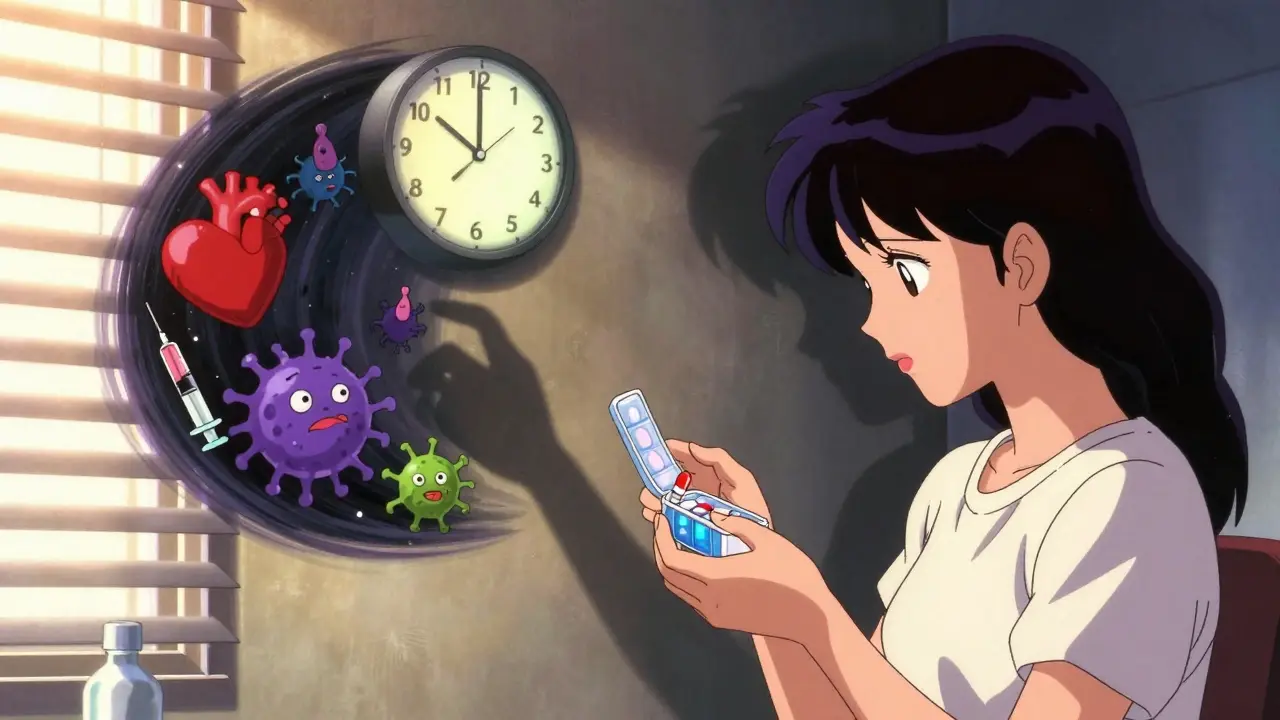
Skipping a dose of your prescription medication might seem harmless-especially if you’re feeling fine, or if you just forgot. But that one missed pill can ripple through your body in ways you don’t see right away. It’s not about being perfect. It’s about keeping your drug levels steady so your treatment actually works.
Why Timing Matters More Than You Think
Your body doesn’t work on a schedule you can guess. Medications are designed to stay in your bloodstream at a specific level-high enough to do their job, but not so high that they cause harm. When you skip a dose, that level drops. When you take it late, it spikes unevenly. Both mess with the balance your doctor carefully calculated. For example, antibiotics like amoxicillin or doxycycline need to be taken every 8 or 12 hours to kill all the bacteria. If you stop early because you feel better, the strongest bacteria survive. They multiply. Next time, the same drug won’t work. That’s how antibiotic resistance starts-and it’s not just a hospital problem. It’s happening in homes, because people skip doses. Hypertension meds are even more silent. High blood pressure doesn’t hurt. You don’t feel it. But every time you miss a dose, your arteries take another hit. Over time, that leads to heart attacks, strokes, kidney damage. The American Heart Association says nearly half of U.S. adults have high blood pressure. And a huge number of them stop taking their pills when they feel fine. That’s like turning off your car’s brake lights because you don’t see anyone behind you.Drugs That Can’t Wait
Some medications are so sensitive to timing that even a few hours off can be dangerous. Warfarin, a blood thinner, requires daily consistency. If you take it one day at 8 a.m. and the next at 8 p.m., your INR levels swing. Too high? You could bleed internally. Too low? You could clot. That’s why patients on warfarin get blood tests every 2-4 weeks-to check if their timing is on point. Insulin for diabetes? Timing is everything. Take it too early before a meal? Your blood sugar crashes. Too late? It spikes dangerously. Same with diabetes pills like metformin-taking them with food reduces side effects and keeps glucose stable. Organ transplant patients on immunosuppressants like tacrolimus or cyclosporine? Miss a dose, and your body might start rejecting the new organ. These drugs have a razor-thin window between working and failing. There’s no room for error.Why People Skip-And What Really Happens
People skip for real reasons. Forgetfulness. Too many pills. Side effects. Cost. Fear. Believing they don’t need it anymore. A family doctor in rural Alabama found that the biggest reason patients got it wrong? They didn’t understand the instructions. Not because they were careless. Because the doctor said, “Take it twice a day,” and the patient thought that meant morning and night-not every 12 hours. The consequences aren’t theoretical. Dignity Health reports patients end up back in the hospital because they skipped doses. Their symptoms got worse. Their condition advanced. What could’ve been managed at home became an emergency. EmblemHealth found that 3 out of 10 people stop taking their meds because they think they’re not working. But with hypertension or cholesterol drugs, you don’t “feel” them working. That doesn’t mean they’re not doing their job. It means they’re preventing damage you can’t see.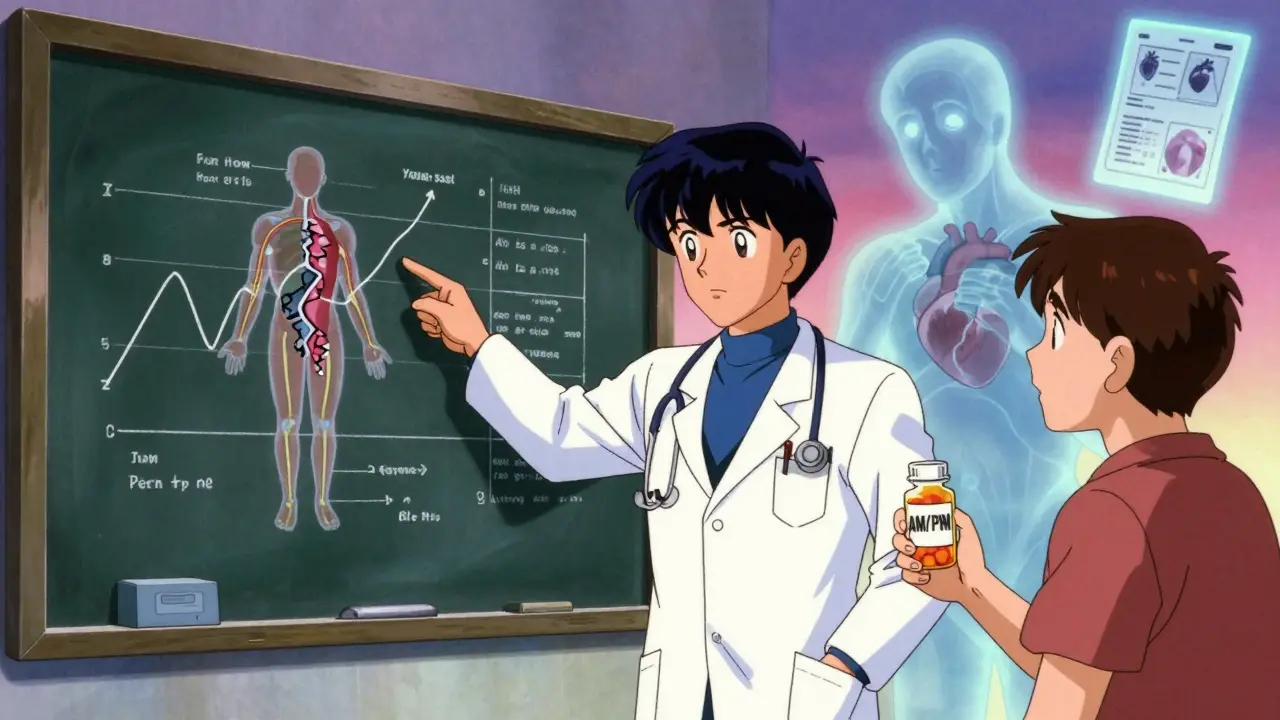
How to Stay on Track-No Magic Needed
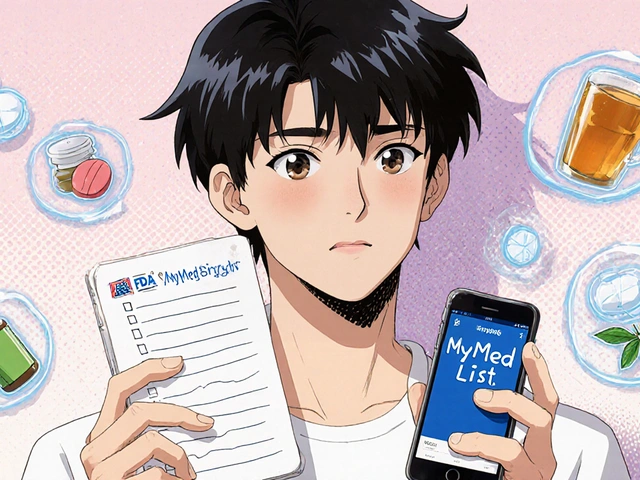
You don’t need an app or a smart pill bottle. You need a system that fits your life. Start by pairing your meds with a daily habit. Take your morning pill right after brushing your teeth. Take your evening pill when you sit down for dinner. Linking it to something you already do makes it automatic. Use a pill organizer. Not the fancy ones with alarms. Just a simple 7-day box with morning/afternoon/evening slots. Fill it once a week. If you don’t see a pill there, you know you missed it. Ask your pharmacist to simplify your regimen. If you’re taking five pills at three different times a day, ask if any can be combined or switched to once-daily versions. Research shows each extra daily dose cuts adherence by about 16%. Use the “teach-back” method. Before you leave the doctor’s office, say: “So I take this pill at 8 a.m. and 8 p.m., with food, and I don’t skip it even if I feel fine.” If they nod, you got it right. If they correct you, you just avoided a mistake.What to Do If You Miss a Dose
Don’t panic. Don’t double up. Check the label. Most medications say what to do if you miss a dose. If it’s been less than half the time until your next dose (say, you were supposed to take it at 8 a.m. and it’s now 11 a.m.), take it now. If it’s been more than half the time (it’s now 2 p.m.), skip it. Don’t take two at once. That’s how overdoses happen. For antibiotics, always finish the full course-even if you feel 100% better on day 4. Stopping early is the #1 cause of resistant infections. For blood thinners, insulin, or transplant meds: call your doctor or pharmacist immediately. Don’t guess. These aren’t the kind of meds where you can wing it.
Who Can Help You Stay on Track
You don’t have to do this alone. Pharmacists are your secret weapon. They don’t just fill prescriptions. They review all your meds for timing conflicts, side effects, and duplication. Many pharmacies offer free medication therapy management-no extra cost. Ask for it. Medicare Part D plans are required to offer this service to eligible members. Even if you’re not on Medicare, check with your insurer. Many commercial plans do too. If you’re on multiple meds, ask for a “medication review” during your annual check-up. Bring a list of everything you take-including vitamins, supplements, and over-the-counter drugs. Your doctor might find a better way to schedule them.The Bigger Picture
Skipping doses isn’t just your problem. It’s a public health crisis. The CDC estimates that non-adherence leads to 125,000 preventable deaths in the U.S. every year. It causes 10-25% of hospital admissions. That’s not because people are lazy. It’s because the system hasn’t made it easy. The Million Hearts initiative, launched in 2012, is trying to fix that. Their goal: prevent one million heart attacks and strokes by 2027. One of their biggest tools? Getting people to take their meds on time. Your pills aren’t just chemicals. They’re tools for survival. For some, they’re the only thing standing between them and a stroke. For others, they’re the reason they can still play with their grandkids. You don’t have to be perfect. But you do have to be consistent. One missed dose might not break you. But a pattern of skipping? That’s how health crumbles slowly-without warning.Frequently Asked Questions
What happens if I skip a dose of my blood pressure medication?
Skipping a dose of your blood pressure medication causes your blood pressure to rise unpredictably. Even if you feel fine, the pressure inside your arteries is still damaging your heart, kidneys, and brain. Over time, this increases your risk of stroke, heart attack, or kidney failure. Consistent daily dosing keeps pressure stable and prevents long-term damage.
Can I take my meds with food if the label says “on an empty stomach”?
No. Some medications, like certain antibiotics or thyroid pills, need an empty stomach to be absorbed properly. Food can block absorption, making the drug less effective. If you’re unsure, ask your pharmacist. Never assume it’s okay-it could mean your treatment isn’t working.
Why do I need to finish my antibiotic course if I feel better?
Antibiotics kill the weakest bacteria first. The strongest ones survive if you stop early. These survivors multiply and become resistant. That’s how superbugs form. Finishing the full course-even if you feel fine-ensures all the bacteria are gone and prevents future infections from being untreatable.
I take 8 pills a day. Is there a way to make this easier?
Yes. Talk to your doctor or pharmacist about simplifying your regimen. Some medications can be switched to once-daily versions. Others can be combined into a single pill. Reducing the number of daily doses improves adherence by up to 16% per pill removed. Don’t assume you’re stuck with a complicated schedule-ask for help.
My pills look similar. How do I avoid mixing them up?
Use a labeled pill organizer with separate compartments for morning, afternoon, and evening. Write the name and purpose of each pill on a small sticky note and tape it to the box. Some pharmacies offer blister packs with printed labels for each dose. Never rely on color or shape alone-many pills look alike.
Can I use my phone to remind me to take my meds?
Yes, and it’s one of the most effective tools. Set multiple alarms for each dose. Use a free app like Medisafe or MyTherapy. Some apps even let you track side effects or share your log with family members. But don’t rely on memory alone-even alarms can be ignored. Pair them with a physical habit, like taking your pill right after brushing your teeth.



Comments
Nicola George
December 27, 2025Yeah right, like I’m gonna set alarms for my blood pressure pills while I’m trying to survive a 12-hour shift and my kid’s screaming because the Wi-Fi’s down again. I miss doses because life doesn’t care about your pharmacokinetics, sweetheart.
Liz Tanner
December 27, 2025I get it. I used to skip my metformin because I ‘felt fine.’ Then I had a near-hypoglycemic episode at the grocery store. Now I keep my pills next to my toothbrush. It’s not glamorous, but it works. You don’t need an app-just a habit.
Babe Addict
December 29, 2025Actually, the pharmacokinetic models for most chronic meds assume linear absorption and first-order elimination, but real-world GI variability, CYP450 polymorphisms, and protein binding fluctuations mean that even strict adherence can produce subtherapeutic or toxic peaks. You’re not just missing a pill-you’re disrupting a nonlinear dynamic system. And don’t even get me started on the enterohepatic recirculation of warfarin.
Satyakki Bhattacharjee
December 30, 2025People forget because they are lost in the material world. The body knows what it needs. If you feel fine, maybe you don’t need the pills. Nature is wiser than doctors with their charts and timers.
Anna Weitz
December 31, 2025My aunt died because she took her blood thinner at 8pm instead of 8am once and they said it was her fault. They don’t tell you that the system is rigged. Insurance companies want you to die so they can save money on meds. You think they care if you live? They just want you to keep paying
Elizabeth Alvarez
January 2, 2026Have you ever wondered if the whole medication schedule thing is just a Big Pharma plot to keep us dependent? I mean, think about it-why do we need to take pills every 8 hours? Why not one pill a week? Why not a gene therapy that just fixes the problem permanently? They don’t want that because then they’d lose billions. And don’t get me started on the FDA being in bed with the drug companies-remember the opioid crisis? Same playbook. They’re poisoning us slowly so we keep buying more pills.
dean du plessis
January 4, 2026I’ve been on statins for five years and I never missed a dose. I just take mine with my morning coffee. It’s simple. I don’t overthink it. The body likes routine. Just find your rhythm and stick to it.
Kylie Robson
January 6, 2026Actually, the therapeutic index for tacrolimus is 5–15 ng/mL, and the inter-individual variability in CYP3A4/5 metabolism can span up to 20-fold. That’s why TDM is mandatory. Missed doses create subtherapeutic troughs that trigger alloreactive T-cell proliferation-hence graft rejection. You can’t wing it with calcineurin inhibitors. Period.
Nikki Thames
January 6, 2026It is deeply irresponsible to suggest that individuals should bear the full burden of medication adherence without systemic support. The fact that a person must remember to take pills multiple times a day, while navigating employment, childcare, and financial instability, is not a personal failure-it is a societal failure. You cannot moralize compliance when the infrastructure to support it is absent.
Olivia Goolsby
January 7, 2026And what about the fact that most of these drugs are made in China, and the FDA doesn’t even test the raw ingredients properly? I read a whistleblower report-90% of the active pharmaceutical ingredients in our meds are contaminated with heavy metals or carcinogens, and the pills are just sugar pills with trace amounts of the real drug. So even if you take them perfectly, you’re still getting junk. And they know it. They just don’t care. Your ‘consistent dosing’ is just feeding the machine.
Gerald Tardif
January 8, 2026Look-I used to be the guy who’d skip his blood pressure meds for weeks. Then I started pairing my pill with my coffee. No alarms. No apps. Just coffee → pill. Now I haven’t missed in 18 months. Small wins matter. You don’t need to be perfect. Just show up.
Monika Naumann
January 9, 2026In my country, we do not rely on foreign pharmaceuticals. We use Ayurvedic herbs and traditional wisdom. The Western medical system is built on profit, not healing. Why should we bow to their pill schedules when our ancestors lived longer without them?
Elizabeth Ganak
January 11, 2026my mom uses a pill box and it changed everything. she used to forget everything but now she just fills it on sundays and its so easy. no stress. just do what works for you.
Raushan Richardson
January 12, 2026Y’all are overcomplicating this. It’s not rocket science. Take your meds like you brush your teeth. Do it. Don’t make it a drama. Your future self will thank you. No guilt. No judgment. Just do it.
Robyn Hays
January 14, 2026I love how this post doesn’t just lecture-it gives real, low-effort tools. I used to think I needed a fancy app. Turns out, my keychain with a little pill case and pairing it with my evening tea? That’s the magic. Simple. Human. Sustainable. Thanks for not making me feel like a failure for being messy.
Write a comment