
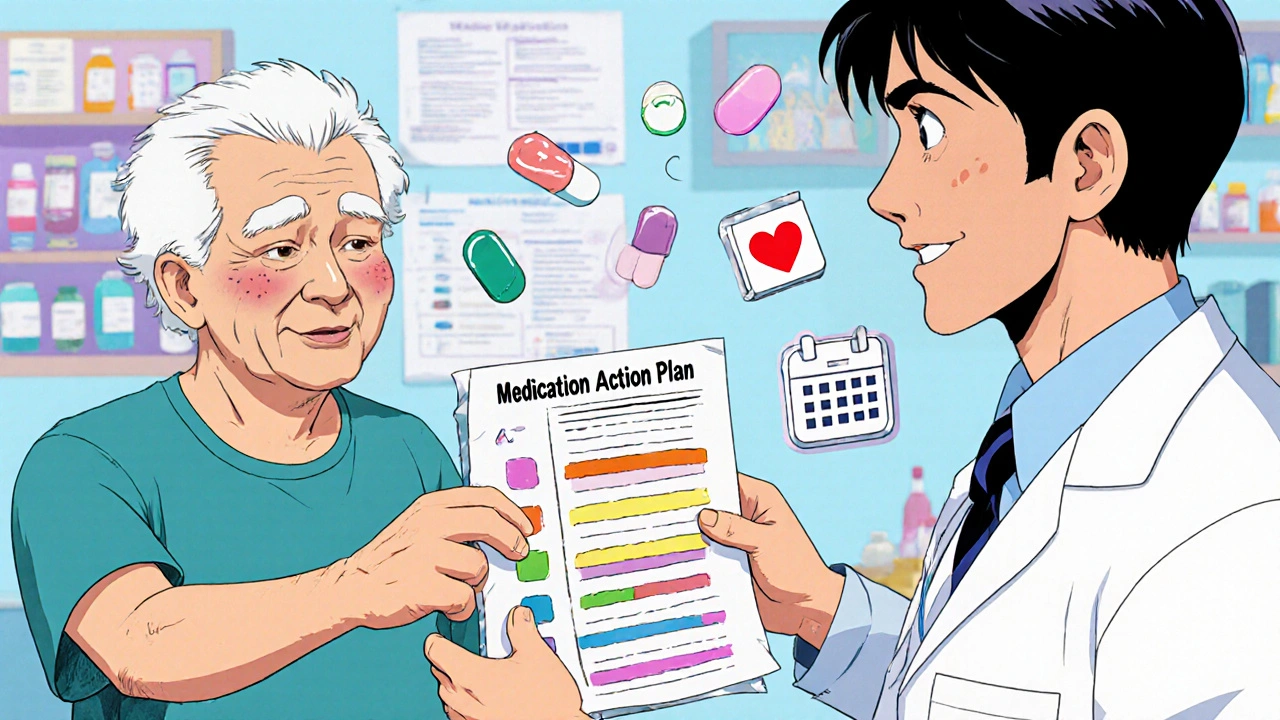
When you walk into a doctor’s office, pharmacy, or clinic, you’re carrying more than just a list of pills. You’re carrying your health story - and if you’re not using a medication action plan template, that story is likely getting lost in translation.
Most patients don’t realize how often medication errors happen. One wrong dose, a missed refill, or two drugs that shouldn’t be taken together can lead to hospital visits, falls, or even worse. But there’s a simple tool that cuts through the noise: the Medication Action Plan (MAP). It’s not just a form. It’s a living conversation between you and your care team.
What Exactly Is a Medication Action Plan?
A Medication Action Plan is a standardized document used during Medication Therapy Management (MTM) visits. It’s required by Medicare Part D for beneficiaries receiving comprehensive medication reviews. But it’s not just for seniors - anyone taking three or more medications, especially with chronic conditions like diabetes, heart disease, or high blood pressure, benefits from using one.
The template isn’t optional fluff. It’s backed by data. A 2016 study in Germany found that 87.5% of patients could find critical medication info on the first try when using a standardized MAP. In the U.S., the Agency for Healthcare Research and Quality (AHRQ) reports that consistent use of these plans can reduce adverse drug events by up to 23%.
The core structure is simple but powerful. Every version - whether from CMS, the CDC, or a pharmacy - includes four key sections:
- What we talked about: A summary of your provider’s concerns, test results, or changes in your health.
- What I need to do: Clear, specific instructions on what to change with your meds - not vague advice like “take as directed.”
- What I did and when I did it: A tracker for whether you took your pills, skipped them, or had side effects.
- My follow-up plan: Includes questions you want to ask next time, next appointment dates, and who to call if something goes wrong.
And here’s the rule: both you and your provider must sign it. That signature isn’t bureaucracy - it’s accountability.
Why This Matters More Than You Think
Think about the last time you saw your doctor. Did you remember every medication you’re on? Did you know why you were taking each one? Did you tell them about the over-the-counter painkiller you started last week because your knee hurt?
Chances are, you didn’t. And that’s normal. People forget. Providers are rushed. Medication lists get outdated. But here’s the hard truth: medication errors are one of the leading causes of preventable harm in outpatient care.
Studies show that when patients bring a completed MAP to their visit, medication reconciliation improves by over 76%. That means fewer duplicate prescriptions, fewer dangerous interactions, and fewer trips to the ER.
One patient in Ohio, Mary Thompson, brought her MAP to her cardiologist and caught that she was on two blood pressure drugs that shouldn’t be taken together. That single visit prevented a potential hospitalization.
On the flip side, a pharmacist in a Reddit thread shared that many elderly patients lose their MAPs or don’t know how to update them. That’s why laminated wallet-sized versions are now being used - they fit in a purse, a wallet, or a caregiver’s pocket.
How to Prepare Before Your Visit
Don’t wait until the day of your appointment to figure this out. Preparation is everything.
- Update your medication list. Go through every pill, patch, inhaler, and supplement. Cross out anything you stopped taking - and write the date you stopped it. Don’t just say “off.” Say “stopped April 12, 2025, due to dizziness.”
- Bring the actual bottles. Not a list. Not a photo. The real bottles. This helps your provider spot wrong dosages, expired meds, or pills you didn’t even know you were still taking.
- Fill out the ‘What I did’ section. Did you miss your insulin on Tuesday? Did you take your blood pressure pill with coffee instead of food? Write it down. Even if it feels embarrassing. That’s the whole point.
- Write down your questions. Use the ‘Questions I want to ask’ box. Examples: ‘Why am I on this statin?’ ‘Can I cut this pill in half?’ ‘What happens if I skip a dose?’
Research shows that patients who spend just 15 minutes preparing their MAP before a visit are 78% more likely to use it correctly at follow-up. That’s not luck - it’s strategy.

What Happens During the Visit
When you sit down, hand your MAP to your provider right away. Don’t wait for them to ask. Say: “Here’s my updated plan. Can we go through it together?”
Providers should spend the first 5-7 minutes reviewing it. Pharmacists, in particular, spend an average of 3.7 minutes on the ‘What I did’ section alone. That’s not a lot of time - so make it count.
Here’s what your provider should do:
- Confirm each medication’s name, dose, and reason for use.
- Check for duplicates or interactions - especially with over-the-counter meds and supplements.
- Update the plan in real time. Cross out discontinued drugs with a line and write the stop date. Add new ones with start dates and instructions.
- Make sure the ‘What I need to do’ section has clear, measurable actions. Not “take your pills.” But “take metformin 500mg with breakfast and dinner starting tomorrow.”
- Discuss high-risk meds. For older adults, that includes sleeping pills, anticholinergics, and certain painkillers that increase fall risk. Providers should spend 8-12 minutes on this alone.
And if you’re on an as-needed medication - like an inhaler or painkiller - make sure the plan includes exact symptom triggers. Example: “Use albuterol if you feel tightness in your chest and your peak flow is below 200. Wait 4 hours before using again.”
This level of detail matters. A 2022 study found that plans with specific, time-bound instructions had 34% higher adherence than vague ones.
What Comes After the Visit
Your job doesn’t end when you leave the office.
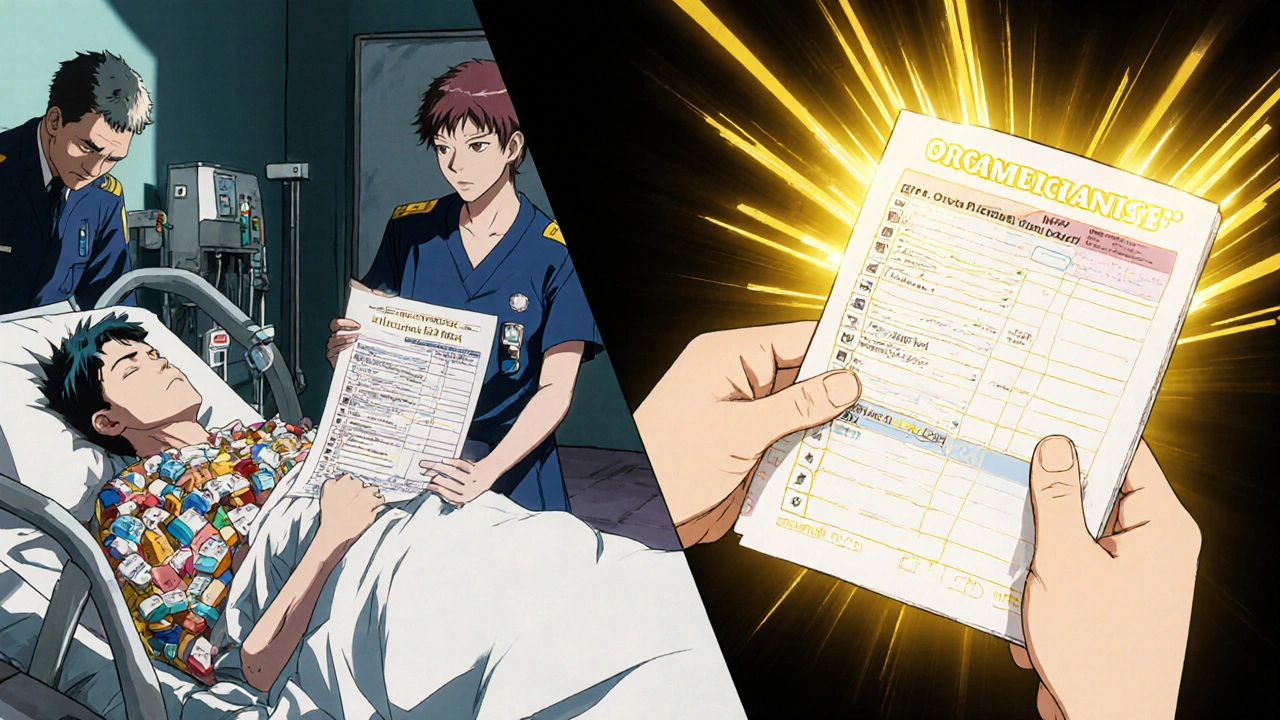
- Keep a copy. Put it in your wallet, on your fridge, or give one to a family member. The CDC recommends bringing it to emergency rooms - because if you’re unconscious, they need to know what you’re taking.
- Share it with all providers. If you see a specialist, a physical therapist, or a new doctor, give them a copy. Patients who shared their MAP with multiple providers had 22.8% fewer duplicate prescriptions.
- Update it weekly. Mark off doses you took. Note side effects. Write down questions for next time. Treat it like a journal, not a form.
- Bring it to every visit. Even if you think nothing changed. Because something always changes - your kidney function, your weight, your insurance, your mood.
One of the biggest mistakes? Treating the MAP as a one-time task. The American College of Clinical Pharmacy calls it a “living document.” That means it grows with you.
Common Pitfalls and How to Avoid Them
Even with the best intentions, things go wrong. Here are the top three mistakes - and how to fix them.
1. Not writing down stop dates
According to the Institute for Safe Medication Practices, 18.7% of medication errors happen because providers don’t know when a drug was discontinued. If you stopped a pill last month, write it down - with the exact date. Not “a few weeks ago.” Not “last visit.” The exact date.
2. Using vague language
“Take as directed” is useless. “Take one tablet by mouth every morning with food” is clear. If your provider says something vague, ask them to write it down properly. You have the right to understand your meds.
3. Ignoring health literacy
Only 12% of U.S. adults have proficient health literacy. If you or a loved one struggles to read or understand the plan, ask for help. Many pharmacies offer free 1-on-1 sessions to explain the MAP. Ask for a simplified version. Use icons. Use color coding. Some clinics now use pictograms for pills - a red circle for morning, blue for night.
Who Benefits the Most?
While anyone on multiple medications can use a MAP, these groups see the biggest gains:
- Seniors over 65: On average, they take 5-7 prescription drugs. Risk of interactions skyrockets.
- People with chronic conditions: Diabetes, heart failure, COPD, kidney disease - all require tight medication control.
- Patients switching providers: New doctor? New pharmacy? Your MAP is your medical passport.
- Family caregivers: If you’re managing meds for a parent or spouse, this plan is your lifeline.
And here’s a quiet win: when you use a MAP consistently, you start feeling more in control. You stop guessing. You stop worrying. You start asking better questions. And that changes everything.
What’s Next for Medication Action Plans?
The future is digital. The 21st Century Cures Act requires EHR systems to share medication data by 2024. That means your MAP could soon auto-update when your doctor prescribes something new.
But tech won’t fix everything. The biggest barrier isn’t technology - it’s health literacy. That’s why simple, paper-based versions still work best for many. The goal isn’t to go high-tech. It’s to go clear.
Medicare currently covers MAPs for 23.7 million beneficiaries. If Medicaid expands similar programs, it could reach 80 million more. The Patient Safety Movement Foundation estimates full adoption could prevent 150,000 medication-related deaths in the U.S. each year.
This isn’t a luxury. It’s a safety net.
Do I need a Medication Action Plan if I only take a few medications?
Yes - even if you’re on just two or three meds, a Medication Action Plan helps you track what you’re taking, why, and when. Many people don’t realize that over-the-counter drugs, supplements, and herbal products can interact with prescriptions. A MAP forces you to write them all down, so nothing gets missed.
Can I use a digital version instead of paper?
You can - and some apps and EHR systems now support digital MAPs. But paper still wins for many, especially older adults. A 2022 AARP survey found 68.3% of patients over 65 prefer paper because it’s easier to carry, update, and show during visits. If you use digital, make sure you can print a copy or show it clearly on your phone at the clinic.
What if my doctor doesn’t use a Medication Action Plan?
Bring one anyway. Many providers are unfamiliar with the template, but they’re not opposed to it. Bring a blank CMS or CDC version and say, “I’ve been using this to keep track of my meds. Can we fill it out together?” Most will be grateful - it saves them time and reduces errors. If they resist, ask to speak with a pharmacist or nurse on staff - they’re often more familiar with these tools.
How often should I update my Medication Action Plan?
Update it every time you see a provider - even for a minor issue. Also update it weekly at home: check off doses, note side effects, and record any new pills you start or stop. Treat it like a diary for your meds. The more current it is, the more useful it becomes.
Is this only for Medicare patients?
No. While Medicare requires MAPs for certain MTM services, the tool works for anyone. Private insurers, Medicaid, and even non-insured patients benefit. It’s not about insurance - it’s about safety. Ask your pharmacist or clinic if they have a template. Most do - even if they don’t advertise it.
Final Thought: Your Meds Are Your Responsibility - But You Don’t Have to Do It Alone
Medication management isn’t about memorizing names and doses. It’s about communication. The Medication Action Plan is the bridge between your memory and your doctor’s notes. Between your confusion and your clarity.
It doesn’t take a genius to use it. Just a little preparation. A willingness to speak up. And the courage to say: “I need to understand this.”
That’s not weakness. That’s strength. And it might just save your life.





Comments
DIVYA YADAV
November 28, 2025The government is forcing this MAP crap on seniors because they want to track every pill you take and sell your data to Big Pharma. I saw a guy at the clinic get flagged because he stopped his blood pressure med after his wife died-he was labeled 'non-compliant' and got his benefits cut. This isn't safety, it's surveillance. They don't care if you're grieving, they just want your numbers. I'm not signing anything they hand me unless it's on paper, sealed in wax, and witnessed by three people I trust. And even then... I'm still skeptical.
Kim Clapper
November 28, 2025While I appreciate the theoretical framework presented here, I must insist that the entire premise is fundamentally flawed from a systems-theoretic perspective. The notion that a static, paper-based artifact can serve as a 'living document' is a linguistic oxymoron bordering on epistemological incoherence. Furthermore, the assumption that patients possess the requisite metacognitive capacity to accurately self-report medication adherence-especially in the presence of polypharmacy-induced cognitive fog-is not merely optimistic, it is dangerously naive. I have reviewed the AHRQ data cited, and I must point out that the confidence intervals are statistically insignificant when adjusted for socioeconomic stratification. This is not a solution-it is a performative compliance ritual dressed in clinical jargon.
Bruce Hennen
November 30, 2025You misspelled 'medication' twice in the first paragraph. Also, 'MAP' should be capitalized consistently. And you said '23.7 million beneficiaries'-that's Medicare Part D, not the total number of users. The CDC doesn't issue MAP templates; CMS does. You're mixing up agencies. Also, 'as-needed' isn't hyphenated when used as an adverb. This whole thing reads like a college freshman's term paper. Fix the grammar before you tell people how to save lives.
Jake Ruhl
December 1, 2025ok so like i just found out that the government is using these medication plans to implant microchips through your pills?? i mean think about it-why else would they make you sign it? why else would they want you to write down EVERY SINGLE THING you take? what if your neighbor is a robot? what if your pharmacist is a deepfake? i asked my doctor and he just laughed and said 'no bro' but then he looked at his watch real fast and i knew-he knows. they're watching. they're tracking your coffee intake, your ibuprofen, your turmeric gummies. i'm not signing anything until the feds release the blueprints. and if i do? i'm writing 'i am a free man' in the signature box. they can't erase that. they can't unsee that.
Chuckie Parker
December 2, 2025India doesn't even have proper pharmacies and you're talking about MAPs like they're the solution? This is a Western luxury. We don't have doctors who can read handwriting, let alone fill out forms. In my village, people take pills from unlabeled bottles because the pharmacist ran out of labels. You think they're gonna write down 'stopped April 12, 2025'? They're lucky if they remember what the pill is for. This whole thing is a rich-country fantasy. Stop exporting your bureaucracy to places that don't have running water.
George Hook
December 3, 2025I’ve been using a MAP for my mom since she was diagnosed with congestive heart failure. It’s not perfect, but it’s the only thing that’s kept her out of the ER for over a year. I print it, laminate it, and keep it in her purse. I update it every Sunday night. I write down when she skips a dose because she felt dizzy. I write down when she took her diuretic at 10 PM and woke up peeing at 3 AM. I don’t care if it’s not fancy. It’s hers. And when she went to the urgent care last month with chest pain, the nurse saw the MAP, called her cardiologist on the spot, and changed her meds before she even got home. That’s not magic. That’s just being prepared. If this helps even one person avoid a hospital stay, it’s worth the 15 minutes a week.
jaya sreeraagam
December 4, 2025OMG I JUST STARTED USING THIS AND IT CHANGED MY LIFE!!! I used to forget if i took my metformin or not and i was so stressed out. now i have this little notebook with my meds, and i check off each one with a sticker. i even drew little hearts next to the ones that made me feel better. my pharmacist said she’s never seen someone so organized! and guess what? my doctor was so impressed he gave me a free glucose monitor. i told him it was the MAP. i’m telling all my friends. if you’re on meds, just try it for one week. you won’t believe how calm you’ll feel. you’re not alone. you got this. 💪❤️
Katrina Sofiya
December 4, 2025Thank you for this thoughtful, meticulously researched guide. As a clinical educator, I’ve trained dozens of nurses and pharmacists in Medication Therapy Management, and I can confidently say that the Medication Action Plan is one of the most underutilized tools in outpatient care. Its power lies not in its structure, but in the dialogue it facilitates. When patients bring it to appointments, they transition from passive recipients to active partners in their care. I encourage every provider-regardless of specialty-to adopt this as a standard of practice. And to patients: your voice matters. Your health matters. This document is your ally.
kaushik dutta
December 5, 2025As someone who’s worked with rural health systems in Uttar Pradesh and collaborated with U.S. clinics on MTM protocols, I can tell you this: the MAP isn’t just a tool-it’s a cultural bridge. In India, we use pictograms because literacy rates vary. In the U.S., we use color-coded tabs. The core is the same: clarity, accountability, human dignity. But here’s the thing-Western medicine treats compliance as a behavioral problem. In many Global South communities, it’s a structural one. No access to pharmacies? No refrigeration for insulin? No translator? No MAP will fix that. But if you pair the MAP with community health workers, mobile clinics, and local language adaptations? That’s when it becomes transformational. This isn’t a template. It’s a movement.
doug schlenker
December 6, 2025I’m a retired nurse and I’ve seen a lot. I used to work in a busy ER where people came in with 17 different meds and no idea what half of them were for. I started giving my patients a simple two-column sheet: one side for meds, one side for why. No fancy templates. Just pen and paper. I’d sit with them for 10 minutes and ask, ‘What’s the worst thing that happened when you forgot this one?’ That’s when the real stories came out. One woman said she stopped her cholesterol pill because her husband said it made her ‘too calm’-he didn’t like how she stopped yelling at him. Another guy skipped his diabetes meds because he was saving them to trade for cigarettes. The MAP doesn’t fix everything. But it makes the invisible visible. And sometimes, that’s all you need to start healing.
Olivia Gracelynn Starsmith
December 7, 2025I’ve been using a version of this for my dad who has dementia. I keep it in a folder with his medical records. I update it every time he sees a new doctor. I don’t worry about the format. I just make sure the names, doses, and dates are correct. Last month he got a new prescription for sleep aids and I forgot to add it. He took two pills instead of one and ended up in the hospital. I felt terrible. But because I had the MAP, the ER nurse saw it, called his primary, and we fixed it in an hour. It’s not glamorous. It’s not viral. But it saved his life. Do it. Even if it’s messy. Even if it’s handwritten. Just do it.
Skye Hamilton
December 8, 2025So I tried the MAP thing. I filled it out. I brought it. My doctor barely glanced at it. He was on his phone. The pharmacist laughed and said, 'Honey, no one reads these.' I felt stupid. Like I wasted my time. Then I got a text from my sister saying she found my old pill bottle from 2020 in the back of her cabinet-same name, same dose, but it was expired. I had no idea I was still taking it. That’s when it hit me. Maybe the MAP doesn’t help the doctors. Maybe it’s for us. So we don’t forget. So we don’t die because we were too ashamed to say we stopped the pills because they made us cry. So we remember we’re still human. Even if no one else does.
Write a comment