

Buying things from abroad used to be simple: find a deal, pay for shipping, and wait for the package. But if you're trying to save on medication costs or specialty goods today, you've probably noticed that the rules have completely changed. The era of the "duty-free" $800 limit is gone. Since late 2025, the U.S. government has basically rewritten the playbook on how packages enter the country, making it much harder-and more expensive-to order small items from overseas.
If you aren't careful, a $50 order could suddenly cost you another $80 in taxes, or worse, your package could be seized at the border. To navigate this, you need to understand the new reality of International Mail-Order, which is the process of purchasing goods from foreign merchants via postal or private carriers. Whether you're looking for cheaper prescriptions or niche electronics, the legal landscape is now defined by strict valuation and classification rules.
The Death of the $800 Threshold
For decades, U.S. shoppers enjoyed a loophole called the de minimis threshold. If your package was worth less than $800, it usually sailed through customs without any one-time import taxes. That ended on August 29, 2025, when U.S. Customs and Border Protection (CBP) implemented Executive Order 14324. This order scrapped the $800 exemption for almost everyone.
Now, nearly every commercial shipment entering the U.S. is subject to duties. The only real exception is for purely private gifts valued under $100. This means that if you're buying something from a business-even a tiny boutique in Germany or a pharmacy in Canada-you will likely owe money to the government before you can get your hands on the product. This change has turned "cheap" international shopping into a calculated risk.
Understanding the New Duty Collection Methods
Depending on when you order and who you use, the way you pay these taxes differs. We have transitioned through a dual-phase system. Until February 28, 2026, shippers could choose between two methods. Since we are now past that window, the U.S. has moved to a permanent ad valorem system. This means the duty is based on a percentage of the actual value of the item.
To keep things clear, here is how the costs were structured during the transition and what you face now:
| Feature | Method 1 (Ad Valorem) | Method 2 (Flat Rate) |
|---|---|---|
| Calculation | Percentage of declared value | Fixed fee per item |
| Cost Range | Varies by product category | $80, $160, or $200 per item |
| Status (Post-Feb 2026) | Current Standard | No longer permitted |
| Best For | Low-to-mid value goods | High-tariff luxury items |
Because we are now using only the ad valorem system, the precision of the item's declared value is everything. If a seller under-declares the value to help you avoid taxes, the CBP may flag the shipment, leading to delays or heavy fines.
The Role of HS Codes and Documentation
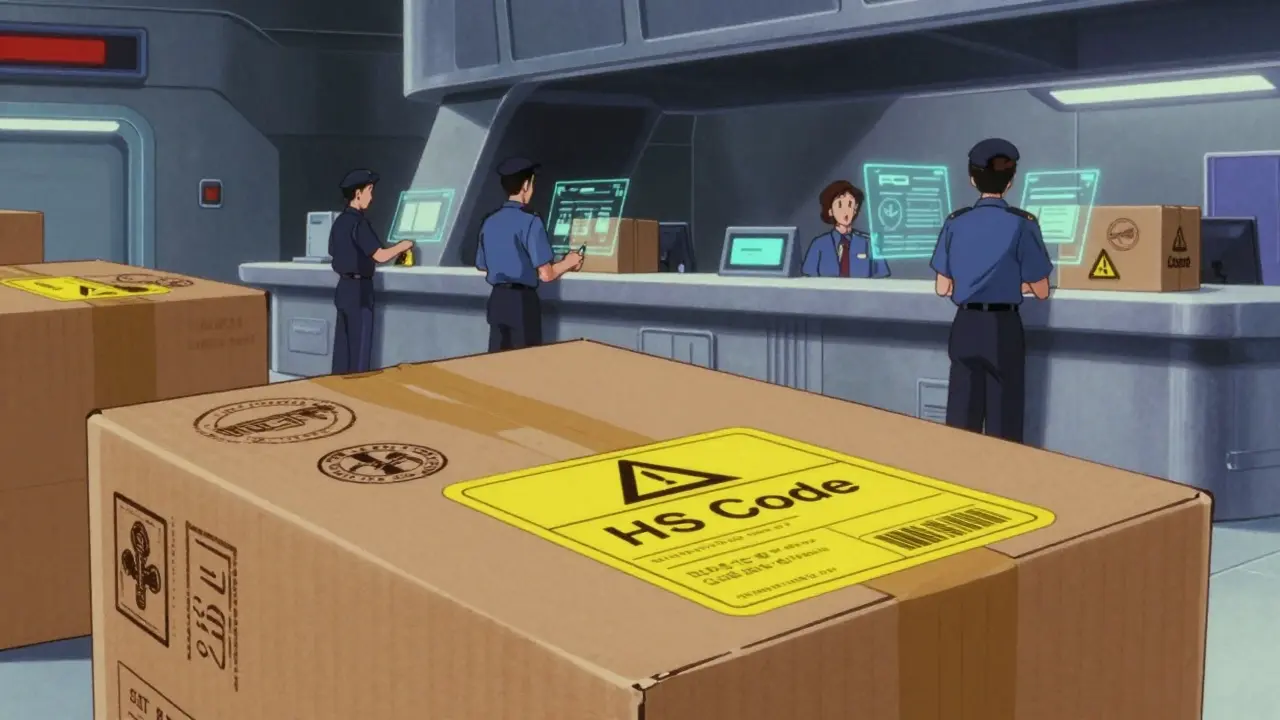
You might have noticed your favorite international sellers asking for more info than usual. That's because as of September 1, 2025, the US Postal Service requires a six-digit Harmonized System (HS) Code for all commercial shipments. Think of an HS code as a universal language for customs; it tells the government exactly what is in the box so they know which tax rate to apply.
Using the wrong code is a dangerous game. Experts warn that a simple mistake in the HS code can result in duties being assessed at rates 300% higher than necessary. To stay legal and safe, ensure your package includes:
- A Detailed Commercial Invoice: Avoid generic terms like "gift" or "sample." If it's a specific medication or a piece of tech, the description must be exact.
- A Packing List: This should match the invoice perfectly.
- Bill of Lading (BOL): Required for the carrier to track the legal movement of the goods.
- Certificate of Origin (CO): Especially important for items coming from Mexico or Canada to qualify for USMCA trade preferences.
Choosing the Right Carrier: Postal vs. Express
Not all shipping methods are created equal in this new environment. Standard national postal services are struggling. For example, Deutsche Post stopped accepting many business parcels to the U.S. because they couldn't handle the complex duty collection. If you try to use a basic postal service, your package is more likely to be stuck in a customs warehouse.
On the other hand, express carriers like DHL, FedEx, and UPS are better equipped. They act as customs brokers, meaning they handle the paperwork and payment on your behalf (though they'll bill you for it, often with an extra convenience fee). While their base shipping rates are higher, the likelihood of your package arriving safely and legally is significantly higher.

Risks and Red Flags to Watch For
When you're trying to save money-especially on health-related products-it's tempting to use "gray market" shippers who promise to bypass customs. Avoid this. The CBP has a rigorous approval process for "qualified parties" and uses Activity Code 3 bonds to hold carriers accountable. If a carrier is caught skirting the rules, they face penalties up to $100,000 per violation.
If a seller tells you they can "guarantee" no customs fees on a commercial order, they are likely lying or using illegal methods. This puts your shipment at risk of seizure. For those ordering high-value items (over $2,500), remember that you'll need an Automated Export System (AES) filing, which is a formal electronic declaration of the goods leaving the origin country.
Can I still get duty-free packages from abroad?
Only if the shipment is a purely private gift valued under $100. Commercial purchases, regardless of the price, are now subject to duties under the 2025 regulations.
What happens if the HS code on my package is wrong?
Incorrect codes can lead to two outcomes: either your package will be delayed while customs asks for clarification, or you'll be charged a much higher duty rate than necessary-sometimes up to 300% more than the correct rate.
Who is responsible for paying the import duty?
Generally, the recipient (the importer of record) is responsible. However, depending on the agreed Incoterms (shipping terms), the seller might pay it. Always clarify if you are paying DDP (Delivered Duty Paid) or DAP (Delivered At Place) before ordering.
Are express carriers safer than the regular mail?
Yes. Carriers like DHL and FedEx have built-in customs brokerage services that handle the electronic filing of HS codes and duty payments, which significantly reduces the chance of your package being seized or lost.
What is the AES filing for high-value items?
The Automated Export System (AES) is a requirement for shipments exceeding $2,500 per item. It requires a Letter of Authorization and a formal electronic filing before the item even leaves the country of origin.
Next Steps for Safe Ordering
If you are an individual consumer, your best bet is to shift toward integrated logistics providers. If the cost of the duty makes a small purchase irrational-like the famous example of $50 craft supplies incurring an $80 fee-it may be time to look for regional fulfillment hubs. Many companies are now using warehouses in Mexico or Canada to manage shipping into the U.S. more efficiently.
Before you hit the "buy" button on an international site, ask the seller for the specific HS code they plan to use and check if they offer DDP shipping. This ensures there are no surprise bills waiting for you at the door, and it keeps your transaction fully compliant with U.S. law.




Comments
Divine Manna
April 5, 2026The transition to a permanent ad valorem system was an inevitability for any state attempting to maintain a semblance of fiscal sovereignty over its borders. It is quite naive to expect that a loophole as wide as the $800 de minimis threshold could persist in an era of hyper-efficient global e-commerce without eventually triggering a corrective legislative response from the CBP.
Beth LeCours
April 5, 2026too hard now.
Brian Shiroma
April 7, 2026Oh great, so now we get to pay a premium just to have the government treat us like criminals for ordering a bottle of vitamins from Canada. I'm sure the extra fees are going straight into a very important fund for more customs agents to stare at boxes with suspicion.
Goodwin Colangelo
April 9, 2026If you're still trying to use the regular mail for business stuff, just stop. I've seen way too many packages get stuck in limbo because the sender didn't know how to handle the HS codes. Go with DHL or UPS; they charge a fee for the brokerage, but it's way cheaper than losing your entire order and the money you spent on it.
Jenna Carpenter
April 10, 2026literally nobody read the fine print on the lables and then they wonder why their stuff is gone lol. its common sense ppl
HARSH GUSANI
April 11, 2026Why are we even talking about US rules? 🇮🇳 India has way better systems for trade and we don't just change the rules overnight to screw over the little guy like they do in America! 🙄 Absolute joke of a system! 🚩
simran kaur
April 12, 2026The sudden insistence on HS codes is just a front for more invasive data collection. They aren't just taxing the goods; they're building a database of every single niche item moving across borders to track consumption patterns for their little social credit experiment. Don't believe for a second that this is about revenue.
Rachelle Z
April 14, 2026Wow... just wonderful that everything is more expensive now!!! 🙄💖 I love how the government helps us save money by taking more of it!!! 💅✨
The Charlotte Moms Blog
April 16, 2026Absolutely ridiculous... the lack of transparency here is stunning!!! How am I supposed to budget for my kids' needs when a $50 order can turn into a $130 nightmare... just total incompetence!!!
Branden Prunica
April 17, 2026I literally had a package seized last month because of a stupid HS code error and I almost had a meltdown. Like, it's a piece of plastic! Why does the government care so much that I'm importing a small toy from Japan?! It's actually heartbreaking.
angel sharma
April 18, 2026We must view this as an opportunity to refine our logistics and become more disciplined in how we manage our international trade because once you master the documentation and the HS codes you will find that you are actually more efficient than you were when you were just relying on loopholes that could be closed at any moment without warning!
Sakshi Mahant
April 20, 2026It is helpful to see the breakdown of the different shipping methods, as it allows us to make informed choices while respecting the laws of different nations. Perhaps we can find a middle ground by supporting more local hubs as suggested in the post.
Hudson Nascimento Santos
April 20, 2026There is a certain irony in the way we seek liberation through global commerce only to find ourselves bound by the very bureaucratic chains we thought we were escaping. The movement of a physical object across a line in the sand now requires a digital prayer to the gods of customs.
sophia alex
April 22, 2026Exactly! The US is the only country that can actually enforce these things properly anyway. 🇺🇸 If you can't afford the duties, maybe you shouldn't be shopping in Europe or Asia! 💅 Keep the borders tight and keep the quality high! 💋
Ace Kalagui
April 23, 2026I really feel for everyone struggling with this transition, especially those relying on medication from abroad, and I think it's just so important that we all hold each other up and share our experiences with the different carriers to ensure nobody else gets hit with those surprise $80 fees that can really break a monthly budget when you're already stressed out.
It's just such a complex world now, but if we just take a deep breath and slowly learn the HS code system together, I'm sure we can all find a way to get our specialty goods safely without feeling the crushing weight of customs anxiety every time the mail arrives.
Write a comment