
Hypoglycemia Risk Calculator
Personal Risk Assessment
Based on your diabetes medications, age, kidney function, and diabetes duration.
Your Hypoglycemia Risk Assessment
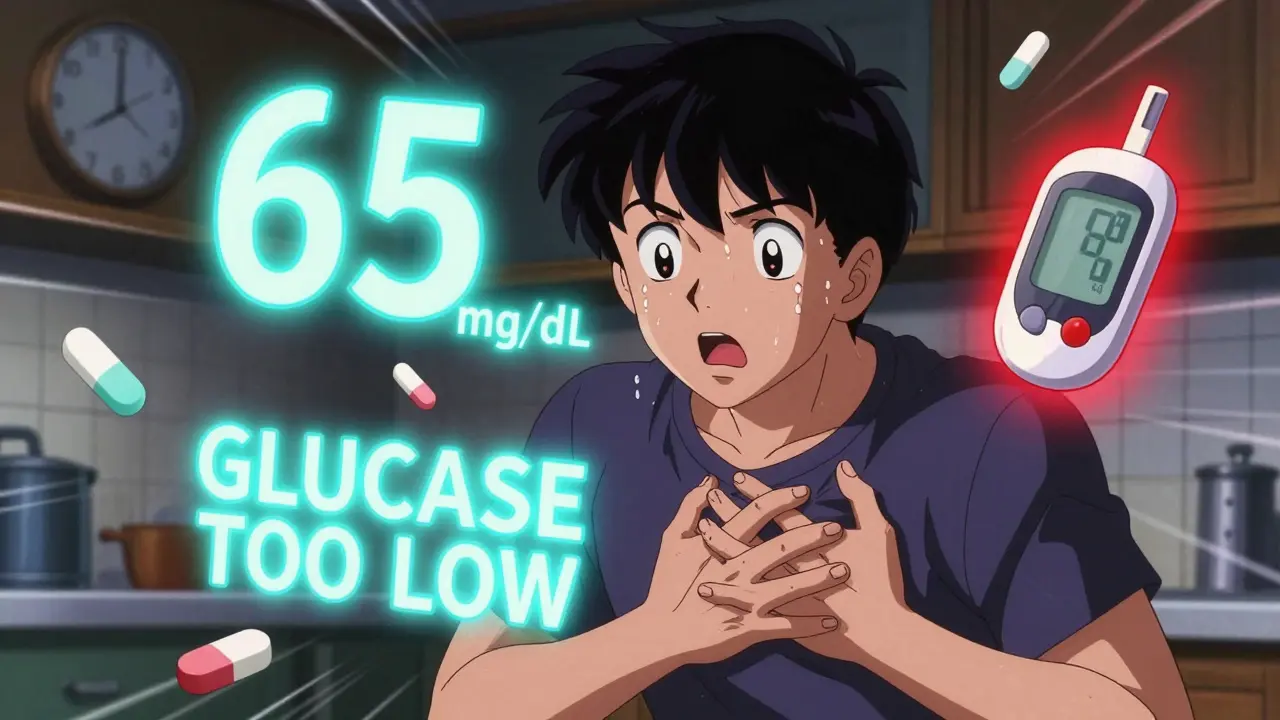
Low blood sugar from diabetes meds isn’t just a nuisance-it can be dangerous. If you’re on insulin, sulfonylureas, or meglitinides, you’ve probably felt the shaky hands, sweating, or sudden confusion that tells you your glucose has dropped too low. But here’s the truth: hypoglycemia doesn’t have to rule your life. With the right plan, you can stay safe, avoid hospital trips, and still live normally.
First, know the numbers. The American Diabetes Association defines hypoglycemia as blood glucose below 70 mg/dL. That’s the red flag. But symptoms start showing around 65 mg/dL-sweating, hunger, racing heart. Below 55 mg/dL, things get serious: confusion, drowsiness, even seizures. These aren’t just "bad days." They’re medical events. The CDC says about 10% of diabetes-related hospital admissions come from severe low blood sugar. That’s preventable.
Which Medications Put You at Risk?
Not all diabetes drugs cause low blood sugar. Metformin? Almost zero risk. GLP-1 agonists like semaglutide? Less than 2%. But if you’re on insulin, sulfonylureas (glimepiride, glipizide, glyburide), or meglitinides (repaglinide, nateglinide), your risk jumps. Sulfonylureas cause low blood sugar in 15-30% of users each year. Insulin? That number climbs to 20-40%, depending on how complex your regimen is. And here’s the catch: many people don’t realize their meds are the culprit. They blame stress, skipping meals, or "just being tired." But the numbers don’t lie.
Some newer sulfonylureas like glimepiride are safer than older ones like glyburide-20-30% fewer lows. Short-acting insulin analogs (lispro, aspart) cut hypoglycemia risk by 19% compared to regular human insulin. That’s a real difference you can ask your doctor about.
Who’s Most at Risk?
It’s not just about the drug. Your body matters too. People over 65 have a 40% higher risk. If you have kidney disease (eGFR under 60), your risk more than doubles. After 15 years with diabetes, 10% of type 2 and 25% of type 1 patients lose their warning signs-that’s called hypoglycemia unawareness. You won’t feel the shake. You won’t know until you’re dizzy or passed out.
Other red flags: taking beta-blockers for high blood pressure (they hide the early symptoms), drinking alcohol (responsible for 22% of severe lows in people under 40), or exercising without adjusting food or insulin. One study found 31% of active patients had daytime lows because they didn’t eat extra carbs before a workout.
The 15-15 Rule (And Why Most People Get It Wrong)
When your glucose drops below 70, you need fast-acting sugar. Not a candy bar. Not a banana. Not a handful of raisins. You need exactly 15 grams of pure glucose. That’s:
- 3-4 glucose tablets
- 1 tube of glucose gel
- 4 ounces of regular soda (not diet)
- 1/2 cup of fruit juice
Wait 15 minutes. Check again. If it’s still under 70, repeat. This works 89% of the time-if you do it right. But here’s the problem: 63% of people use artificial sweeteners, complex carbs, or "a snack" instead. That’s like trying to put out a fire with a bucket of sand. It doesn’t work fast enough. Glucose tablets are cheap-$8-$12 for 20-and they’re designed for this exact moment.

What You Need to Carry (And Where)
Don’t wait for a crisis. Build your "hypo kit" now. At minimum, carry:
- Glucose tablets (keep one in your wallet, purse, car, and gym bag)
- A glucagon emergency kit (Baqsimi nasal spray or Gvoke injection)
- Your blood glucose meter or CGM
Glucagon is not optional. If you pass out or can’t swallow, someone else needs to give you this. Baqsimi nasal spray takes 10 seconds to use. Gvoke is a pre-filled syringe. Both are FDA-approved and easier than old glucagon kits that required mixing. Cost? Baqsimi is $250, Gvoke is $350. Insurance often covers it. Medicare now pays for glucagon for all insulin users.
And here’s what works: 54% of people who avoid severe lows keep "hypo bags" in multiple places-home, car, office. One man in San Francisco keeps a bag in his bike helmet. Another keeps glucose gel in her toddler’s diaper bag. You’re not being paranoid. You’re being smart.
Technology That Actually Helps
Continuous glucose monitors (CGMs) like Dexcom G7 or Freestyle Libre 3 cut hypoglycemia time by 35% and severe events by 48%. They beep before your glucose crashes. They show trends. They let you see if your sugar’s dropping after lunch or at 3 a.m.
But cost is a barrier. CGMs cost $89-$399 per month out-of-pocket for Medicare patients. That’s why 35% of low-income users don’t use them. If you’re on insulin, Medicare now covers CGMs. Ask your doctor for a prescription. If you can’t afford it, ask about patient assistance programs from manufacturers.
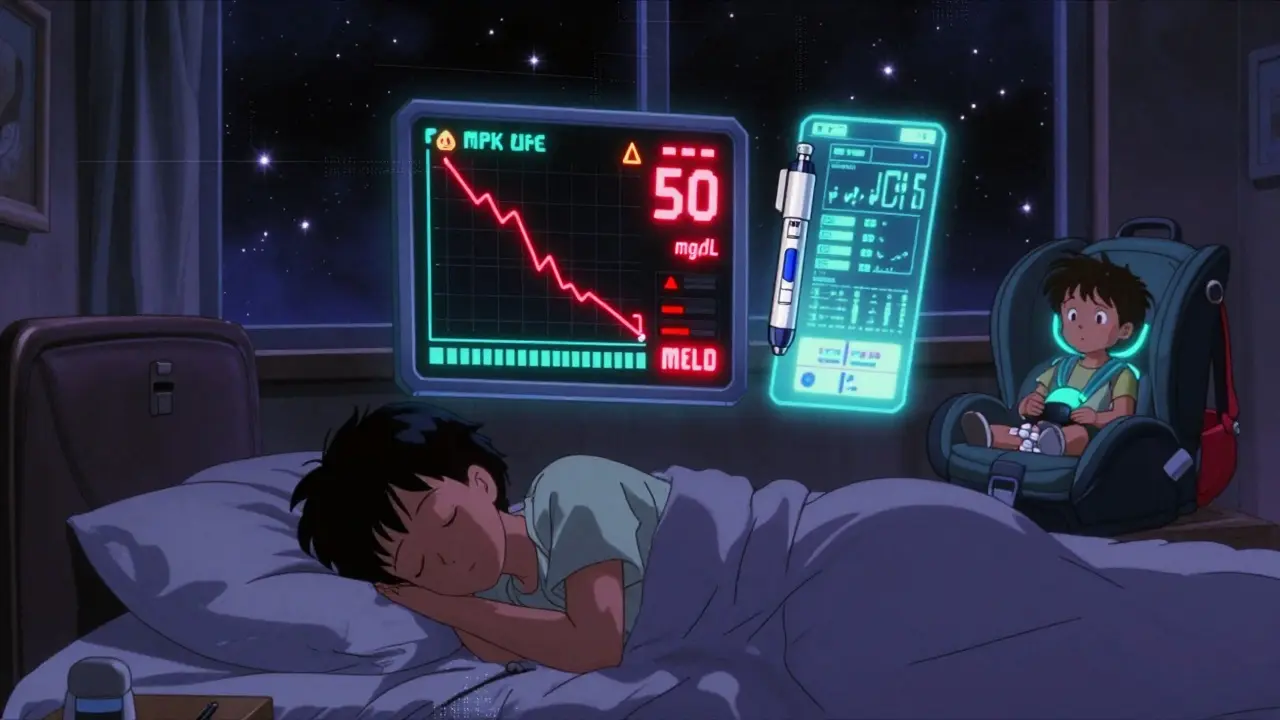
Smart insulin pens (like InPen or NovoPen Echo) track your doses and sync with apps. They help you spot patterns: "Every time I take 10 units at dinner, I crash at 2 a.m." That’s gold. These pens cost about $150, with sensors at $50/month. Still cheaper than a hospital visit.
What No One Tells You About Logging
Most people log their glucose numbers. But logging alone doesn’t help. You need to log context. The Joslin Diabetes Center found that patients who tracked:
- Medication time and dose
- Food (grams of carbs, not "a slice of bread")
- Exercise duration and intensity
- Stress or illness
- Glucose reading
Reduced hypoglycemia by 52% in six months. That’s not magic. That’s pattern recognition. You can’t fix what you don’t measure. And 78% of people carry glucose tablets-but 35% admit they often run out. If you’re not logging, you’re guessing. And guessing kills.
When to Call Your Doctor
If you’ve had two or more severe lows in three months, talk to your provider. That’s not normal. That’s a signal to change your plan. Your doctor should:
- Review your meds. Can you switch from glyburide to glimepiride? From long-acting insulin to a newer analog?
- Check your kidney function. If your eGFR is low, your body can’t clear insulin properly.
- Test for hypoglycemia unawareness. If you’ve had diabetes over 15 years, get screened.
- Recommend a CGM. Even if you’re on oral meds, if you’ve had a low, you need data.
Don’t wait for a hospital trip. The Endocrine Society says hypoglycemia risk should be assessed at every visit. Ask your doctor: "Based on my meds and history, what’s my personal low blood sugar risk score?" There’s a validated 8-point tool that predicts severe events with 82% accuracy.
Real-World Fixes That Work
People aren’t just surviving-they’re thriving. Here’s what works:
- Set phone alarms for meals and insulin timing. 67% of users say this cuts their lows.
- Always eat carbs with alcohol. One beer = 15g carbs. Two beers? Double it.
- Adjust insulin before exercise. If you’re going for a walk, take 5-10g of carbs. If you’re hiking, take 20g.
- Train family members on how to use glucagon. 41% of type 1 patients have someone trained.
- Keep glucose tablets in your child’s backpack if you’re a parent. 68% of people on Reddit say they’ve skipped meals because of fear of lows-and that’s dangerous.
The future is here. Predictive systems like Control-IQ on the Tandem pump reduce overnight lows by 3.1 hours. AI-driven dosing algorithms (coming in 2024) could cut hypoglycemia by 60%. But you don’t need the latest tech to be safe. You need a plan, a kit, and a habit of logging.
Hypoglycemia isn’t a failure. It’s a signal. Listen to it. Act on it. Change your plan. Your life depends on it.



Comments
Sneha Mahapatra
February 28, 2026I’ve been living with type 2 for 12 years, and hypoglycemia unawareness hit me hard last winter. I didn’t feel anything until I nearly passed out in the grocery store. Now I keep glucose gel in my coat pocket, my purse, and even my knitting bag. I know it sounds weird, but it’s saved me twice. I don’t talk about it much-I’m not dramatic-but I’m glad someone finally wrote this clearly.
Also, the 15-15 rule? I used to think a banana was enough. Turns out, bananas are slow. Glucose tabs are the real MVP. I buy them in bulk now. $8 for 20? That’s cheaper than an ER visit. I’m just glad I learned this before it was too late.
bill cook
March 1, 2026I don’t get why people make such a big deal about this. My grandma had diabetes and she just ate candy whenever she felt weird. Problem solved. You’re overcomplicating it with all these tablets and gadgets. Life’s not a lab experiment. Just eat something sweet and move on.
Katherine Farmer
March 1, 2026The 15-15 rule is statistically sound, yes-but the real issue is compliance. Most patients are non-adherent by design. They don’t want to carry ‘medical paraphernalia’ because it stigmatizes them. And let’s not pretend that glucose gel in a diaper bag is a sustainable public health strategy. This is Band-Aid medicine for a systemic failure in chronic disease education. We need policy changes, not pocket kits.
Full Scale Webmaster
March 1, 2026Okay, let’s get real. This whole article is basically a glorified ad for Dexcom and Baqsimi. Who funded this? Big Pharma? Because the tone? It’s dripping with corporate messaging. ‘Glucagon is not optional’? Who said that? The FDA? Or the guy who sells it? And don’t get me started on the $350 Gvoke. You think a working-class person in rural Ohio can afford that? No. So you’re telling people to ‘just ask your doctor’ while ignoring that 40% of Americans can’t even afford a $400 copay. This isn’t empowerment. It’s guilt-tripping with a side of profit margin.
And don’t even get me started on the ‘logging context’ thing. You want me to log my insulin dose, carbs, stress, exercise, AND my mood? I’m not a data scientist. I’m a single mom who works two jobs. You’re not helping. You’re exhausting people.
Angel Wolfe
March 1, 2026They don’t want you to know this but insulin isn’t even supposed to be used for type 2. That’s a scam. The ADA and Big Pharma got together in the 90s to make people dependent on expensive drugs so they’d keep paying. Glimepiride? Glyburide? Those are just the tip of the iceberg. They’re replacing natural blood sugar regulation with synthetic dependency. And now they want you to buy CGMs? That’s surveillance. They’re tracking your glucose like it’s a crime. Wake up. This isn’t medicine. It’s control.
Ajay Krishna
March 1, 2026I’m from India, and I’ve seen so many people here just ignore lows because they think it’s ‘just weakness’ or ‘not serious.’ But this article? It’s a lifeline. My cousin had a seizure last year because no one knew glucagon existed. Now I’ve printed this out and given copies to every diabetic person I know. Glucose tabs in the car? Check. Glucagon in the fridge? Check. I even taught my niece how to use it. Small things. Big impact. You’re not alone. We’ve got your back.
Noah Cline
March 3, 2026The pharmacokinetics of sulfonylureas are poorly understood by the general population. Glyburide, in particular, has a prolonged half-life due to hepatic metabolism via CYP2C9, leading to accumulation in renal impairment. Glimepiride, with its lower affinity for SUR1 receptors and reduced renal excretion, demonstrates superior safety profiles in elderly populations. The 15-15 rule is empirically valid, but the reliance on exogenous glucose without accounting for endogenous gluconeogenesis is a physiological oversimplification. You’re not managing hypoglycemia-you’re treating its symptoms.
Lisa Fremder
March 5, 2026I’ve had two lows this month. I didn’t even know I was low until I cried in the shower. I’m done pretending this is just ‘a part of diabetes.’ I’m calling my doctor tomorrow. I’m getting a CGM. I’m not asking permission. I’m not waiting for insurance. I’m done being scared. If you’re still using bananas, you’re playing Russian roulette with your brain.
Brandon Vasquez
March 5, 2026I appreciate the clarity here. No fluff. Just facts. I’ve been on insulin for 8 years and I used to think I was just ‘bad at managing.’ Turns out, I was just using the wrong tools. Glucose tablets changed everything. I carry them in my wallet now. No shame. My wife even keeps one in her purse. We’re not freaks. We’re prepared. This isn’t about perfection. It’s about safety. Thank you for saying what needs to be said.
Brandie Bradshaw
March 5, 2026I’ve been logging everything for six months now-meds, meals, walks, stress levels, even the weather-and the difference is night and day. I used to have three lows a week. Now? Maybe one a month. And it’s not because I’m ‘better.’ It’s because I stopped guessing. I started seeing patterns. Like how my sugar crashes every time I take a nap after lunch. Or how my morning insulin dose is too high on rainy days. It’s not magic. It’s math. And math doesn’t lie. If you’re not logging, you’re flying blind. And that’s not bravery-it’s recklessness.
Martin Halpin
March 5, 2026You know what’s funny? The whole ‘15-15 rule’ thing? I tried it once. Took my 15 grams of glucose. Waited 15 minutes. Checked. Still low. Took another 15. Still low. Took another. Then I ate a whole bag of gummy bears. And guess what? I felt fine. So what’s the point of all this rigid science? Maybe the body knows better than the algorithm. Maybe we’re over-engineering a natural process. I’m not saying ignore the numbers-but don’t let them turn you into a robot. Sometimes, you just need to eat the damn candy.
Ben Estella
March 7, 2026I work in a hospital. Seen too many people come in with blood sugar at 38. Always the same story: ‘I thought I was fine.’ No. You weren’t. And now you’re on a ventilator. Stop being a hero. Carry the damn tablets. Get the glucagon. Train your kids. Your spouse. Your dog if you have to. This isn’t optional. This is survival. And if you think it’s embarrassing? You’re already dead. Just ask your body.
Jimmy Quilty
March 9, 2026I think the real issue is that they dont want us to know that insulin can be replaced by fasting and keto. I tried it for 3 months and my lows stopped. The docs dont tell you this because they make money off your meds. CGMs? Just a way to keep you hooked. I got off insulin. My HbA1c is 5.2. I eat meat. I dont eat carbs. I dont need gadgets. I need freedom. And you? You’re still buying into the system. Wake up.
Miranda Anderson
March 9, 2026I read this while sitting in my car after a low at work. I didn’t even realize I was shaking until I checked my CGM. It said 59. I ate two glucose tabs. Sat there for 15 minutes. Didn’t move. Just breathed. And then I felt… okay. Not great. Not amazing. Just okay. And I thought-this is what they mean by ‘living normally.’ Not perfect. Not fearless. Just okay. And that’s enough. I’m not trying to be a superhero. I’m just trying to make it to dinner without passing out. This article didn’t give me hope. It gave me permission to be human.
Gigi Valdez
March 10, 2026This is a well-structured, evidence-based overview of hypoglycemia management. The integration of clinical guidelines from the ADA, CDC, and Endocrine Society is commendable. The emphasis on context-aware logging aligns with current behavioral endocrinology literature, particularly the work of the Joslin Diabetes Center on pattern recognition. I would only suggest expanding the section on socioeconomic barriers to CGM access, as disparities in device utilization remain a critical public health concern. Well done.
Write a comment