

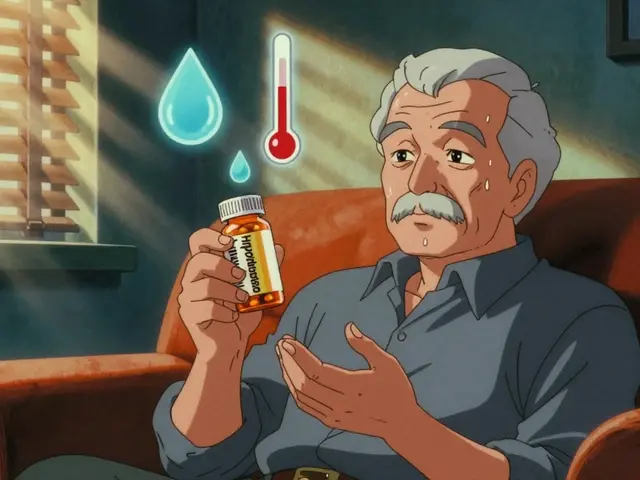
When the temperature climbs, your body relies on one main tool to stay cool: sweating. But if you're taking diuretics or anticholinergics, that tool can stop working - and the consequences can be deadly.
Every year, heat-related illness sends tens of thousands to the hospital. And among those most at risk? People taking common medications like furosemide (Lasix), hydrochlorothiazide (Microzide), oxybutynin (Ditropan), or amitriptyline (Elavil). These aren't rare drugs. In fact, over 30 million Americans take diuretics for high blood pressure or heart failure. Another 20 million take anticholinergics - often for overactive bladder, depression, or Parkinson’s. Many of them are older adults, and they're not always aware their meds are making them more vulnerable to heat.
How Diuretics Put You at Risk
Diuretics - often called "water pills" - help your body get rid of extra fluid. That's great for lowering blood pressure or reducing swelling. But when it's hot, that same mechanism becomes dangerous.
These drugs work by making your kidneys flush out sodium and water. That lowers blood volume. And when your blood volume drops, your heart has a harder time pumping blood to your skin, where heat needs to escape. You might not even feel thirsty, because diuretics can mask your body's natural signal to drink.
Worse, many diuretics - especially thiazides like hydrochlorothiazide - also drain potassium. Low potassium can cause muscle cramps, irregular heartbeat, and even cardiac arrest during heat stress. A 2022 study of 1.2 million Medicare patients found that those taking loop diuretics had a 37% higher risk of being hospitalized for heat-related illness, even when temperatures were just above 80°F (26.7°C). That’s not a heatwave. That’s a normal summer day.
How Anticholinergics Block Your Body’s Cooling System
While diuretics mess with your fluid balance, anticholinergics attack your body’s cooling mechanism at the source: sweat.
These drugs block acetylcholine, a chemical your body uses to trigger sweat glands. Medications with a high anticholinergic burden score (ACB = 3) - like oxybutynin, tolterodine, or tricyclic antidepressants - can reduce sweating by 30% to 50%. That means your body can’t cool down, even if you're outside in 90°F weather.
And here’s the scary part: you won’t know it’s happening. Anticholinergics can cause confusion, dizziness, or memory issues. So if you start feeling hot, dizzy, or disoriented, you might not realize it’s heat illness. You might just think you’re "feeling off." That’s why so many heat-related deaths involve people on these drugs. In Oregon’s 2021 heat dome, 63% of the 800+ heat-related deaths involved diuretics or anticholinergics.

What You Need to Do Right Now
Don’t stop taking your meds. But do take these steps:
- Drink water - even if you don’t feel thirsty. Your body may not signal you properly. Aim for at least 8 ounces every hour if you’re outside or in a hot room. Avoid alcohol and caffeine - they make dehydration worse.
- Check your urine. If it’s dark yellow or you’re peeing less than usual, you’re dehydrated. Light yellow or clear? You’re doing okay.
- Wear the right clothes. Loose, light-colored cotton lets air flow and helps sweat evaporate. Dark, tight clothing traps heat. And yes - wear sunscreen. Many anticholinergics make your skin more sensitive to sunburn.
- Stay indoors during peak heat. Between 10 a.m. and 4 p.m., the sun is strongest. If you must go out, stay in the shade. Use a hat and umbrella.
- Know the warning signs. Headache, dizziness, nausea, muscle cramps, confusion, rapid heartbeat, or hot, dry skin (no sweating) - these are red flags. Don’t wait to feel "really bad." Act fast.
When to Call Your Doctor
You don’t need to guess whether your meds need adjusting. Talk to your provider before summer hits.
Some patients benefit from temporary dose changes during extreme heat. A 2022 pilot study at Massachusetts General Hospital found that 42% of heart failure patients on diuretics needed lower doses during a heatwave - and their symptoms improved without worsening their condition.
For anticholinergic users, especially older adults, it’s smart to set up a "buddy system." Have someone check on you twice a day during heat events. A text, a call, or a quick visit can save your life. If you live alone and have memory issues, ask your doctor about a home monitoring system or a medical alert device.

Why This Isn’t Just "Common Sense"
Most heat safety advice says "drink water" and "stay cool." But that’s not enough for people on these medications. You’re not just at risk because you’re outside. You’re at risk because your body’s natural defenses are being blocked or weakened by drugs you need to survive.
The CDC says clinicians should have a clear plan for each patient: "What symptoms mean trouble? When should you go to the ER? Who should you call?" If your doctor hasn’t given you that plan, ask for it. You deserve more than generic advice.
And here’s the hard truth: research on this is still limited. Most studies were done on young, healthy men in short-term lab settings. But the people most at risk - older adults with heart disease, kidney problems, or dementia - aren’t in those studies. That means we’re flying blind in some ways. We know the danger. We just don’t have perfect data.
What’s Being Done
The National Institute on Aging is funding $4.2 million in new research to study how these drugs affect older adults in real heat. Penn State is running a $2.8 million study tracking how medications change body temperature in people over 60. The EPA says 92% of heat-related deaths in 2022 involved someone taking a medication that interferes with heat regulation.
That’s not a coincidence. It’s a pattern. And as climate change makes extreme heat more common - the number of days over 90°F has jumped 47% since 1970 - this isn’t going away. It’s getting worse.
What you do today matters. Not tomorrow. Not next summer. Now.
Can I stop taking my diuretic if it’s too hot?
No. Never stop or change your dose without talking to your doctor. Stopping a diuretic suddenly can cause dangerous fluid buildup, high blood pressure, or heart failure. Instead, ask your provider if a temporary dose reduction is safe during extreme heat. Many patients can safely adjust their dose for a few days with medical supervision.
Do all anticholinergics stop sweating the same way?
No. Medications are ranked by anticholinergic burden (ACB) score. Drugs with ACB = 3 - like oxybutynin, tolterodine, amitriptyline, and diphenhydramine - strongly block sweating. Those with ACB ≤ 2 - like some bladder meds or allergy pills - have much less effect. Ask your pharmacist to check your meds’ ACB scores. If you’re taking multiple drugs with even low scores, the effect can add up.
I take both a diuretic and an anticholinergic. Am I at double the risk?
Yes - and worse. These drugs attack heat vulnerability in different ways: one dehydrates you, the other stops you from sweating. Together, they create a perfect storm. Studies show people taking both have significantly higher rates of heat-related hospitalization than those taking just one. If you’re on both, you need a personalized heat safety plan with your doctor.
Is it safe to use fans or air conditioning if I’m on these meds?
Yes - and you should. Fans help sweat evaporate, which cools you down. Air conditioning is one of the best ways to prevent heat illness. If you can’t afford AC, ask your local health department about cooling centers. Many cities offer free access during heat emergencies. Never rely on just a fan in extreme heat if you’re on these medications - use AC if possible.
What should I do if I start feeling dizzy or confused in the heat?
Act immediately. Move to a cool place. Drink water. Call 911 or have someone take you to the ER. Confusion or dizziness in hot weather isn’t normal - especially if you’re on diuretics or anticholinergics. It could be heat stroke, which can kill within minutes. Don’t wait to feel "really sick."






Comments
Mark Harris
February 7, 2026Yo, this post is a game-changer. I’ve been on hydrochlorothiazide for years and never thought about how heat hits different when you’re on it. I started chugging water like it’s my job now. No more hiking at noon. Been doing 6 a.m. walks instead. Life saver.
Natasha Bhala
February 9, 2026just read this and immediately texted my grandma. she’s on oxybutynin and refuses to use ac. i’m so scared. thanks for posting this.
Niel Amstrong Stein
February 10, 2026fr tho. i’ve been on amitriptyline for 8 years. never knew sweat was a thing i lost. now i’m checking my urine color like it’s a daily horoscope. 🤦♂️💧
Jesse Lord
February 12, 2026thank you for writing this. my dad had a heat stroke last summer and no one connected it to his meds. he’s on furosemide and diphenhydramine. we didn’t know the combo was a death trap. this changed everything.
Catherine Wybourne
February 13, 2026how is it that we’ve had decades of public health messaging about hydration and sunscreen, but no one ever mentioned that your medication might be silently sabotaging your body’s survival mechanisms? i’m not mad, i’m just… profoundly disappointed.
Heather Burrows
February 15, 2026people really need to stop blaming the meds. if you’re out in 90 degree weather and you’re not drinking water, that’s on you. not the doctor. not the pill. you chose to be outside. basic logic.
Ritu Singh
February 17, 2026As a cultural ambassador from India, where monsoon heat is both a daily reality and a silent killer, I must emphasize that this is not merely a Western concern. In rural India, elderly patients on diuretics for hypertension often endure temperatures exceeding 45°C without access to cooling centers, hydration reminders, or even basic medical supervision. The absence of public health education on medication-induced heat vulnerability is not a gap-it is a chasm. We must advocate for community-based interventions: local pharmacies educating patients, temple volunteers checking on elders, and mobile health units distributing hydration kits. This is not just medical advice. It is a moral imperative.
Mary Carroll Allen
February 17, 2026i just looked up my meds and holy cow i have 3 things with acb scores. one is for anxiety, one for bladder, and one for sleep. i thought they were all fine. now i’m panicking. is it too late to ask my doc for alternatives? i’m 62 and i don’t want to die in july because i didn’t know. please help.
Tola Adedipe
February 18, 2026you’re all missing the point. this isn’t about individual responsibility. it’s about systemic neglect. pharmaceutical companies don’t warn because they profit from chronic use. the CDC doesn’t prioritize because older adults aren’t profitable demographics. the system is designed to let people like us drop out quietly during heatwaves. if you’re not angry, you’re not paying attention.
Marcus Jackson
February 19, 2026the 2022 study on 1.2 million medicare patients? that’s the one from JAMA Internal Medicine. they adjusted for comorbidities and still found a 37% spike. also, thiazides are worse than loops in heat because of potassium loss. you’re welcome.
Joey Gianvincenzi
February 20, 2026As a licensed clinical pharmacist with 22 years of experience in geriatric care, I must state unequivocally that the failure of primary care providers to routinely assess anticholinergic burden during annual wellness visits constitutes gross negligence. The FDA has issued black box warnings for multiple anticholinergics in elderly populations. Yet, 78% of patients over 65 on these medications have never received a formal risk assessment. This is not an oversight. It is a scandal. I urge all clinicians to implement mandatory ACB scoring and patient education protocols before summer 2024. Lives depend on it.
Write a comment