
When a new drug hits the market, it doesn’t just come with a price tag-it comes with a legal shield. Two very different types of protection keep generics off shelves: patent exclusivity and market exclusivity. They sound similar, but they’re enforced by different agencies, follow different rules, and can block competition in completely different ways. Understanding the difference isn’t just for lawyers or pharma execs-it’s key to knowing why some drugs cost hundreds of dollars while others drop to pennies overnight.
Patent Exclusivity: The Legal Right to Exclude
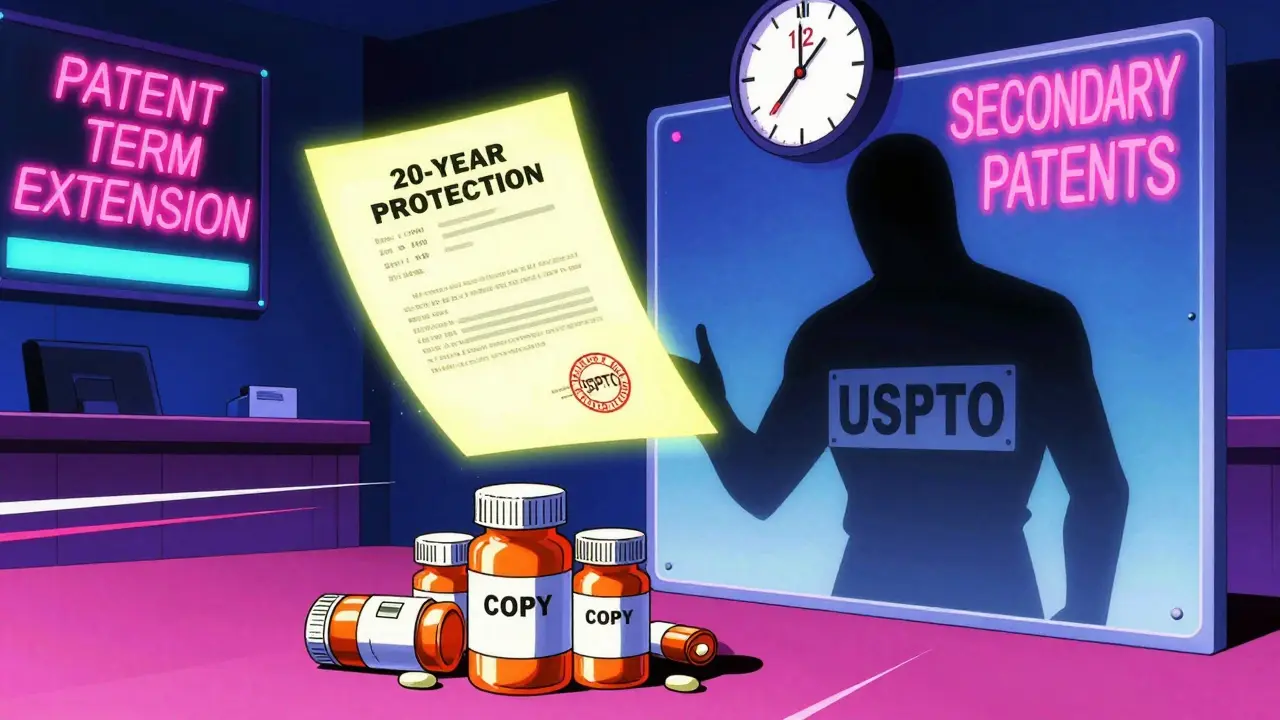
Patent exclusivity comes from the U.S. Patent and Trademark Office (USPTO). It’s based on invention. If a company invents a new chemical compound, a new way to make it, or a new use for an old one, they can file a patent. Once granted, that patent gives them the legal right to stop anyone else from making, selling, or using that invention for 20 years from the date they filed it.
But here’s the catch: most drugs take 10 to 15 years just to get approved by the FDA. That means if a company files a patent on day one of research, by the time the drug actually hits shelves, they might only have 5 to 8 years of real market control left. That’s not enough to recoup the $2.3 billion average cost to develop a drug, according to Tufts Center for the Study of Drug Development.
That’s why patent extensions exist. The law allows two kinds:
- Patent Term Adjustment (PTA): Adds time if the USPTO took too long to review the patent.
- Patent Term Extension (PTE): Adds up to 5 years to make up for time lost during FDA review. But even with this, the total protected time after FDA approval can’t go beyond 14 years.
Patents can cover anything from the active ingredient (the strongest kind) to the pill’s coating or how it’s taken. Many companies file dozens of secondary patents-on delivery methods, dosing schedules, or combinations-to stretch protection. The FTC found that 68% of patents listed in the FDA’s Orange Book are these secondary types, not the core compound.
Market Exclusivity: The FDA’s Approval Lock
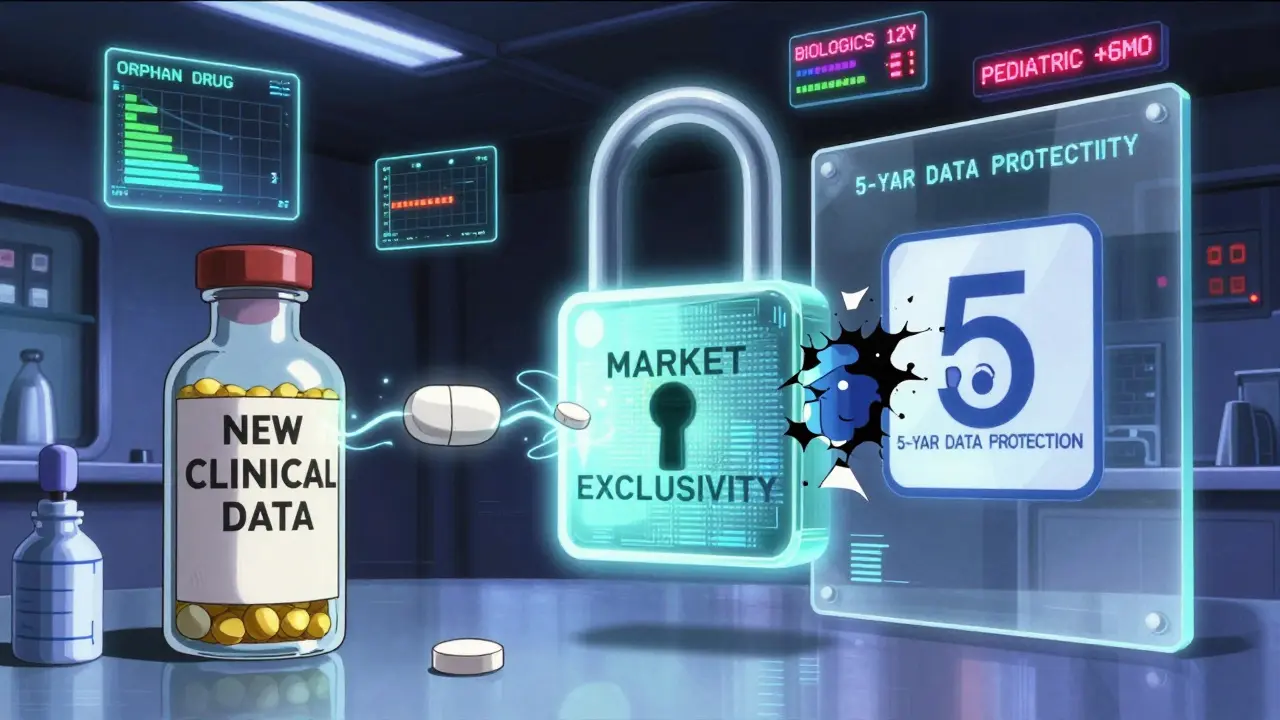
Market exclusivity has nothing to do with patents. It’s granted by the FDA and protects the data and the product, not the invention. Even if a drug isn’t patented, the FDA can still block generics for a set time.
This system started with the Hatch-Waxman Act of 1984. It was meant to balance innovation and competition. The FDA doesn’t care if the drug is new-it cares if the company did the hard work of clinical trials. If you submit original data to prove safety and effectiveness, the FDA won’t let anyone else copy it for a while.
Here’s how it breaks down:
- New Chemical Entity (NCE) exclusivity: 5 years. During this time, the FDA won’t even accept an application from a generic maker. No data sharing allowed.
- Orphan drug exclusivity: 7 years for drugs treating rare diseases (under 200,000 patients in the U.S.). This kicks in even if the drug has no patent.
- Pediatric exclusivity: +6 months added to any existing patent or exclusivity period if the company studies the drug in children.
- Biologics exclusivity: 12 years for complex biological drugs like Humira or Enbrel. This is separate from patents and was created by the BPCIA in 2009.
- 180-day exclusivity: The first generic company to successfully challenge a patent gets this reward. It’s worth hundreds of millions because they get to be the only generic on the market for half a year.
Unlike patents, market exclusivity doesn’t require novelty. A drug can be decades old, but if a company submits new clinical data for a new use, they can get exclusivity. That’s what happened with colchicine-a drug used since ancient Egypt. Mutual Pharmaceutical got 10 years of exclusivity in 2010 just because they did new studies. The price jumped from 10 cents to $5 per tablet.
They Don’t Always Overlap
Many people assume that if a drug is patented, it’s automatically protected from generics. Not true. The FDA’s own analysis of the Orange Book from 2021 shows:
- 27.8% of branded drugs have both patent and regulatory exclusivity
- 38.4% have only patents
- 5.2% have only market exclusivity
- 28.6% have neither
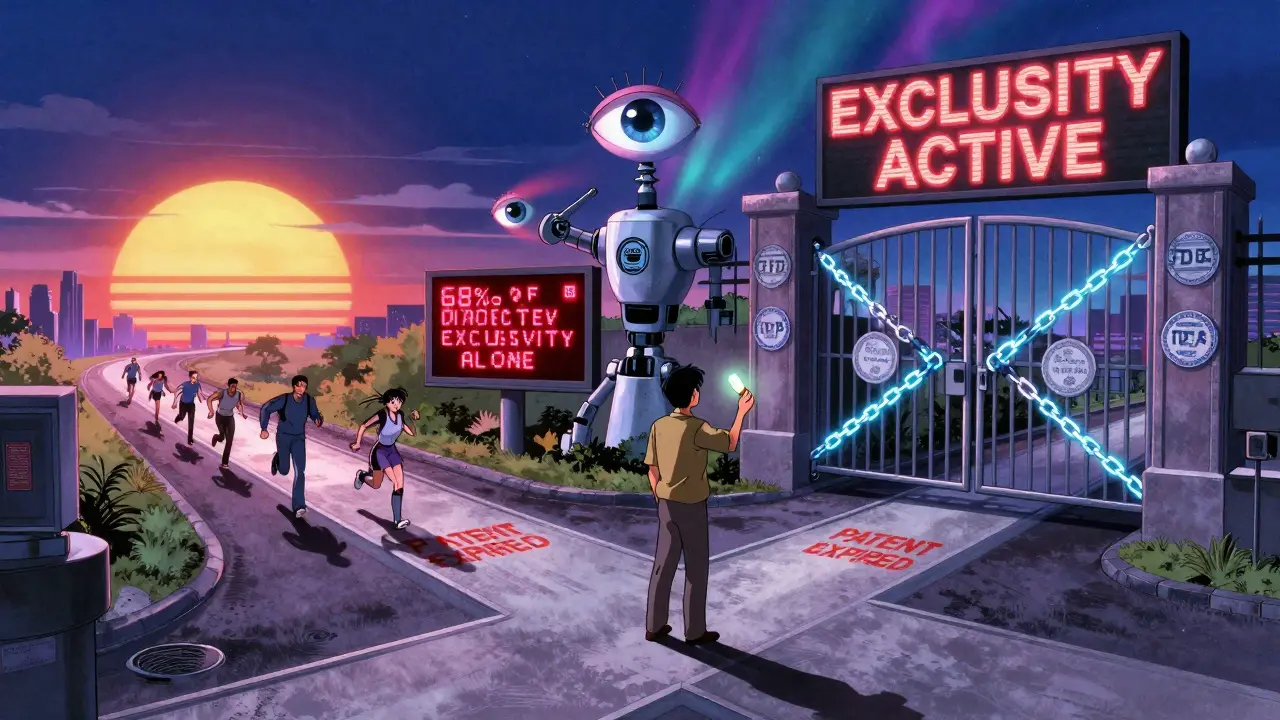
That means over 10% of drugs are protected by exclusivity alone. And here’s the kicker: 78% of drugs with exclusivity but no patent still had zero generic competition during their protection period, according to the Congressional Research Service.
Take Trintellix, an antidepressant. Its main patent expired in 2021. But because it had 3 years of NCE exclusivity, generics couldn’t even file until 2024. Teva Pharmaceuticals lost an estimated $320 million in potential sales because they didn’t realize exclusivity still blocked them.
Why This Matters for Patients and Prices
The global pharmaceutical market hit $1.42 trillion in 2022. Branded drugs make up 68% of that revenue, even though they’re prescribed only 12% of the time. Why? Because exclusivity-patent or regulatory-keeps prices high.
Companies know this. A 2022 survey by the Biotechnology Innovation Organization found that 73% of small biotech firms rely more on regulatory exclusivity than patents to protect their lead products. Why? Because patents are harder to get, easier to challenge in court, and expire faster. Exclusivity? It’s automatic if you meet the FDA’s data requirements.
And it’s getting more important. By 2022, 58% of new drugs had no composition-of-matter patent but still had regulatory exclusivity. That means the FDA’s rules are now the main gatekeeper for market access.
For patients, this means delays in cheaper options. For insurers and governments, it means higher spending. In 2020, the Congressional Budget Office calculated that pediatric exclusivity extensions alone have generated $15 billion in extra revenue for drugmakers since 1997.
What’s Changing Now?
The system is under pressure. The FDA launched its Exclusivity Dashboard in September 2023, making all exclusivity periods public in real time. Generic companies are using it to plan their entries months in advance.
Legislation is also in motion. The PREVAIL Act of 2023 proposes cutting biologics exclusivity from 12 years to 10. Meanwhile, the FDA announced in August 2023 that starting January 1, 2024, companies must give much more detailed justifications for exclusivity claims-especially for older drugs with new uses.
And the stakes are rising. McKinsey predicts that by 2027, regulatory exclusivity will account for 52% of total market protection time for new drugs-up from 41% in 2020. Patents are becoming more fragile. Exclusivity is becoming the new standard.
What You Need to Remember
- Patents = protect inventions. Filed with USPTO. Last 20 years from filing (but often only 10-12 years of real protection).
- Market exclusivity = protect data and product. Granted by FDA. Lasts 5 to 12 years depending on type.
- One can exist without the other. A drug can be off-patent but still blocked by exclusivity.
- Exclusivity can apply to old drugs if new data is submitted.
- Generics can’t enter until both patent and exclusivity have expired-whichever lasts longer.
If you’re wondering why a drug you need still costs $1,000 a month-look beyond the patent. Chances are, the FDA is still holding the door shut.
Can a drug have market exclusivity without a patent?
Yes. Market exclusivity is granted by the FDA based on clinical data submitted for approval, not on patent status. For example, orphan drugs or drugs with new uses for old compounds can get 5 to 7 years of exclusivity even if no patent exists. The colchicine case in 2010 is a well-known example where a centuries-old drug received 10 years of exclusivity with no active patents.
How long does FDA market exclusivity last?
It varies by type: New Chemical Entities (NCEs) get 5 years, orphan drugs get 7 years, biologics get 12 years, and pediatric studies add 6 months to any existing exclusivity or patent. The first generic to challenge a patent gets 180 days of exclusivity. These periods are fixed by law and start when the drug is approved.
Do patents and exclusivity always expire at the same time?
No. They’re calculated differently. Patents start from the filing date (often years before approval), while exclusivity starts at FDA approval. A drug might have 10 years of patent life left when approved, but 5 years of exclusivity. In that case, generics can’t enter until the 5-year exclusivity ends-even if the patent still has 5 more years to run.
Why do generic companies care so much about the 180-day exclusivity?
Because it gives them a legal monopoly on the market for six months after the patent challenge succeeds. During that time, no other generic can enter-even if the patent is expired. That window can bring in $100 million to $500 million in revenue, according to Goldman Sachs. Many generic firms will spend millions on legal battles just to win this first-mover advantage.
Can the FDA deny exclusivity even if a company qualifies?
Yes, but rarely. The FDA must grant exclusivity if the company meets the legal requirements. However, companies often fail to properly claim it. Scendea Consulting found that between 2018 and 2022, 22% of innovator companies didn’t claim all available exclusivity periods-leaving an average of 1.3 years of protection unclaimed. The FDA doesn’t automatically award it; the company must request it.
Understanding these two systems explains why some drugs stay expensive for years after patents expire-and why others suddenly drop in price. It’s not magic. It’s law. And the law is changing.



Comments
Roland Silber
March 7, 2026Patent vs market exclusivity is one of those hidden levers in drug pricing that no one talks about. I used to think patents were the main barrier, but the data here is eye-opening-over 10% of drugs are blocked by exclusivity alone. That colchicine example? Pure exploitation. A drug from ancient Egypt suddenly costs $5 a tablet because someone did a tiny study and filed paperwork. It’s not innovation-it’s loophole gaming.
The FDA’s new dashboard is a step in the right direction, but we need transparency at the application stage, not just after approval. Companies should have to publicly justify why a 200-year-old compound deserves a decade of exclusivity.
Patrick Jackson
March 8, 2026Brooooooo... this is why I hate modern medicine 😭🤯
Patents? Pfft. Market exclusivity? That’s where the real money’s hiding. It’s not about curing disease-it’s about locking down cash with legal jargon. Colchicine? From ancient Egypt to $5 a pill? That’s not capitalism, that’s a con job with a law degree. 🤡💊
And don’t even get me started on the 180-day monopoly for generics-some company spends millions in court just to be the first to sell the same damn pill? We’re rewarding litigation, not patients.
Adebayo Muhammad
March 9, 2026You're all missing the point. The system isn't broken-it's *optimized*. Every single exclusivity period is a calculated, deliberate mechanism to extract maximum rent from the public. The FDA isn't regulating-it's colluding. The USPTO? A rubber stamp. The real question isn't 'how does this work?'-it's 'who benefits?' And the answer is: shareholders, lobbyists, and Ivy League pharma lawyers. The patient? An afterthought. The data proves it. The math doesn't lie. And you? You're still paying for it.
Pranay Roy
March 10, 2026I know what's really going on. This isn't about patents or exclusivity. It's all part of the Great Pharma Control System. The FDA, USPTO, WHO-they're all connected. The 12-year biologics exclusivity? That's not law. That's a backroom deal with Big Tech and the CIA. They're using drug pricing to control population health. You think colchicine is expensive? Wait till they start patenting vitamins. They already have a database. I've seen the leaks. They're preparing for mandatory dosing. Don't trust the FDA. Don't trust the FDA.
Joe Prism
March 11, 2026Exclusivity isn't evil. It's a tool. Used right, it funds innovation. Used wrong? It becomes a tax on the sick.
But here's the real issue: we're treating a legal system like it's a moral one. The law allows this. That doesn't mean we have to accept it.
Fix the system. Don't just rage at it.
Bridget Verwey
March 13, 2026Oh honey. You think this is about science? Nah. This is about who gets to say ‘no’ to a generic pill. The FDA isn’t a regulator-it’s a bouncer at a VIP club for Big Pharma. And guess what? The bouncer’s on commission. 😏
That 180-day window? That’s not fairness. That’s a lottery ticket for companies that bet on lawsuits. Meanwhile, Grandma’s still choosing between insulin and groceries.
Time to kick the bouncer out.
Andrew Poulin
March 14, 2026Stop overcomplicating this. Patents expire. Exclusivity doesn’t. That’s it. Companies game the system. FDA lets them. Patients pay. Simple. Fix the law. End the 12-year biologics loophole. No more 5-year NCE for old drugs. Done. No more debate.
Weston Potgieter
March 14, 2026I read this whole thing and all I got was the same story: rich people make rules to keep poor people from getting cheap medicine. Wow. Groundbreaking. Next you’ll tell me water is wet. At least have the decency to call it what it is-corporate theft dressed up as innovation. The fact that we still debate this is why America’s dying.
Joey Pearson
March 16, 2026Big thanks for breaking this down so clearly. I’ve been confused about this for years. The colchicine example alone made me realize how broken the system is.
But here’s the good news-we’re starting to see change. The FDA’s new rules, the PREVAIL Act, public pressure. It’s slow, but it’s moving.
Keep pushing. Your voice matters.
William Minks
March 16, 2026As someone from a country where drugs are affordable because they don’t have these exclusivity tricks, I can say this: the U.S. system is a disaster.
My cousin in Nigeria pays $2 for a drug that costs $120 here. Not because it’s cheaper to make. Because here, the law says ‘no’ to competition.
It’s not innovation. It’s isolation.
Jeff Mirisola
March 17, 2026Patents protect invention. Exclusivity protects investment. Both have a place. But when exclusivity gets extended to drugs that are 200 years old? That’s not protecting investment-that’s hijacking public trust.
And let’s be real: if a company can get 12 years of exclusivity for a biologic with no patent, why should we fund R&D at all? Just wait for a drug to go off-patent, tweak the delivery method, and cash in.
We’re not encouraging innovation. We’re rewarding manipulation.
Write a comment