
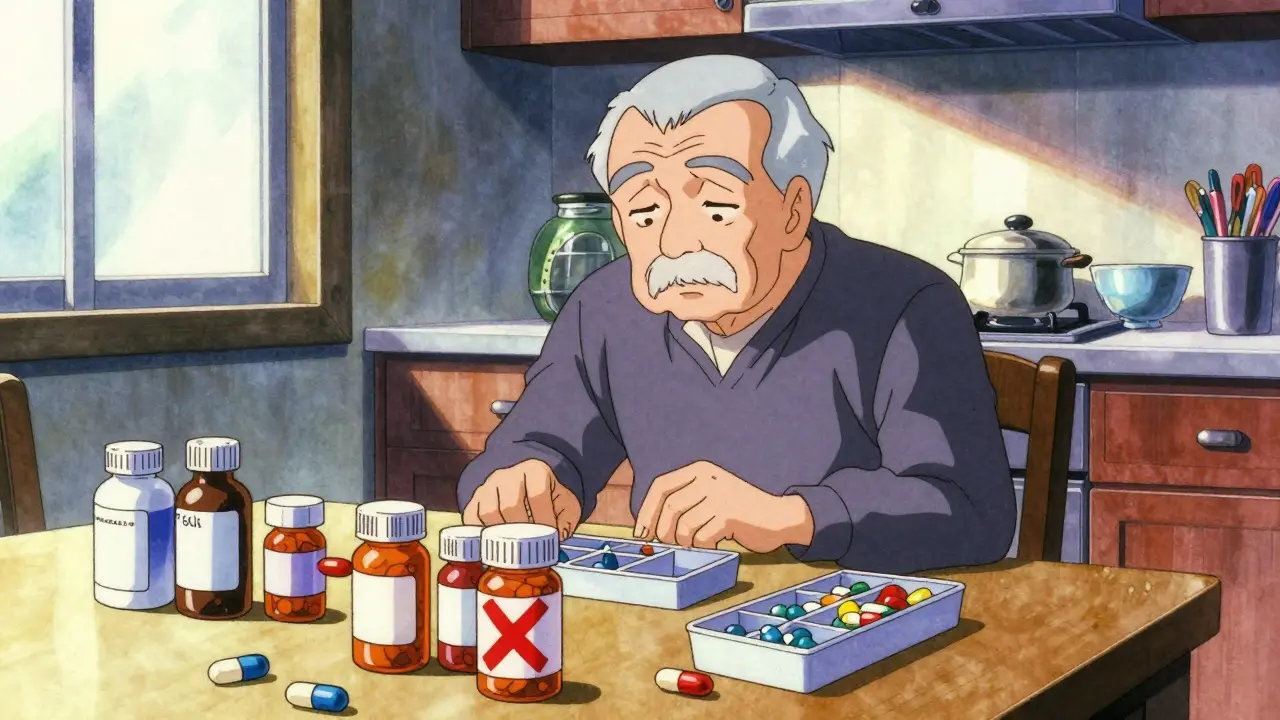
More than 40% of adults over 65 in the U.S. are taking five or more prescription drugs every day. That’s not just common-it’s dangerous. Polypharmacy, the term for taking multiple medications at once, isn’t always a mistake. Sometimes it’s necessary. But too often, it’s a mess. Pills pile up after hospital stays, new doctors add more without knowing what’s already being taken, and seniors end up with a pill organizer that looks like a science experiment gone wrong.
Why Polypharmacy Is a Silent Crisis
It starts with good intentions. An older adult has high blood pressure, arthritis, diabetes, and maybe depression. Each condition gets its own prescription. Then they fall and get a painkiller. They have trouble sleeping, so they get a sedative. A stomach issue leads to a proton pump inhibitor. Before long, they’re on ten, twelve, even fifteen medications. And nobody ever steps back to ask: Do you still need all of these? The numbers are staggering. According to the CDC, the average senior takes 5.8 prescriptions today-up from 2.8 in 1988. One in five adults over 65 takes ten or more. In nursing homes, it’s worse: nearly 91% of residents take five or more daily. And it’s not just about quantity. Many of these drugs are risky for older bodies. Aging changes how your body handles medicine. Your liver processes drugs 30-50% slower after age 80. Your kidneys clear them out at about 1% less efficiency each year after 40. That means drugs stick around longer. Higher doses become toxic. Side effects that would be mild in a 30-year-old can be life-threatening in a 75-year-old. The American Geriatrics Society’s Beers Criteria lists 56 medications that are especially risky for seniors. Benzodiazepines like diazepam? They double the chance of a fall. NSAIDs like ibuprofen? They raise the risk of internal bleeding by 2.5 times. Anticholinergics-found in some sleep aids, bladder meds, and even allergy pills-can speed up memory loss. One study linked them to a 50% higher risk of dementia over seven years. And it’s not just the drugs themselves. The system fails too. A 2021 National Institute on Aging report found that 42% of seniors get prescriptions from three or more different doctors. Each one focuses on their own specialty. No one’s looking at the full picture. Medication errors after hospital discharge are the #1 cause of readmissions in older adults. Half of those errors happen because no one reviewed what the patient was already taking.What Happens When Too Many Pills Are Taken
The consequences aren’t theoretical. They show up in emergency rooms, nursing homes, and funeral homes. Falls are the most common and deadly result. About 35% of emergency visits by seniors are due to falls linked to medications-especially sedatives, blood pressure drugs, and painkillers. A single fall can mean a broken hip, months in rehab, and a permanent loss of independence. Delirium is another silent killer. It’s not dementia. It’s sudden confusion, agitation, or withdrawal-often caused by a new drug or interaction. Up to 30% of hospital delirium cases in older adults are drug-related. Many families think their loved one is “just getting confused with age.” It’s often the medicine. Nonadherence is huge. Sixty-eight percent of seniors on multiple medications can’t keep up with complex schedules-some need pills at 3 or 4 different times a day. A quarter skip doses because they can’t afford them. And only 55% can tell you what each pill is for. That means they’re taking things they don’t understand, and stopping things they think are useless. Cost is another hidden burden. Seniors spend an average of $1,200 a year on prescriptions. With Medicare Part D’s coverage gap, many choose between food and medicine. The Agency for Healthcare Research and Quality estimates that inappropriate polypharmacy costs the U.S. over $30 billion annually in hospital stays, ER visits, and long-term care.Deprescribing: The Forgotten Solution
The answer isn’t more drugs. It’s fewer. Deprescribing-systematically stopping medications that aren’t helping or are doing more harm than good-isn’t new. But it’s still rare. Only 15% of Medicare beneficiaries get a formal medication review, even though CMS has required it since 2018. A 2021 Duke Health review found that when deprescribing is done right, it cuts adverse drug events by 22% and hospital admissions by 17%. That’s not a small gain. That’s life-changing. Here’s how it works:- Start with the highest-risk drugs: benzodiazepines, opioids, anticholinergics, and long-term proton pump inhibitors. These are the first to go.
- Ask: Why was this prescribed? Is the original problem still here? Has the benefit faded?
- Check for duplicates. One patient had three different blood pressure pills from three different doctors.
- Look at goals of care. Is the goal to live longer-or to live better? For someone with advanced dementia, a statin for cholesterol might not matter anymore.
- Go slow. Don’t stop everything at once. Taper one drug at a time. Watch for withdrawal symptoms or rebound effects.
Who Should Be Involved
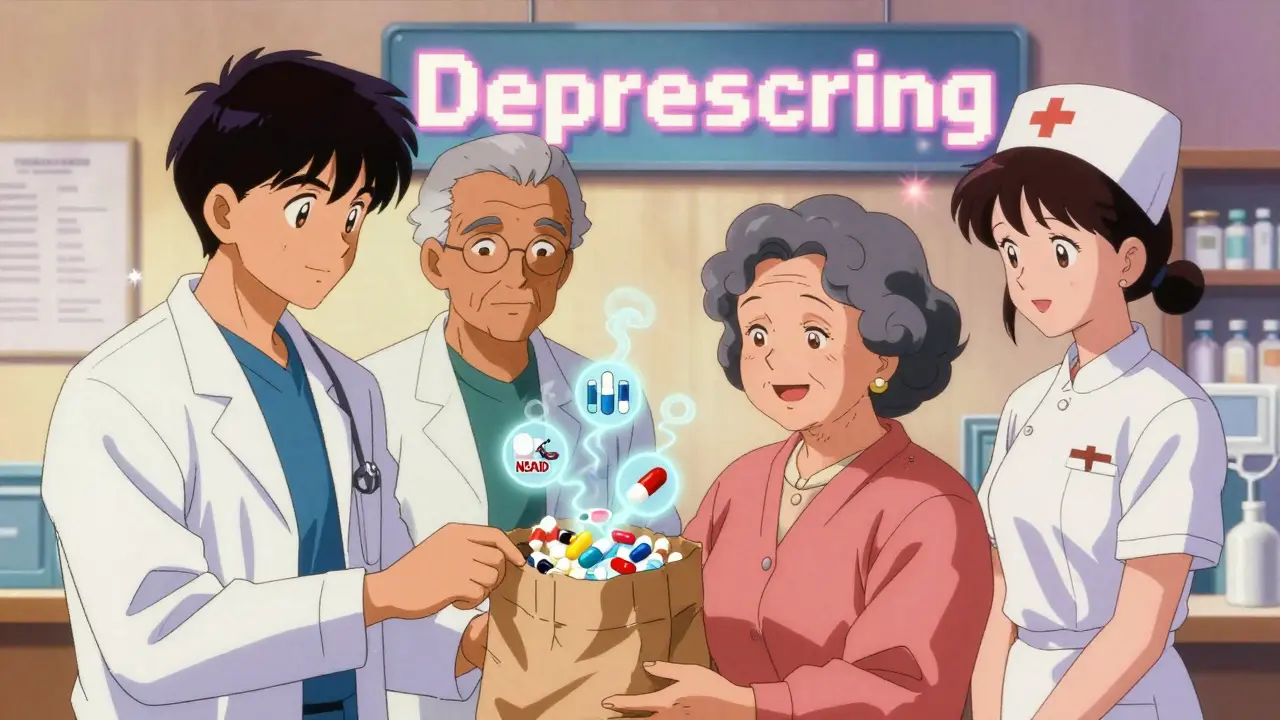
Managing polypharmacy isn’t a one-person job. It needs a team. Pharmacists are the unsung heroes. A 2020 CMS study showed that pharmacist-led medication therapy management reduced hospital readmissions by 24% in Medicare patients. They spot interactions, flag duplicates, and simplify regimens. Primary care doctors need to lead the conversation. Too often, specialists write prescriptions without knowing what others have ordered. The American Geriatrics Society’s Choosing Wisely campaign says clearly: Don’t prescribe without reviewing the full drug list. Nurses and caregivers play a key role too. They see daily patterns: Is the patient taking pills? Are they confused? Are they falling more? Their input is often the first warning sign. Studies show that teams with doctors, pharmacists, and nurses together achieve 32% better results than solo providers. That’s not a suggestion-it’s the standard of care.Tools That Help
There are practical tools to make this easier. The STOPP/START criteria are used in hospitals and clinics to identify inappropriate medications (STOPP) and missing ones that should be added (START). On average, they find 3.2 potentially harmful drugs per older adult. The Medication Regimen Complexity Index (MRCI) scores how hard a pill schedule is to follow. High scores predict nonadherence. Simple fixes-like switching from three times a day to once a day-can make a huge difference. New tech is helping too. The FDA-approved MedWise platform uses genetic data to predict how a person will react to specific drugs. In a 2022 trial, it cut adverse events by 41%. It’s not everywhere yet-but it’s coming. The Centers for Medicare & Medicaid Services launched the “Deprescribing for Better Outcomes” initiative in January 2023, funding $15 million to build standardized protocols. That’s a big step toward making deprescribing routine, not rare.
What Seniors and Families Can Do
You don’t need to wait for the system to fix itself. Here’s what you can do today:- Bring all medications to every doctor visit. Include vitamins, supplements, and herbal products. Many seniors don’t think these count-but they can interact dangerously.
- Ask: Is this still needed? What happens if I stop it? Don’t be afraid to question a prescription.
- Use one pharmacy. That way, the pharmacist can track all your drugs and warn you about interactions.
- Set up a pill organizer with alarms. But don’t rely on it alone. Make sure someone checks in weekly.
- Talk about goals of care. If you’re 85 with heart failure and dementia, do you want aggressive treatment-or comfort? That changes what medications make sense.
- Check costs. If a pill is too expensive, ask for a generic, a lower dose, or a patient assistance program. AARP reports 25% of seniors skip doses because of cost. You’re not alone.
The Future of Senior Medication Management
The field is shifting. The old idea-that more drugs mean better care-is fading. The new focus is on appropriate prescribing: the right drug, at the right dose, for the right person, at the right time. The National Institute on Aging is funding 12 major studies (totaling $42 million through 2025) to build evidence-based guidelines for older adults with multiple chronic conditions. The goal? To move away from counting pills-and toward measuring quality of life. Geropharmacogenomics-the study of how genes affect drug response in older adults-is emerging. In the next five years, it could reduce adverse drug events by half for people who get genetic testing. But none of this matters if we don’t change the culture. Polypharmacy isn’t about lazy doctors or careless patients. It’s a broken system. Too many specialists. Too little communication. Too little time to review. Too few incentives to stop. The solution isn’t technology. It’s attention. It’s asking the hard questions. It’s listening to the patient, not just the chart.When to Call for Help
If you or a loved one is taking five or more medications, and you’re not sure why, it’s time to act. Look for these red flags:- Falls or dizziness after starting a new drug
- Confusion or memory lapses that started after a medication change
- Skipping doses because of cost or complexity
- Not knowing what any of the pills are for
- Visiting multiple doctors without a central coordinator
What is polypharmacy?
Polypharmacy is the regular use of five or more medications at the same time. It’s common in older adults due to multiple chronic conditions, but it increases the risk of harmful drug interactions, falls, confusion, and hospitalizations. It’s not just about the number of pills-it’s about whether each one is still necessary and safe.
Are all multiple medications bad for seniors?
No. Some seniors need multiple drugs to manage conditions like heart disease, diabetes, or high blood pressure. The problem isn’t the number-it’s when medications are added without review, become outdated, or are unnecessary. The goal is to take only what’s truly needed for health and quality of life.
What are the most dangerous medications for elderly patients?
According to the American Geriatrics Society Beers Criteria, high-risk drugs include benzodiazepines (like Valium), NSAIDs (like ibuprofen), anticholinergics (found in some sleep aids and bladder meds), long-term proton pump inhibitors, and opioids. These increase fall risk, bleeding, dementia, and kidney damage. Many can be safely stopped or replaced.
What is deprescribing?
Deprescribing is the planned, gradual reduction or stopping of medications that are no longer beneficial or are causing harm. It’s not quitting drugs cold turkey-it’s a careful, monitored process done with a doctor or pharmacist. Studies show it reduces hospital visits and improves daily function in older adults.
How can I help my elderly parent manage their medications?
Start with a brown bag review: have them bring all pills, vitamins, and supplements to a doctor’s appointment. Ask each prescriber: Why is this needed? Can anything be stopped? Use one pharmacy, set up reminders, and check in weekly. Don’t assume they understand what each pill does. Many don’t.
Is there financial help for seniors who can’t afford their meds?
Yes. Many drug companies offer patient assistance programs. Medicare Part D has a coverage gap (donut hole), but low-income seniors may qualify for Extra Help. Pharmacists can help you apply. AARP also has resources to find low-cost alternatives and generics. Never skip doses because of cost-talk to someone first.






Write a comment