
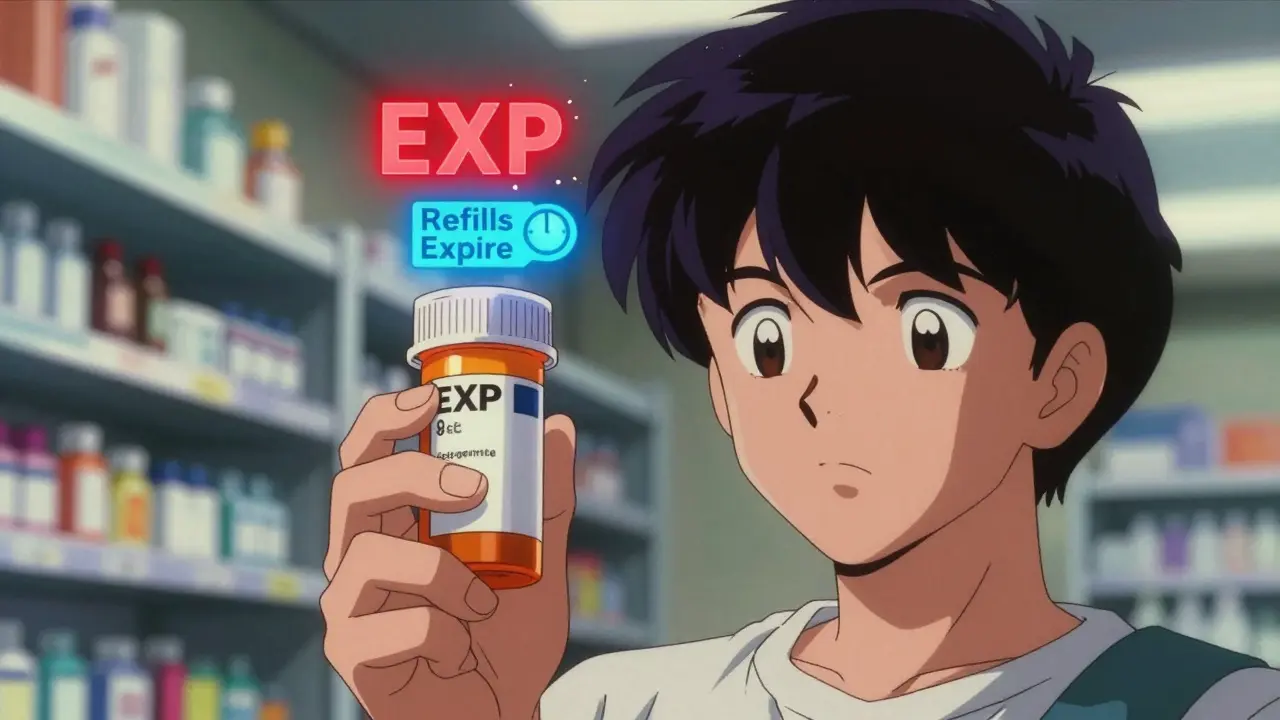
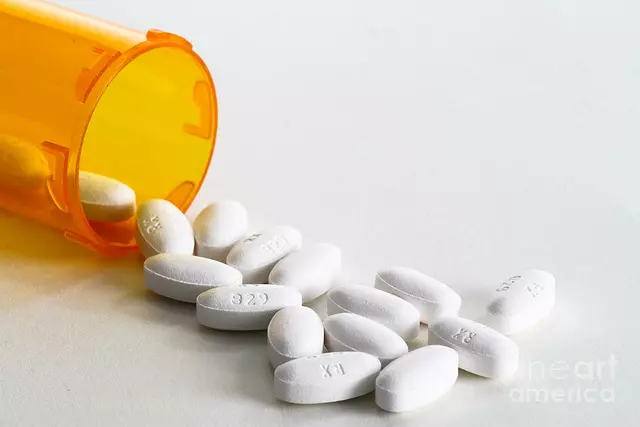
Have you ever looked at your prescription bottle and wondered why there are two dates? One says expiration, the other says refill-by. You might think they mean the same thing - that your medicine is no longer good after either date. But they don’t. Confusing them can cost you money, delay your treatment, or even put your health at risk.
Let’s cut through the noise. If you take any kind of regular medication - whether it’s for high blood pressure, diabetes, asthma, or anxiety - understanding the difference between these two dates isn’t just helpful. It’s essential.
What Does the Expiration Date Really Mean?
The expiration date on your prescription label is a safety cutoff. It’s not just a suggestion. It’s a legal and scientific boundary set by the manufacturer and enforced by the FDA. This date tells you when the medication is guaranteed to be fully potent and safe to use under normal storage conditions.
Manufacturers test their drugs under controlled heat, light, and humidity to see how long they stay stable. The FDA requires this testing under ICH Q1A(R2) guidelines. Even if your pills look fine, smell fine, and haven’t changed color, the manufacturer can’t guarantee they’ll still work after that date.
Here’s the catch: studies show that most medications remain effective well past their expiration date - sometimes years. The FDA’s own testing found that 88% of drugs retain their strength beyond the labeled date. But here’s the thing - pharmacists can’t legally dispense expired medication. So even if your pills are still good, the pharmacy won’t refill them after the expiration date.
For non-refrigerated medications, the pharmacy usually sets the expiration date at one year from when you picked it up. For things like insulin, eye drops, or antibiotics that need refrigeration, it’s often 30 days. That’s because those drugs break down faster once opened.
What Is the Refill-By Date? (And Why It’s Not About Safety)
The refill-by date has nothing to do with how long your medicine lasts. It’s an administrative rule. It’s the last day your doctor’s original prescription allows you to get more refills.
Think of it like a gift card with an expiration. Your doctor wrote a prescription for, say, 12 refills. The pharmacy puts a label on your bottle saying "REFILLS EXPIRE 12/15/2025." That doesn’t mean your pills stop working on that date. It means after that date, you need a new prescription from your doctor - even if you still have pills left.
This rule exists for two reasons: safety and oversight. For controlled substances like opioids, stimulants, or benzodiazepines, federal law limits refill periods to 6 months. For other drugs, most states allow up to 12 months. California lets 12 months. New York caps it at 6 months for certain drugs. So the refill-by date varies depending on where you live and what you’re taking.
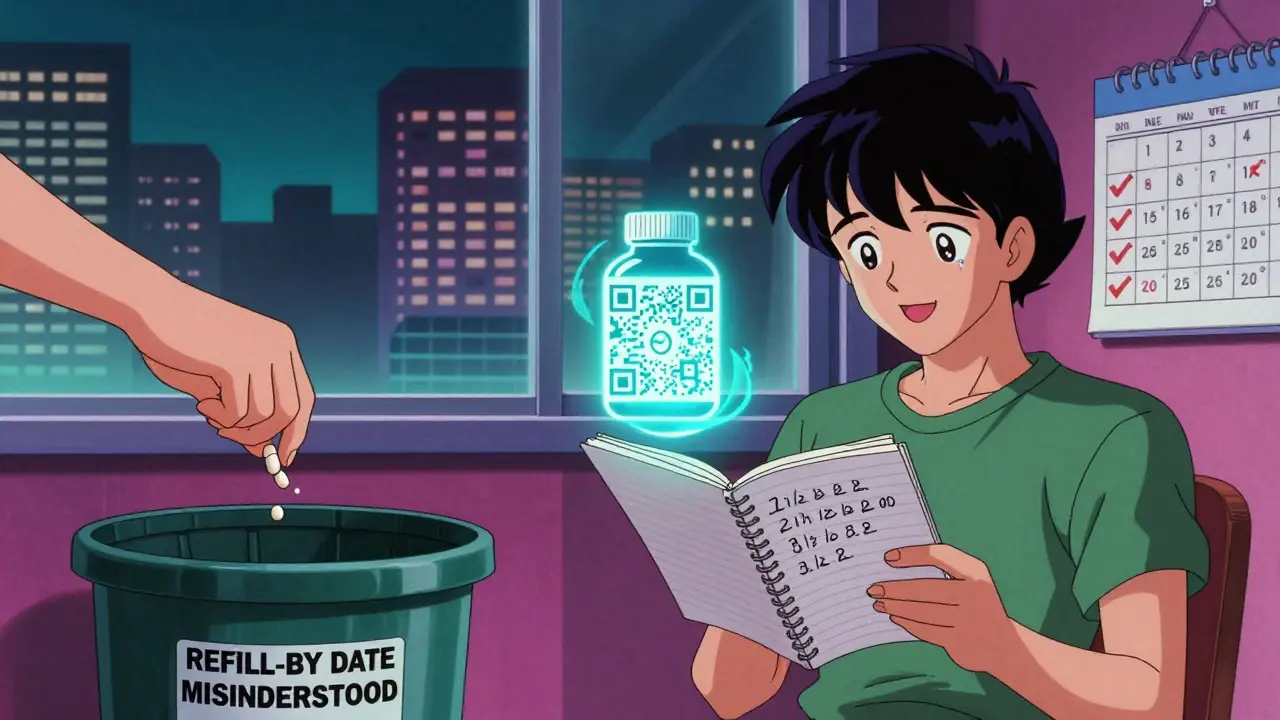
Here’s where it gets messy: a 2023 survey found that 54.3% of people couldn’t tell the difference between the two dates. And 28.7% of them threw away perfectly good medicine because they thought the refill-by date meant the pills were expired.
Why Mixing Them Up Costs You Money and Health
Let’s say you’re on a monthly medication for high blood pressure. Your refill-by date is in June. Your expiration date is in December. You forget to refill in June. By July, you’re out of pills. You call your doctor. They send a new prescription. But now you have to wait three days for it to be filled. You go without your medicine. Your blood pressure spikes. You end up in urgent care.
That scenario happens to thousands of people every month. According to Medicare data, 23.7% of beneficiaries miss doses or go without medication because they didn’t refill before the refill-by date. And it’s not just about inconvenience. Skipping doses increases hospitalization risk by up to 40% for chronic conditions like heart disease and diabetes.
On the flip side, some people refill after the refill-by date has passed - but still use pills that are well within their expiration date. That’s safe. But if they try to refill after the expiration date? The pharmacy won’t do it. Even if you have 50 pills left, they’ll say "no" - because the label says expired.
One Reddit user shared how they tossed $300 worth of unexpired insulin because they confused the refill-by date with the expiration date. That’s not rare. It’s common.
How to Read Your Prescription Label Like a Pro
Here’s how to quickly spot the difference on your bottle:
- Expiration Date: Usually labeled "EXP" or "Expires On." It’s often printed in red or bold. This date is based on the manufacturer’s stability data and the pharmacy’s one-year rule.
- Refill-By Date: Usually says "Refills Expire" or "Last Fill Date." It’s often in blue or black. This date is based on your doctor’s original prescription and state law.
Look for these key phrases:
- "Do not use after [date]" → This is your expiration date.
- "No more refills after [date]" → This is your refill-by date.
Check the number of refills left. If it says "3 Refills Remaining," you still have refills - but only until the refill-by date. After that, even if you have pills, you need a new script.
What to Do When You’re Confused
If you’re not sure which date is which, call your pharmacy. They’re required to explain it. Ask:
- "Is this date when the medicine stops working?" → If yes, it’s expiration.
- "Do I need a new prescription to get more?" → If yes, it’s refill-by.
Set reminders. A 2023 study from the American Pharmacists Association found that people who set phone alerts 7 days before their refill-by date reduced missed doses by 63.4%. Use your calendar. Use your phone. Use sticky notes. Just don’t rely on memory.
Keep a simple log: write down the name of each med, the refill-by date, and the expiration date. You don’t need an app. A notebook works fine.
What’s Changing in 2024 and Beyond
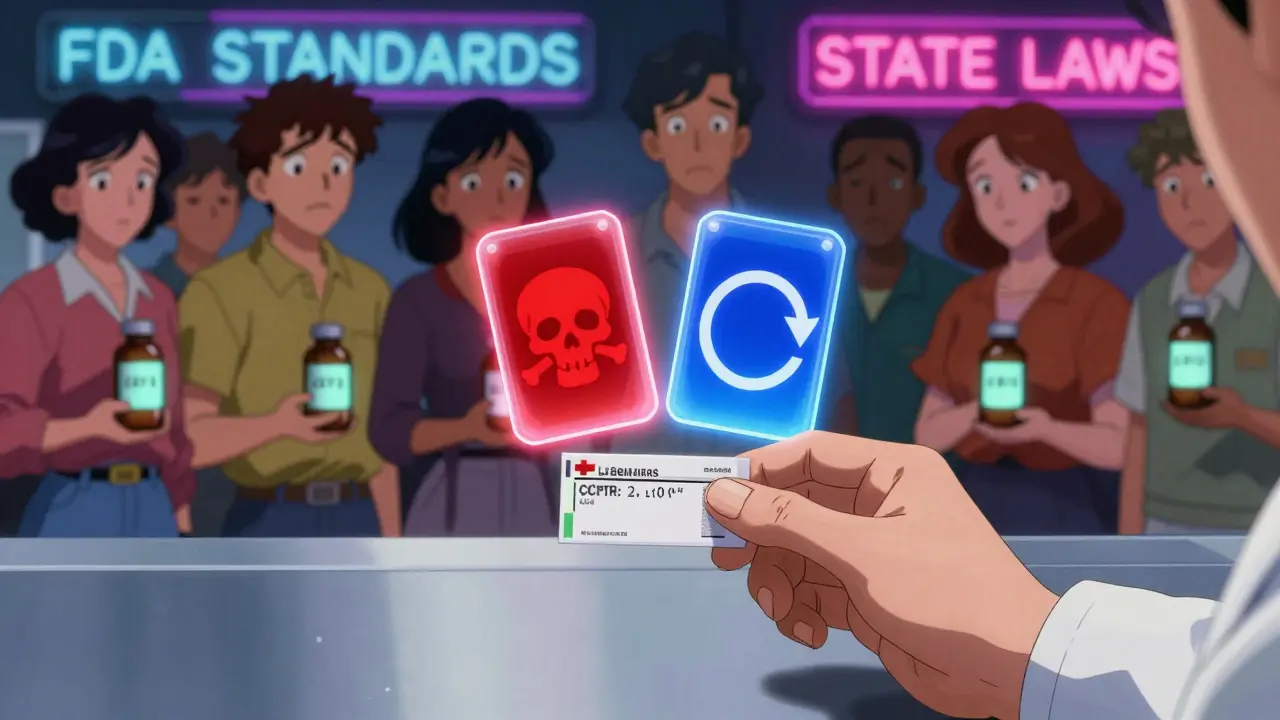
Pharmacies are finally trying to fix this confusion. CVS, Walgreens, and other chains started using color-coded labels in early 2023: red for expiration (safety), blue for refill-by (admin). Some now include QR codes on labels. Scan it, and a short video explains the difference.
CVS reported a 47.8% drop in patient questions about dates after rolling out these smart labels in 5,000 stores. The FDA is pushing for standardized wording across all labels by mid-2024. They want to replace vague terms like "Refills Expire" with clearer ones like "Last Day to Refill."
By 2025, experts predict 78% of prescriptions will have digital labels you can access on your phone - with interactive features that show you exactly when your refill window closes and when your pills are safe to use.
Bottom Line: Two Dates. Two Rules.
Expiration date = safety. Don’t use past this. Ever.
Refill-by date = access. Don’t wait past this, or you’ll need a new prescription.
You can still take your medicine after the refill-by date - as long as it’s before the expiration date. You just can’t get more from the pharmacy without a new script.
Don’t throw away medicine because you missed a refill deadline. Don’t risk your health by using expired pills. Know the difference. Mark your calendar. Ask your pharmacist. Your body will thank you.
Can I still take my medicine after the refill-by date if it’s not expired?
Yes, as long as the medicine hasn’t reached its expiration date, it’s still safe and effective to use. The refill-by date only means you can’t get more refills from the pharmacy without a new prescription from your doctor. You’re not breaking any rules by finishing pills you already have - even if the refill window has closed.
Why can’t I just refill my prescription after the refill-by date?
Pharmacies follow federal and state laws that limit how long a prescription remains valid for refills. For most medications, that’s one year. For controlled substances like opioids or ADHD meds, it’s six months. After that, your doctor must review your condition, update your treatment plan, and issue a new prescription. This isn’t a pharmacy rule - it’s a safety and oversight requirement to prevent misuse and ensure ongoing care.
Is it safe to use medication past its expiration date?
While many medications retain their potency beyond the labeled expiration date - especially if stored properly - the FDA and pharmacists still advise against using them. The expiration date is the last day the manufacturer guarantees full effectiveness and safety. After that, there’s no way to know if the drug has degraded. For life-saving meds like epinephrine or insulin, never use expired versions. For other drugs, it’s better to get a new prescription than risk reduced effectiveness.
Do expiration dates differ between brand-name and generic drugs?
No. Both brand-name and generic drugs must meet the same FDA standards for stability and labeling. The expiration date is based on the drug’s chemical makeup and packaging, not the brand. Generics are required to have the same shelf life as their brand-name counterparts. If you switch from brand to generic, the expiration date may change based on when the pharmacy dispensed it, but the underlying stability is the same.
What should I do if my refill-by date has passed but I still need the medication?
Call your doctor’s office. Most prescribers can renew your prescription over the phone or electronically, especially if you’re on a stable, long-term medication. For non-controlled drugs, renewal often takes less than 24 hours. For controlled substances, you may need an appointment. Don’t wait until you’re out of pills - start the process a week before your refill-by date to avoid gaps in treatment.



Comments
Jazminn Jones
March 7, 2026The fundamental misunderstanding of pharmaceutical regulatory frameworks among the general populace is not merely an inconvenience-it is a systemic failure of health literacy. The conflation of refill-by and expiration dates reflects a broader societal abandonment of evidence-based reasoning in favor of heuristic decision-making. The FDA’s ICH Q1A(R2) compliance is not a suggestion; it is a legally binding standard rooted in accelerated stability testing under controlled humidity, temperature, and light exposure. To assume pharmacological integrity beyond these parameters is not just naïve-it is a bioethical lapse.
Pharmacies are legally constrained from dispensing expired medications, not due to corporate bureaucracy, but because the manufacturer’s stability data ceases to be valid after the labeled date. Even if a tablet appears unchanged, its active pharmaceutical ingredient (API) may have undergone hydrolytic degradation, rendering subtherapeutic concentrations. For antihypertensives or antiepileptics, this is not merely inconvenient-it is potentially lethal.
The notion that 'most drugs remain effective beyond expiration' is a dangerous oversimplification. The FDA’s 88% potency retention statistic applies to unopened, properly stored solid dosage forms under ideal conditions-conditions rarely replicated in home medicine cabinets. Heat, moisture, and light accelerate degradation. A 2021 study in the Journal of Pharmaceutical Sciences demonstrated that amoxicillin stored at 30°C/75% RH lost 18% potency within six months post-expiration. This is not theoretical. This is clinical risk.
Refill-by dates are administrative, yes-but they exist precisely because physicians require periodic reassessment. Chronic disease management is not static. Renal function declines. Drug interactions emerge. Compliance patterns shift. A refill-by date is not a bureaucratic hurdle; it is a safeguard against therapeutic drift. To treat it as such is to misunderstand the very architecture of modern pharmacotherapy.
Setting phone reminders is a Band-Aid. What we need is mandatory patient education at point-of-dispense, standardized labeling per USP <795, and pharmacist-led medication therapy management. Until then, we are not just misinformed-we are endangered.
Stephen Rudd
March 8, 2026You people are insane. I've been taking my blood pressure pills for 4 years past the expiration date and I'm still standing. The FDA is just trying to sell you more drugs. My neighbor in Melbourne threw out $800 worth of insulin because he got scared by some label. He's now on Medicare because he had a stroke from not taking his meds. The system is rigged. They want you dependent. Look at the price of a new script-$120. The pills are still good. They just don't want you to know that.
Erica Santos
March 10, 2026Oh wow. A whole article about dates on a pill bottle. Next you'll be explaining the difference between 'use by' and 'best before' on yogurt. How thrilling. I'm sure the world was waiting for this deep dive into pharmaceutical bureaucracy. Let me guess-you also believe in the magic of 'expiration' on milk and think it's a moral failure to drink it after the date. How very... responsible of you.
George Vou
March 11, 2026i heard from this guy on yt that the gov just makes up these dates so they can sell more pills. like why would they care if you use your pills after a year? they dont make money off you taking them. its all about the refill system. my cousin works at a pharmacy and she says they get bonuses for getting people to refill early. i threw out my adderall because of the refill date and now i have to pay $200 for a new one. smh.
Scott Easterling
March 12, 2026I can't believe people still fall for this. You think the FDA cares about your health? They care about liability. They don't test drugs for 10 years-they test them for 18 months and slap on a one-year expiration. Then they make pharmacies enforce it. Meanwhile, the military has stockpiles of 20-year-old antibiotics that still work. Why? Because they're not scared of lawsuits. You're being manipulated. Don't be a sheep. If it looks fine, smells fine, and you're not allergic-take it. The system is a scam.
Mantooth Lehto
March 13, 2026I just cried reading this. I threw out my antidepressants because I thought the refill-by date meant they were bad. I went off them for 3 weeks. My anxiety came back like a tsunami. I had to go to the ER. My therapist said I almost had a breakdown. I’m so mad at myself. Why didn’t anyone explain this to me? I feel so stupid. 😭
Melba Miller
March 15, 2026This is why America is collapsing. We’ve turned healthcare into a customer service experience. You can't just take your damn pills? You need a calendar reminder? A QR code? A video? What happened to personal responsibility? We used to read labels. We used to call the doctor. Now we need an app to tell us if our medicine is expired. This isn't progress. This is infantilization.
Katy Shamitz
March 16, 2026I just want to say thank you for writing this. I’m a nurse, and I see this every single day. Patients throwing away perfectly good insulin because they think the refill-by date is the expiration. Or refusing to refill because they’re scared of the expiration date. It breaks my heart. I always write the dates on a sticky note and put it on their fridge. One woman told me she cried when she realized she’d been wasting $400 a month. You’re doing important work. ❤️
Nicholas Gama
March 18, 2026Expiration dates are not suggestions. Refill-by dates are not suggestions. The system exists because people are reckless. You don't get to be a free agent in pharmacology. Your life isn't a personal experiment. The law is there for a reason.
Mary Beth Brook
March 19, 2026The pharmacokinetic stability of non-refrigerated solid dosage forms is governed by Arrhenius kinetics. The one-year expiration window is derived from accelerated degradation modeling at 40°C/75% RH per ICH guidelines. Refill-by dates are governed by DEA 21 CFR §1306.22 and state-specific formulary statutes. The conflation of these two distinct regulatory domains reflects a catastrophic failure in public health communication infrastructure.
Neeti Rustagi
March 20, 2026This is such an important clarification. In India, we often see people hoarding expired medicines, believing they are still effective. I have seen elderly patients taking expired antibiotics for urinary infections-resulting in resistant strains. I always teach my patients: expiration = safety. Refill-by = access. Simple. Clear. Life-saving. Thank you for this.
Dan Mayer
March 22, 2026i read this whole thing and still dont get it. is the refill date the one that says 'last fill' or the one in red? my bottle has both. my pharmacist said it was 'kinda both' but i think she was just tired. also, my pills look weird now. should i still take them? they're not expired. i think.
Write a comment