
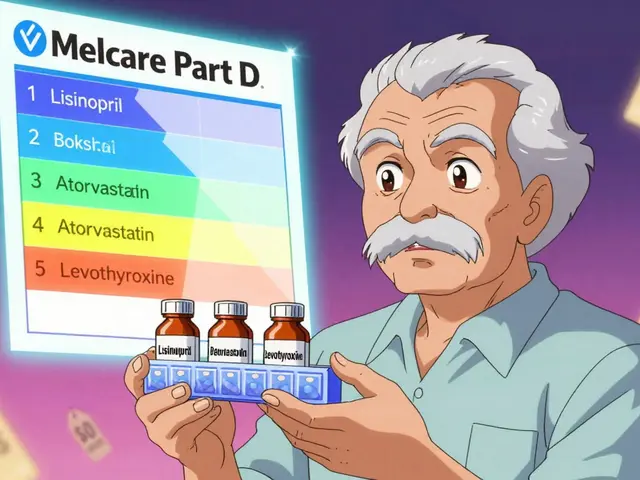
By 2022, generic drugs made up 90.5% of all prescriptions filled in the United States. But they cost just 23.4% of the total drug spending. That’s not magic. It’s the result of nearly 200 years of law, scandal, innovation, and quiet persistence. Most people don’t think about how generic drugs got here. They just pick up their $4 prescription at the pharmacy and move on. But the story behind that bottle is one of survival, regulation, and a system built to keep medicine affordable.
Before Generics: A Wild West of Medicine
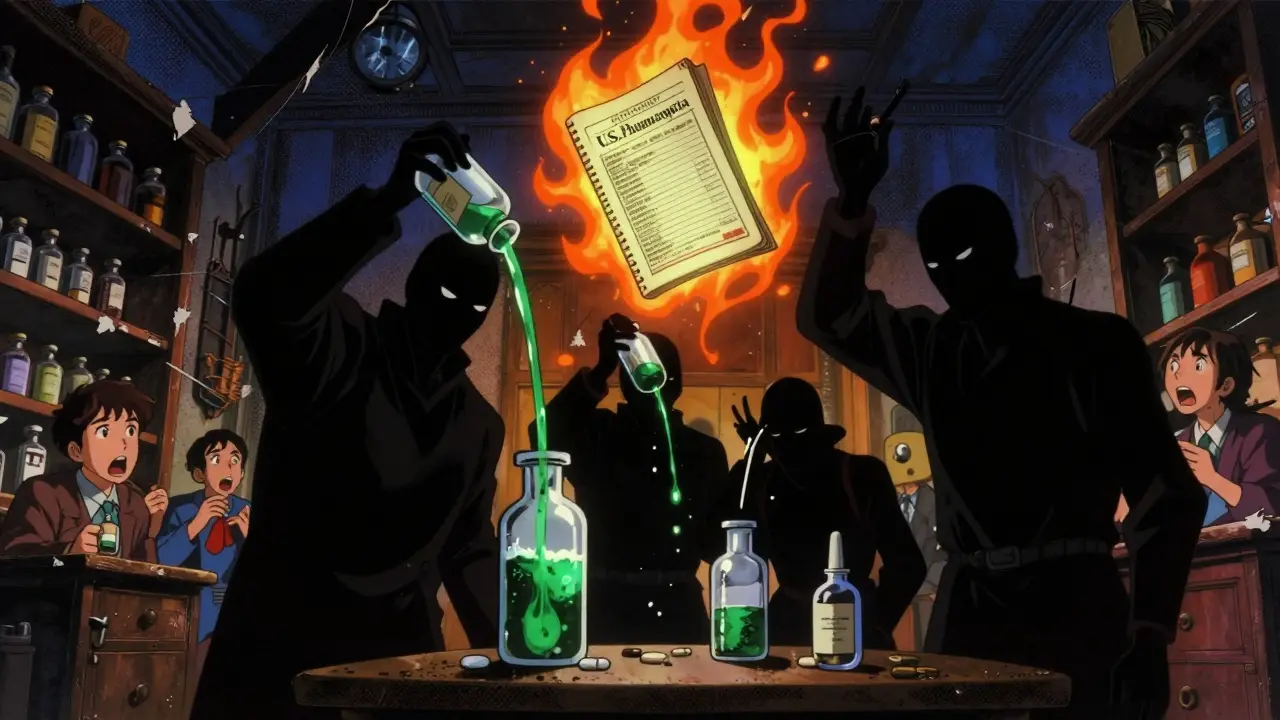
In the early 1800s, there was no real oversight of drugs. If you bought medicine, you had no idea what was actually in it. Pills could be filled with chalk, sugar, or worse. In 1820, eleven doctors met in Washington, D.C., and created the first U.S. Pharmacopeia - a list of standard ingredients and formulas. It was the first step toward trust. But it wasn’t law. Just a suggestion. By 1848, Congress passed the Drug Importation Act. It gave U.S. Customs the power to stop bad drugs from coming in from Europe. Still, domestic drugs? No rules. Counterfeiting was common. In 1888, the American Pharmaceutical Association published the National Formulary to help pharmacists identify real medicines. But again - voluntary. Then came the Elixir Sulfanilamide disaster in 1937. A company dissolved a new antibiotic in diethylene glycol - the same poison used in antifreeze. More than 100 people died, mostly children. Public outrage was immediate. Congress responded with the Federal Food, Drug, and Cosmetic Act of 1938. For the first time, drug makers had to prove their products were safe before selling them. The FDA got real power. But efficacy? Still not required.The 1962 Turning Point: Safety Wasn’t Enough
The thalidomide crisis in Europe - where a drug meant for morning sickness caused severe birth defects - shook the U.S. Even though thalidomide wasn’t approved here, the near-miss forced action. In 1962, Congress passed the Kefauver-Harris Drug Amendments. Now, drug companies had to prove their products worked, not just that they were safe. And here’s the key: all drugs approved between 1938 and 1962 had to go back through the FDA for efficacy review. Thousands of drugs were pulled from the market. Many were useless or dangerous. But this law didn’t help generics yet. The real push for generics came from cost. In 1965, Medicare and Medicaid were created. Suddenly, the federal government was paying for millions of prescriptions. It couldn’t afford to pay full price for every drug. Congress passed rules encouraging federal programs to use cheaper alternatives. That’s when pharmacies and hospitals started asking: “Can we use a generic version of this?” But there was no clear path. Generic manufacturers had to run the same expensive clinical trials as brand-name companies. Why would they bother if they couldn’t compete on price? The system was broken.The Hatch-Waxman Act: The Game Changer
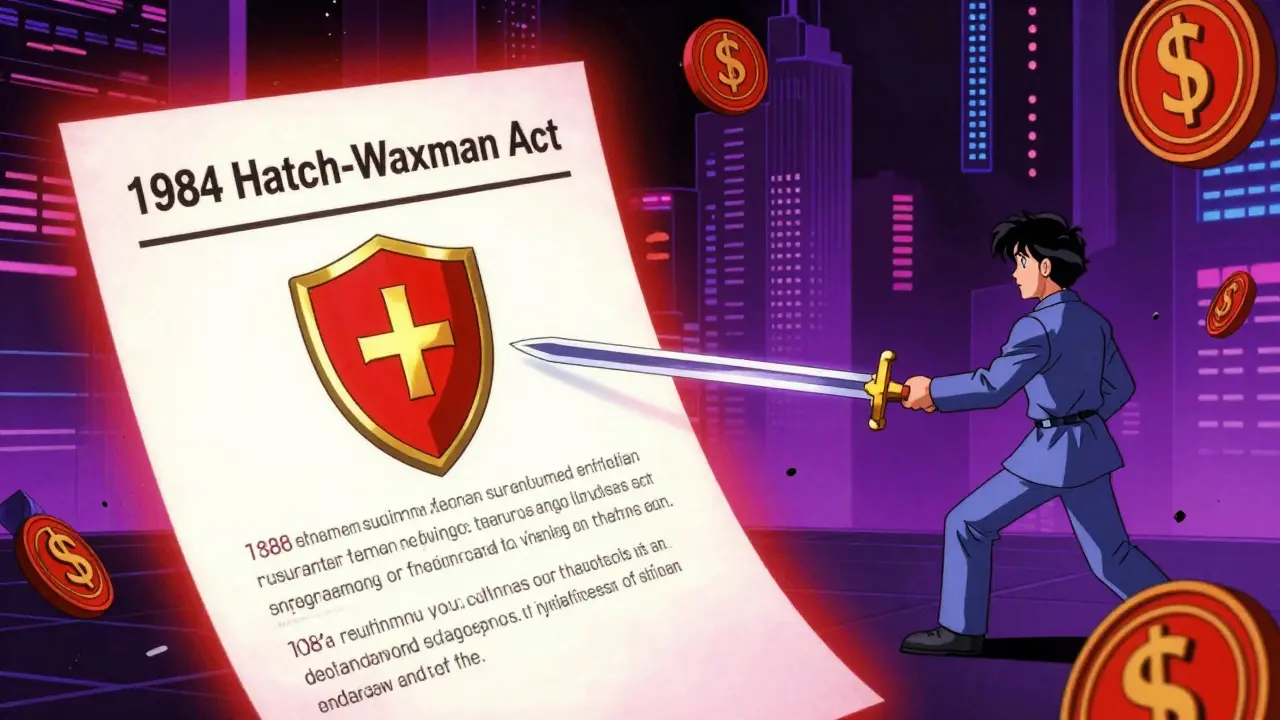
In 1984, Congress passed the Drug Price Competition and Patent Term Restoration Act - better known as the Hatch-Waxman Act. This was the moment everything changed. Before Hatch-Waxman, only 19% of prescriptions were for generic drugs. After? That number would climb to over 90%. Here’s how it worked:- Generic manufacturers no longer had to repeat clinical trials.
- They only needed to prove their drug was bioequivalent - meaning it released the same amount of active ingredient into the body at the same rate as the brand-name version.
- They filed an Abbreviated New Drug Application (ANDA), which was faster and cheaper.
- Brand-name companies got 5 years of market exclusivity plus up to 5 more years if they did new studies.
- Generics could challenge patents - and if they won, they got 180 days of exclusive rights as the first generic on the market.
The Rise of the Generic Industry
By the 2000s, generic drugs were everywhere. But the system started showing cracks. The FDA was overwhelmed. It took up to 30 months just to review an ANDA. Companies waited years to get their products to market. In 2007, the FDA launched the Generic Initiative for Value and Efficiency (GIVE). Then came the Generic Drug User Fee Amendments (GDUFA) in 2012. For the first time, generic manufacturers paid fees to fund FDA reviews. That money helped hire more scientists and inspectors. The results? Review times dropped from 30 months to under 10 months. Approval rates jumped from 45% to 95%. The FDA now approves about 900 generic drugs every year. Today, it oversees more than 22,000 generic products and 13,000 manufacturing sites around the world.Cost Savings That Changed Healthcare
The numbers speak for themselves. In 2021, generic drugs saved the U.S. healthcare system $373 billion. Over the last decade, total savings passed $3.7 trillion. The Congressional Budget Office found that generics cut prescription costs by 80% to 85% compared to brand-name drugs. Think about that. A $150 brand-name pill becomes a $4 generic. A $1,000 monthly treatment drops to $150. That’s not just savings - it’s access. People who couldn’t afford their meds now can. Hospitals can treat more patients. Insurance premiums stay lower. Generic drugs are the invisible backbone of affordable healthcare in America.
The Dark Side: Shortages, Price Gouging, and Supply Chains
But it’s not all smooth sailing. Since 2018, there have been over 1,200 drug shortages in the U.S. About 65% of them involved generic drugs. Why? Two big reasons: manufacturing problems and lack of competition. Many generic drugs are made in just one or two factories - often in India or China. The FDA found that 80% of active pharmaceutical ingredient (API) facilities are outside the U.S. When a factory has a quality issue - or when a natural disaster hits - supply chains break. No one else can make the drug fast enough. And then there’s price gouging. While most generics got cheaper over time, a small number - about 15% - saw price spikes of over 100% between 2013 and 2017. Why? When a drug has only one or two manufacturers, they can raise prices with little pushback. A drug like doxycycline, used for infections, jumped from $20 to over $1,800 per bottle in a few years. The FDA couldn’t stop it - there was no competition. Brand-name companies also found ways to delay generics. They’d file lawsuits to trigger a 30-month automatic stay on generic approval. Or they’d refuse to sell samples needed for bioequivalence testing. In 2019, Congress passed the CREATES Act to stop this. The FDA has now taken 27 enforcement actions under it.What’s Next? Biosimilars and Global Pressures
The next wave of competition isn’t small-molecule generics anymore. It’s biosimilars - cheaper versions of complex biologic drugs like Humira, Enbrel, and insulin. These drugs cost tens of thousands a year. But they’re harder to copy. The FDA approved its first biosimilar in 2015. Since then, only a handful have hit the market. Why? Legal battles, patent thickets, and complex manufacturing. Still, analysts expect biosimilars to take 10% to 15% of the biologics market by 2030. That could save billions more. Meanwhile, the U.S. still imports most of its drug ingredients. The pandemic showed how fragile that is. Some experts are pushing for more domestic manufacturing. But it’s expensive. No one wants to build a factory that only makes a $0.10 pill.Why This Matters to You
You might not think about the history of generic drugs. But every time you fill a prescription and pay $5 instead of $150, you’re benefiting from a system built on decades of law, failure, and reform. The Hatch-Waxman Act didn’t just change the market - it changed lives. It kept people alive, kept families from bankruptcy, and made healthcare possible for millions. The challenges today - shortages, price spikes, global supply chains - aren’t going away. But the system has proven it can adapt. The FDA is faster. The laws are sharper. And the public demand for affordable medicine hasn’t faded. The next time you get a generic prescription, don’t just take it. Remember: it’s not just a cheaper version. It’s the result of a long fight to make medicine a right, not a luxury.Are generic drugs really as effective as brand-name drugs?
Yes. The FDA requires generic drugs to have the same active ingredient, strength, dosage form, and route of administration as the brand-name version. They must also be bioequivalent - meaning they work the same way in the body. Generic drugs go through the same strict quality controls. The only differences are in inactive ingredients like fillers or dyes, which don’t affect how the drug works.
Why are generic drugs so much cheaper?
Generic manufacturers don’t have to repeat expensive clinical trials. Instead, they prove their drug is bioequivalent to the brand-name version through simpler tests. They also don’t spend money on marketing or advertising. Without those costs, they can sell the same medicine for a fraction of the price.
Can generic drugs have different side effects?
The active ingredient - the part that treats your condition - is identical. So the main side effects are the same. But sometimes, the inactive ingredients (like dyes or preservatives) can cause reactions in people with rare allergies. If you notice a new reaction after switching to a generic, talk to your doctor. It’s not common, but it can happen.
Why do some generic drugs have shortages?
Many generic drugs are made in just one or two factories, often overseas. If one factory has a quality issue, shuts down for inspection, or faces a supply chain disruption, there’s no backup. Low profit margins also mean manufacturers don’t always invest in extra capacity. When demand spikes or a plant goes offline, shortages follow.
Is it safe to buy generic drugs from online pharmacies?
Only if the pharmacy is verified by the National Association of Boards of Pharmacy (NABP) as a Verified Internet Pharmacy Practice Site (VIPPS). Many online sellers offer fake or contaminated generics - especially from unregulated countries. The FDA warns that 96% of online pharmacies operate illegally. Always fill prescriptions through licensed U.S. pharmacies.
How does the FDA ensure generic drug quality?
The FDA inspects every manufacturing facility - both in the U.S. and abroad - before approving a generic drug. They also do routine inspections and test samples. Since 2012, the FDA has increased inspections of foreign facilities by over 400%. They also require manufacturers to report quality issues immediately. If a drug fails tests, it’s pulled from the market.

Comments
Harshit Kansal
January 5, 2026Man, I remember when my dad had to pay $300 for his blood pressure med. Now he pays $4 at Walmart. No joke, generics saved his life. India makes these pills and they work just fine. No need for the fancy brand names.
Brian Anaz
January 6, 202690% of prescriptions? Yeah, and 90% of the manufacturing is in China and India. We’re literally outsourcing our healthcare to countries with weaker regulations. This isn’t progress-it’s vulnerability. One bioterror attack or trade war and we’re screwed.
Joann Absi
January 8, 2026GENERIC DRUGS ARE THE ONLY REASON I CAN AFFORD MY ANTIBIOTICS 😭😭😭 I had to choose between rent and my thyroid med last year. Now I get it for $3. The FDA doesn’t care but I do. THANK YOU HATCH-WAXMAN 🇺🇸🇺🇸🇺🇸
Melanie Clark
January 8, 2026The FDA is a puppet of big pharma and the Indian manufacturers they approve without proper inspections. I know someone whose generic cholesterol pill made him dizzy and gave him rashes. The brand name didn’t. The inactive ingredients are poison. They’re hiding this from you. Wake up. This is a controlled population tactic
Jeane Hendrix
January 9, 2026It’s fascinating how the ANDA pathway created this massive efficiency gain without compromising safety. The bioequivalence standard is actually brilliant-minimizes redundancy while maintaining therapeutic equivalence. The GDUFA user fees were a game-changer for FDA capacity, though the geopolitical fragility of API supply chains remains a systemic risk. We need more domestic capacity, but the economics are brutal for low-margin generics.
Saylor Frye
January 10, 2026Oh wow, so generics are just… cheaper? I thought they were like knockoff sneakers. Turns out they’re just… the same thing? Who knew? I guess capitalism works sometimes. Cool. I’m gonna go back to my $150 brand-name vitamin now.
Wesley Pereira
January 10, 2026Someone needs to explain to me why we’re proud of a system that lets a $0.10 pill become $1,800 because there’s only one factory left. We’re not saving money-we’re just letting monopolies rip us off. And then we call it ‘market efficiency.’
Amy Le
January 12, 2026My cousin’s kid had an allergic reaction to a generic version of amoxicillin because of the dye. The brand didn’t do it. The FDA says ‘inactive ingredients don’t matter’-but they matter to the person taking it. So yeah, it’s the same drug… until it isn’t. And then you’re in the ER.
Stuart Shield
January 12, 2026I worked in a pharmacy in London back in 2010. We used to get UK-made generics, then switched to Indian ones. The pills looked different, tasted different, but worked the same. People didn’t care. What they cared about was not having to choose between insulin and groceries. That’s the real win here.
Pavan Vora
January 14, 2026India makes 70% of the world's generics... and we don't even thank them. We call them cheap, we call them risky, but without them, millions of Americans would die. I'm from India, and I'm proud. We didn't have fancy labs or patent lawyers-we had grit. And now we're keeping your grandma alive.
Indra Triawan
January 14, 2026It’s ironic. We built a system to make medicine affordable, but now we treat it like a commodity. People aren’t patients-they’re consumers. And when the profit margin drops below 3%, the factories shut down. We don’t need more laws. We need to stop pretending healthcare is a market.
Susan Arlene
January 16, 2026just took my $4 pill. felt fine. went back to bed. life is good
Vinayak Naik
January 17, 2026Bro, I work in a hospital pharmacy in Mumbai. We ship 1000s of generic pills to the US every week. The FDA inspectors come here, take samples, and say ‘good to go’. But here’s the truth-some of these pills are made in factories with no AC, no clean rooms, and the workers are paid $2 a day. They’re not cutting corners because they’re evil-they’re cutting corners because the price you pay for that $4 pill leaves no room for dignity. We’re all complicit.
Write a comment