
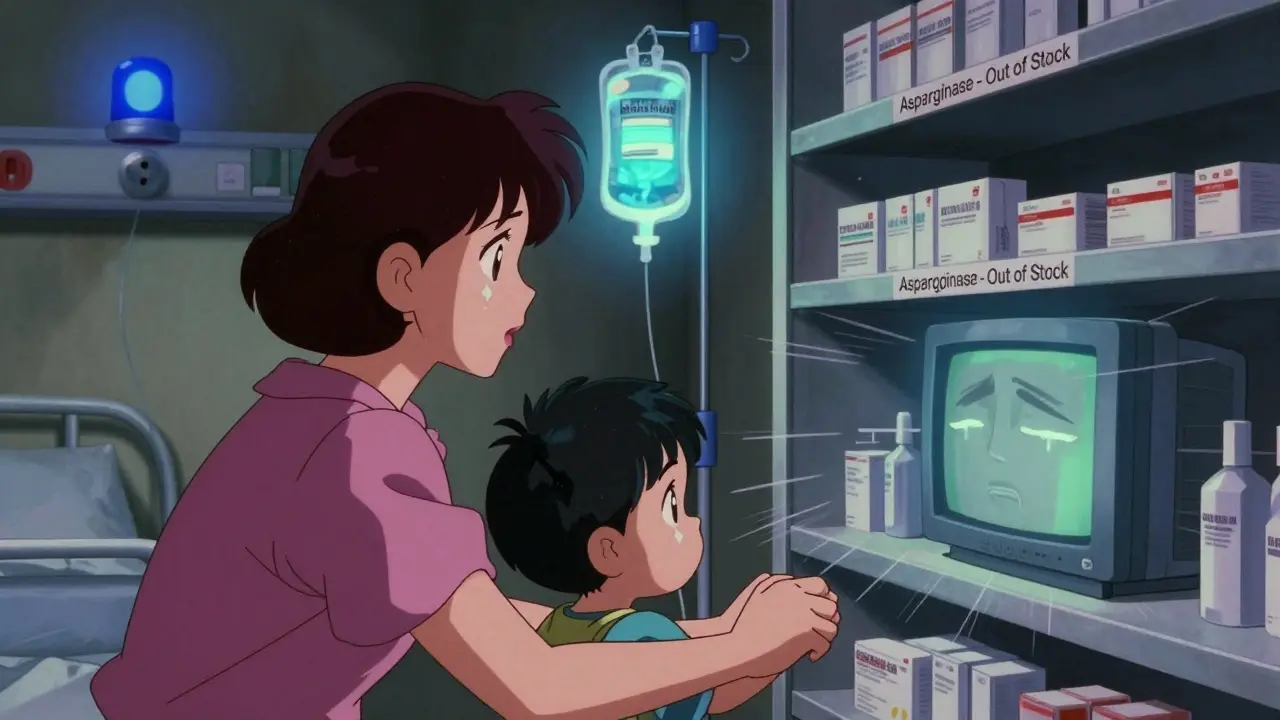
When a patient needs a life-saving drug and it’s simply not there, the consequences aren’t theoretical-they’re immediate, personal, and sometimes deadly. In 2025, over 250 drugs remained in short supply across the U.S., from antibiotics to cancer therapies to basic IV fluids. These aren’t rare exceptions. They’re the new normal. And every shortage means someone, somewhere, is waiting longer for treatment, taking a riskier substitute, or skipping doses altogether.
What Happens When a Critical Drug Disappears?
Imagine you’re a parent whose child has leukemia. The only drug that can keep the cancer in check is asparaginase. One day, the pharmacy calls: it’s out of stock. No backorder. No estimated restock date. The next available dose might be two weeks away. That delay isn’t just inconvenient-it can mean the difference between remission and relapse. This isn’t a rare scenario. Between 2022 and 2025, shortages of oncology drugs like asparaginase, nelarabine, and vincristine lasted an average of 18 months, with some stretching beyond five years. The same is true for antibiotics. When meropenem or ceftriaxone runs out, doctors are forced to use older, less effective, or more toxic alternatives. A 2024 study found that 43% of medication errors in hospitals were directly tied to drug shortages-nurses giving the wrong dose because the label was unfamiliar, or pharmacists substituting drugs without full clinical knowledge. These aren’t mistakes from carelessness. They’re mistakes born of desperation.Who Gets Hurt the Most?
It’s not just cancer patients or ICU cases. Drug shortages ripple through every corner of care. Elderly patients with heart failure need heparin to prevent clots after surgery. When it’s unavailable, hospitals scramble to find alternatives, extending procedure times by 22% and increasing complications. Diabetics rely on insulin-yet even basic insulin formulations have faced intermittent shortages since 2023, forcing patients to ration doses or switch to less reliable brands. Pediatric care is hit hardest. Kids don’t just need smaller doses-they need specific formulations. A drug that comes in a 10mg tablet might not have a liquid version for toddlers. When that happens, pharmacists have to compound medications from scratch, which takes time, increases cost, and raises the risk of dosing errors. In 2023, pediatric hospitals were monitoring 25% more drug shortages than general hospitals, according to Vizient’s survey of 132 U.S. healthcare facilities. And then there’s chronic pain. Patients on long-term opioid therapy for conditions like sickle cell disease or severe arthritis face daily refills. When oral morphine or oxycodone disappears, they’re left without relief. Some turn to the street. Others endure unnecessary suffering. The American Hospital Association found that nearly 30% of Americans have skipped or cut their medication due to cost or availability-and that number is rising.The Hidden Costs: Time, Labor, and System Strain
Behind every shortage is a team of pharmacists, nurses, and administrators working overtime just to keep the lights on. Hospitals now spend an average of 15 to 20 hours per week per drug shortage just tracking inventory, calling suppliers, training staff on alternatives, and rewriting protocols. For pediatric units, that jumps to 25 hours. That’s not a small burden-it’s a full-time job stacked on top of already overloaded shifts. One hospital pharmacist in Ohio described her week: “On Monday, we ran out of lorazepam for seizure control. Tuesday, we had no heparin for dialysis patients. Wednesday, the last vial of propofol was used in the ER. Thursday, we spent six hours training the entire nursing staff on a new sedative. Friday, we got a call that the IV saline bags we ordered were delayed again.” This isn’t an outlier. It’s routine. The financial toll is just as heavy. Drug shortages cost U.S. hospitals nearly $900 million annually in extra labor, wasted time, and alternative medications. Add in canceled surgeries, extended hospital stays, and emergency room visits caused by untreated conditions, and the real cost likely exceeds $3 billion a year. And none of that money goes toward healing patients-it goes toward damage control.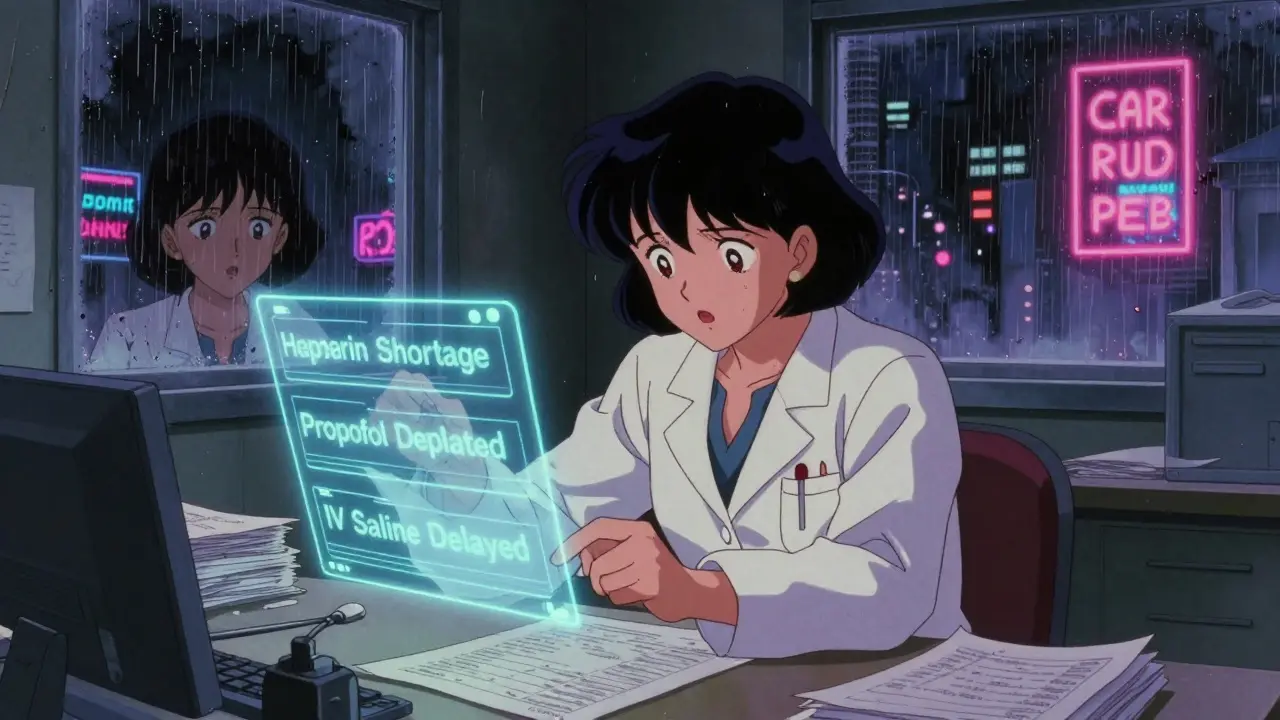
Why Are These Shortages Happening?
The problem isn’t random. It’s structural. Over 80% of drug shortages involve generic medications-drugs that cost pennies to make but are sold for just a few dollars. Pharmaceutical companies have little financial incentive to produce them. If a drug sells for $2 a vial and costs $1.80 to make, there’s no profit. So manufacturers shut down production lines. One plant in Puerto Rico that made 40% of the country’s IV saline bags shut down in 2022 after failing FDA inspections. That single event triggered nationwide shortages that lasted over a year. Global supply chains are another weak point. Raw materials for many drugs come from just two or three countries-India and China. When a factory there faces power outages, regulatory crackdowns, or shipping delays, U.S. hospitals feel it within weeks. The FDA estimates that 47% of shortages trace back to international supply chain issues. Even when manufacturers want to produce more, they can’t. The FDA’s approval process for new production lines takes 18 to 24 months. There’s no fast track for lifesaving drugs. And even when a new supplier gets approved, hospitals are slow to adopt them due to liability fears and outdated electronic health records that don’t recognize new drug codes.What’s Being Done-and Why It’s Not Enough
There have been efforts to fix this. In 2023, Congress passed the Drug Shortage Electronic Registration and Notification Act, requiring manufacturers to notify the FDA six months before a potential shortage. That sounds good-until you realize many companies still delay reporting, or claim a shortage is “temporary” when it’s really permanent. Some hospitals are turning to group purchasing organizations like Vizient, which pool resources to secure inventory across dozens of facilities. Since 2023, these networks have saved members nearly $300 million in avoided inventory costs. But they can’t create drugs that don’t exist. They can only help distribute what’s already made. A few systems are building automated shortage alert tools that scan pharmacy databases in real time. But these are expensive, complex, and mostly used by large urban hospitals. Rural clinics and small community pharmacies still rely on phone calls and spreadsheets. The truth? We’re patching a leaky dam with duct tape. We’re managing symptoms, not curing the disease.
What Patients Can Do
You can’t control the supply chain. But you can protect yourself.- Ask your doctor early: If you’re on a medication that’s commonly in short supply-like insulin, heparin, or certain antibiotics-ask if there’s a backup option. Don’t wait until your prescription runs out.
- Keep a written list: Know the generic and brand names of your meds. Pharmacists need this to find alternatives.
- Call your pharmacy weekly: Don’t assume your drug is in stock. Many shortages are sudden and last only a few days. You might get lucky if you show up just after a delivery.
- Don’t skip doses: If you can’t get your medication, contact your provider immediately. Skipping can lead to dangerous rebounds-like uncontrolled seizures, infections, or heart complications.
The Bigger Picture
Drug shortages aren’t just a pharmacy problem. They’re a public health emergency. Every shortage means someone’s treatment is delayed. Someone’s pain is untreated. Someone’s life is at risk. The numbers tell part of the story: 253 drugs short in 2025, 43% more medication errors, 65% of procedures delayed. But behind each number is a person-maybe your mother, your child, your neighbor. Until we fix the broken economics of generic drug manufacturing, improve supply chain transparency, and give regulators real power to enforce production, these shortages will keep coming. And every time they do, patients pay the price.Drug shortages are not a glitch in the system. They’re a symptom of a system that values profit over people. And until that changes, no one is truly safe.
Why are generic drugs more likely to be in short supply?
Generic drugs make up 83% of all drug shortages because they’re low-margin products. Manufacturers earn little profit on them-sometimes just a few cents per dose-so they stop making them when costs rise or demand dips. Companies focus on high-priced brand-name drugs instead, leaving essential generics underproduced.
Can I get a different drug if mine is out of stock?
Sometimes, yes-but not always. Alternatives may be less effective, more toxic, or require different dosing. For example, switching from heparin to argatroban for anticoagulation requires special monitoring and training. Always consult your doctor before switching. Never self-substitute.
How long do drug shortages usually last?
Most last 3 to 6 months, but some persist for over a year. Oncology and critical care drugs like asparaginase and nelarabine have lasted up to five years. Shortages tied to manufacturing issues or raw material shortages take the longest to resolve.
Are drug shortages getting worse?
Yes. Active shortages peaked at 323 in early 2024 and dropped slightly to 253 by mid-2025, but they’re still far higher than the 187 recorded in 2021. Most shortages since 2022 are tied to new manufacturing failures and global supply disruptions, suggesting the trend is still upward.
What should I do if my medication is unavailable?
Contact your prescriber immediately. Don’t wait until your prescription runs out. Ask if there’s an alternative, if a different formulation is available, or if you can get a partial supply to tide you over. Also check with your pharmacy weekly-shortages can resolve quickly with new shipments.



Comments
Kathy McDaniel
January 27, 2026i just found out my mom's heparin was out for 3 weeks last year. she had to stay an extra 5 days in the hospital just because they couldn't get it. i cried for 2 hours after the nurse told me. this isn't just a statistic. it's real life.
and honestly? i'm tired of hearing about 'market forces' when people are dying. we can do better.
April Williams
January 28, 2026THIS IS WHY WE NEED TO BAN FOREIGN DRUG MANUFACTURING. CHINA AND INDIA ARE KILLING AMERICANS WITH THEIR SHODDY LABS AND CORRUPT INSPECTIONS. WE SHOULD BE MAKING EVERY SINGLE MEDICINE HERE. PERIOD. NO EXCUSES.
Harry Henderson
January 29, 2026Stop crying about it and start demanding change. The FDA has been asleep at the wheel for decades. If you want to fix this, call your rep. Go to town halls. Protest outside pharma HQs. Stop being passive. This isn’t a ‘system glitch’-it’s corporate negligence on a national scale.
astrid cook
January 30, 2026I knew this was coming. Everyone who works in healthcare saw it years ago. But no one wanted to hear it. Now the whole system is crumbling under the weight of greed. And guess what? The same people who made billions off insulin and antibiotics are now on the board of every ‘solution’ committee. It’s a circus.
Andrew Clausen
January 31, 2026The data in this post is accurate, but the framing is misleading. Drug shortages are not 'a symptom of profit over people'-they are a symptom of price controls, regulatory overreach, and the collapse of low-margin manufacturing economics. The solution isn't moral outrage. It's incentivizing production through market mechanisms, not more bureaucracy.
Marian Gilan
February 1, 2026You think this is bad? Wait till you find out the IV bags are laced with microplastics from the Chinese factories. The FDA knows. They’ve been told. But they’re in bed with Big Pharma. This isn’t a shortage-it’s a controlled demolition of public trust. I’ve got sources. I’m not crazy. You’re just not listening.
Desaundrea Morton-Pusey
February 2, 2026Why do we even care? It’s just drugs. People die all the time. Maybe if we stopped wasting money on sick people and focused on the healthy, we’d be better off. This country is broke. Get real.
Murphy Game
February 4, 2026The real story? The shortages are being artificially prolonged to drive up prices of the alternatives. That’s why asparaginase stays out for 5 years-because the substitute drug is 12x more expensive and the same company makes both. This isn’t an accident. It’s a cartel.
John O'Brien
February 5, 2026I work in a rural pharmacy. We get one shipment of insulin every 3 weeks. Patients call me at 2am asking if we got it yet. I’ve had people cry on the phone because they’re cutting their doses in half. We’re not just managing shortages-we’re managing trauma. And no one’s paying us extra for it.
Kegan Powell
February 7, 2026this is the quiet crisis no one talks about 🤍
imagine being a kid with leukemia and your only hope is a vial that might not come in for weeks
imagine being a nurse who has to choose who gets the last dose
imagine being a parent who has to beg for medicine
we are not just failing systems
we are failing people
and we are the ones who let it happen
suhail ahmed
February 8, 2026I come from India, and I’ve seen how these factories work. The raw materials? Half of them come from here. The workers? Paid pennies. The inspectors? Paid off. This isn’t just a US problem-it’s a global rot. We need international oversight, not just more paperwork. Fix the root, not the symptom.
Candice Hartley
February 9, 2026My dad’s on insulin. We check the pharmacy every Tuesday. Sometimes we get lucky. Sometimes we don’t. I just hope someone reads this and realizes: this isn’t about politics. It’s about people who just need to live.
Write a comment